Back
BackIntro to Chemistry Study Guide: Bonding, Properties, Reactions, and Acids/Bases
Study Guide - Smart Notes
 Tailored notes based on your materials, expanded with key definitions, examples, and context.
Q8. Draw a picture of each type of bond. Then, explain why covalent and ionic substances tend to be brittle, while metallic bonds tend to be malleable.
Background
Topic: Chemical Bonding and Physical Properties
This question tests your understanding of the differences between covalent, ionic, and metallic bonds, and how these differences affect the physical properties of substances, such as brittleness and malleability.
Key Terms:
Covalent bond: A bond formed by the sharing of electrons between atoms.
Ionic bond: A bond formed by the transfer of electrons from one atom to another, resulting in oppositely charged ions.
Metallic bond: A bond formed by the attraction between free-moving valence electrons and metal ions.
Brittle: Tendency to break or shatter easily.
Malleable: Ability to be hammered or bent into shape without breaking.
Step-by-Step Guidance
Draw a simple diagram for each bond type:
Covalent: Two atoms sharing electrons.
Ionic: Positive and negative ions held together by electrostatic attraction.
Metallic: Metal ions surrounded by a 'sea' of delocalized electrons.
Consider the structure of each bond type:
Covalent and ionic substances have rigid, directional bonds.
Metallic substances have non-directional bonds due to the electron sea.
Think about what happens when force is applied:
Covalent and ionic bonds break when layers are shifted, causing brittleness.
Metallic bonds allow atoms to slide past each other, resulting in malleability.
Try solving on your own before revealing the answer!
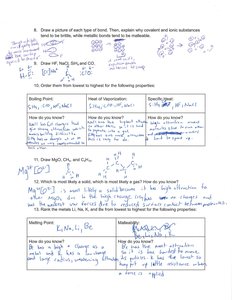
Q9. Draw HF, NaCl, SiH4, and CO.
Background
Topic: Lewis Structures and Molecular Representation
This question tests your ability to draw simple Lewis structures for molecules and ionic compounds.
Key Terms:
Lewis structure: Diagram showing the arrangement of atoms and electrons in a molecule.
HF: Hydrogen fluoride (covalent molecule).
NaCl: Sodium chloride (ionic compound).
SiH4: Silicon tetrahydride (covalent molecule).
CO: Carbon monoxide (covalent molecule).
Step-by-Step Guidance
Identify the type of bonding in each compound (ionic or covalent).
Draw the Lewis structure for each molecule, showing shared or transferred electrons.
Label partial charges or formal charges where appropriate.
Try solving on your own before revealing the answer!
Q10. Order HF, NaCl, SiH4, and CO from lowest to highest for boiling point, heat of vaporization, and specific heat. How do you know?
Background
Topic: Physical Properties of Substances
This question tests your understanding of how molecular structure and bonding affect boiling point, heat of vaporization, and specific heat.
Key Terms:
Boiling point: Temperature at which a substance changes from liquid to gas.
Heat of vaporization: Energy required to convert a liquid to a gas.
Specific heat: Amount of energy required to raise the temperature of 1 gram of a substance by 1°C.
Step-by-Step Guidance
Consider the type of bonding and intermolecular forces in each substance.
Rank the substances based on the strength of their intermolecular forces (ionic > hydrogen bonding > dipole-dipole > dispersion).
Use your ranking to predict the order for boiling point, heat of vaporization, and specific heat.
Try solving on your own before revealing the answer!
Q11. Draw MgO, CH4, and C7H10.
Background
Topic: Lewis Structures and Molecular Representation
This question tests your ability to draw Lewis structures for an ionic compound and two covalent molecules.
Key Terms:
MgO: Magnesium oxide (ionic compound).
CH4: Methane (covalent molecule).
C7H10: Hydrocarbon (covalent molecule).
Step-by-Step Guidance
Identify the type of bonding in each compound.
Draw the Lewis structure for each, showing shared or transferred electrons.
Label charges or formal charges where appropriate.
Try solving on your own before revealing the answer!
Q12. Which is most likely a solid, which is most likely a gas? How do you know?
Background
Topic: States of Matter and Molecular Properties
This question tests your understanding of how molecular structure and bonding affect the physical state of a substance at room temperature.
Key Terms:
Solid: Substance with fixed shape and volume.
Gas: Substance with variable shape and volume.
Intermolecular forces: Forces between molecules that determine physical state.
Step-by-Step Guidance
Consider the strength of intermolecular forces in each compound.
Predict which compound is most likely to be a solid based on strong ionic or covalent bonds.
Predict which compound is most likely to be a gas based on weak intermolecular forces.
Try solving on your own before revealing the answer!
Q13. Rank the metals Li, Na, K, and Be from lowest to highest for melting point. How do you know?
Background
Topic: Periodic Trends and Metallic Properties
This question tests your understanding of how atomic structure and periodic trends affect the melting points of metals.
Key Terms:
Melting point: Temperature at which a solid becomes a liquid.
Periodic trend: Predictable change in properties across a period or group.
Metallic bonding: Attraction between metal ions and delocalized electrons.
Step-by-Step Guidance
Consider the position of each metal on the periodic table.
Recall that alkali metals (Li, Na, K) generally have lower melting points than alkaline earth metals (Be).
Rank the metals based on their expected melting points.
Try solving on your own before revealing the answer!
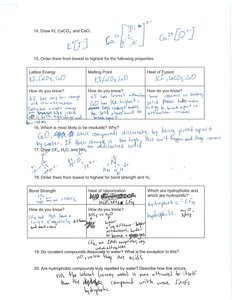
Q14. Draw KI, CaCO3, and CaO.
Background
Topic: Lewis Structures and Ionic Compounds
This question tests your ability to represent ionic compounds with appropriate charges and arrangements.
Key Terms:
KI: Potassium iodide (ionic compound).
CaCO3: Calcium carbonate (ionic compound).
CaO: Calcium oxide (ionic compound).
Step-by-Step Guidance
Identify the ions present in each compound.
Draw the arrangement of ions, showing their charges.
Label the compounds clearly.
Try solving on your own before revealing the answer!
Q15. Order KI, CaCO3, and CaO from lowest to highest for lattice energy, melting point, and heat of fusion. How do you know?
Background
Topic: Ionic Compounds and Physical Properties
This question tests your understanding of how ionic charge and size affect lattice energy, melting point, and heat of fusion.
Key Terms:
Lattice energy: Energy required to separate one mole of an ionic solid into its ions.
Melting point: Temperature at which a solid becomes a liquid.
Heat of fusion: Energy required to change a solid to a liquid at its melting point.
Step-by-Step Guidance
Consider the charges and sizes of the ions in each compound.
Recall that higher charges and smaller ions lead to higher lattice energy and melting point.
Rank the compounds based on these properties.
Try solving on your own before revealing the answer!
Q16. Which is most likely to be insoluble? Why?
Background
Topic: Solubility of Ionic Compounds
This question tests your understanding of solubility rules and the factors that affect whether an ionic compound dissolves in water.
Key Terms:
Solubility: Ability of a substance to dissolve in a solvent.
Ionic compound: Compound composed of positive and negative ions.
Solubility rules: Guidelines for predicting whether an ionic compound will dissolve in water.
Step-by-Step Guidance
Recall common solubility rules for ionic compounds.
Consider the charges and lattice energy of each compound.
Predict which compound is most likely to be insoluble based on these factors.
Try solving on your own before revealing the answer!
Q17. Draw CF4, H2O, and NH3.
Background
Topic: Lewis Structures and Molecular Geometry
This question tests your ability to draw Lewis structures and recognize molecular shapes.
Key Terms:
CF4: Carbon tetrafluoride (tetrahedral molecule).
H2O: Water (bent molecule).
NH3: Ammonia (trigonal pyramidal molecule).
Step-by-Step Guidance
Draw the Lewis structure for each molecule, showing all valence electrons.
Identify the molecular geometry based on electron pair arrangement.
Label lone pairs and bond angles where appropriate.
Try solving on your own before revealing the answer!
Q18. Order CF4, H2O, and NH3 from lowest to highest for bond strength and heat of vaporization. Which are hydrophobic and which are hydrophilic? How do you know?
Background
Topic: Molecular Properties and Intermolecular Forces
This question tests your understanding of bond strength, heat of vaporization, and the concepts of hydrophobic and hydrophilic molecules.
Key Terms:
Bond strength: Energy required to break a bond.
Heat of vaporization: Energy required to convert a liquid to a gas.
Hydrophobic: Repelled by water.
Hydrophilic: Attracted to water.
Step-by-Step Guidance
Consider the types of bonds and intermolecular forces in each molecule.
Rank the molecules based on bond strength and heat of vaporization.
Determine which molecules are hydrophobic or hydrophilic based on their polarity.
Try solving on your own before revealing the answer!
Q19. Do covalent compounds dissociate in water? What is the exception to this?
Background
Topic: Dissociation and Solubility
This question tests your understanding of how covalent compounds behave in water and the exceptions to this rule.
Key Terms:
Dissociation: Separation of a compound into ions in solution.
Covalent compound: Compound formed by sharing electrons.
Acids: Covalent compounds that can dissociate in water.
Step-by-Step Guidance
Recall that most covalent compounds do not dissociate in water.
Identify the exception: acids, which can dissociate to form ions.
Try solving on your own before revealing the answer!
Q20. Are hydrophobic compounds truly repelled by water? Describe how this occurs.
Background
Topic: Hydrophobicity and Solubility
This question tests your understanding of the behavior of hydrophobic compounds in water and the molecular interactions involved.
Key Terms:
Hydrophobic: Repelled by water.
Solubility: Ability to dissolve in a solvent.
Intermolecular forces: Forces between molecules.
Step-by-Step Guidance
Recall that hydrophobic compounds do not mix well with water due to weak interactions.
Describe how water molecules form stronger interactions with each other, excluding hydrophobic molecules.
Try solving on your own before revealing the answer!
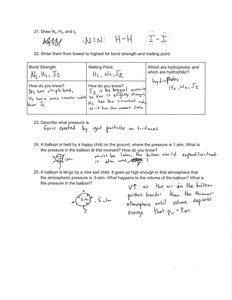
Q21. Draw N2, H2, and I2.
Background
Topic: Lewis Structures for Diatomic Molecules
This question tests your ability to draw Lewis structures for simple diatomic molecules.
Key Terms:
N2: Nitrogen gas (triple bond).
H2: Hydrogen gas (single bond).
I2: Iodine gas (single bond).
Step-by-Step Guidance
Draw the Lewis structure for each diatomic molecule, showing the correct number of bonds.
Label the bond type (single, double, triple).
Try solving on your own before revealing the answer!
Q22. Order N2, H2, and I2 from lowest to highest for bond strength and melting point. Which are hydrophobic and which are hydrophilic? How do you know?
Background
Topic: Molecular Properties and Intermolecular Forces
This question tests your understanding of bond strength, melting point, and hydrophobic/hydrophilic properties of diatomic molecules.
Key Terms:
Bond strength: Energy required to break a bond.
Melting point: Temperature at which a solid becomes a liquid.
Hydrophobic: Repelled by water.
Hydrophilic: Attracted to water.
Step-by-Step Guidance
Consider the bond type in each molecule (single, triple).
Rank the molecules based on bond strength and melting point.
Determine hydrophobic/hydrophilic properties based on polarity.
Try solving on your own before revealing the answer!
Q23. Describe what pressure is.
Background
Topic: Gas Laws and Physical Properties
This question tests your understanding of the concept of pressure in chemistry.
Key Terms:
Pressure: Force exerted by gas particles on the walls of a container.
Gas particles: Atoms or molecules in the gas phase.
Step-by-Step Guidance
Recall that pressure is caused by collisions of gas particles with surfaces.
Describe how the frequency and force of collisions affect pressure.
Try solving on your own before revealing the answer!
Q24. A balloon is held by a happy child on the ground, where the pressure is 1 atm. What is the pressure in the balloon at this moment? How do you know?
Background
Topic: Gas Laws and Atmospheric Pressure
This question tests your understanding of how atmospheric pressure affects the pressure inside a balloon.
Key Terms:
Atmospheric pressure: Pressure exerted by the weight of air in the atmosphere.
Balloon: Flexible container filled with gas.
Step-by-Step Guidance
Recall that the pressure inside the balloon must balance the external atmospheric pressure.
Describe how the balloon expands or contracts to maintain equilibrium.
Try solving on your own before revealing the answer!
Q25. A balloon is let go by a now sad child. It goes up high enough in the atmosphere that the atmospheric pressure is 0.5 atm. What happens to the volume of the balloon? What is the pressure in the balloon?
Background
Topic: Gas Laws and Atmospheric Pressure
This question tests your understanding of how changes in atmospheric pressure affect the volume and pressure inside a balloon.
Key Terms:
Atmospheric pressure: Pressure exerted by the weight of air in the atmosphere.
Volume: Amount of space occupied by the balloon.
Pressure: Force exerted by gas particles inside the balloon.
Step-by-Step Guidance
Recall that as atmospheric pressure decreases, the pressure inside the balloon remains higher, causing the balloon to expand.
Describe how the volume changes in response to the pressure difference.
Try solving on your own before revealing the answer!
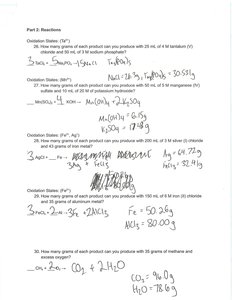
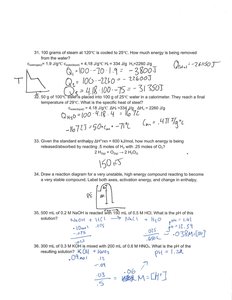
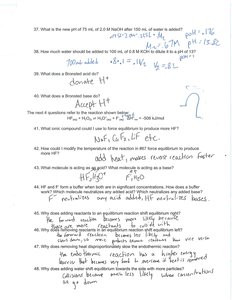
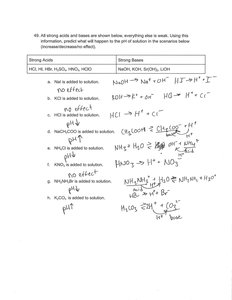
Q26–49. Chemical Reactions, Energy, Acids/Bases, and Equilibrium
Background
Topic: Stoichiometry, Thermochemistry, Acid/Base Chemistry, and Equilibrium
These questions test your ability to calculate product masses, energy changes, pH, and understand equilibrium shifts in chemical reactions.
Key Terms and Formulas:
Stoichiometry: Calculating quantities of reactants and products.
Enthalpy (): Heat change in a reaction.
Specific heat (): Energy required to raise temperature of 1 g by 1°C.
pH: Measure of acidity/basicity.
Equilibrium: State where forward and reverse reactions occur at equal rates.
Step-by-Step Guidance
For stoichiometry, use molarity and volume to find moles, then use balanced equations to find product masses.
For energy calculations, use and phase change enthalpies.
For pH, use and consider neutralization reactions.
For equilibrium, apply Le Chatelier's principle to predict shifts.
Try solving on your own before revealing the answer!