 Back
BackIntroductory Chemistry: Comprehensive Study Guide
Study Guide - Smart Notes
 Tailored notes based on your materials, expanded with key definitions, examples, and context.
Atomic Structure and Properties
Introduction to Atomic Structure
Atoms are the fundamental units of matter, composed of subatomic particles: protons, neutrons, and electrons. The arrangement and behavior of these particles determine the chemical properties of elements.
Protons: Positively charged particles found in the nucleus.
Neutrons: Neutral particles also located in the nucleus.
Electrons: Negatively charged particles orbiting the nucleus in defined energy levels or shells.
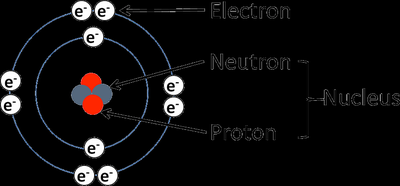
The atomic number (Z) is the number of protons and defines the element. The mass number (A) is the sum of protons and neutrons. Isotopes are atoms of the same element with different numbers of neutrons.
Atomic mass is the weighted average of all isotopes of an element, as found on the periodic table.
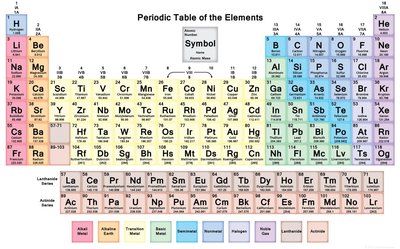
Moles and Molar Mass
The mole is the SI unit for amount of substance, defined as Avogadro’s number () of particles. Molar mass is the mass of one mole of a substance, expressed in g/mol.
Number of moles:
Number of particles:
Electron Configuration
Electrons occupy energy levels (shells) and subshells (s, p, d, f) according to the Aufbau principle, Hund’s rule, and Pauli exclusion principle. The arrangement of electrons determines chemical reactivity and periodic trends.
Aufbau Principle: Electrons fill lowest energy orbitals first.
Hund’s Rule: Electrons occupy orbitals singly before pairing.
Pauli Exclusion Principle: No two electrons in an atom can have the same set of quantum numbers.
Molecular and Ionic Compound Structure and Properties
Chemical Bonds
Chemical bonds are forces that hold atoms together in compounds. The main types are covalent, ionic, and metallic bonds.
Bond Type | Description | Example |
|---|---|---|
Covalent | Sharing of electrons between atoms | CO2 |
Ionic | Transfer of electrons from metal to nonmetal, forming cations and anions | NaCl |
Metallic | Delocalized electrons shared among metal cations | Copper wire |
Electronegativity differences determine bond type: large differences (>1.7) yield ionic bonds, small differences yield covalent bonds.
Potential Energy and Bond Formation
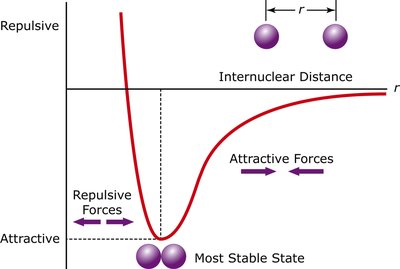
Bond formation is governed by the balance of attractive and repulsive forces. The most stable bond length corresponds to the lowest potential energy.
VSEPR Theory and Molecular Geometry
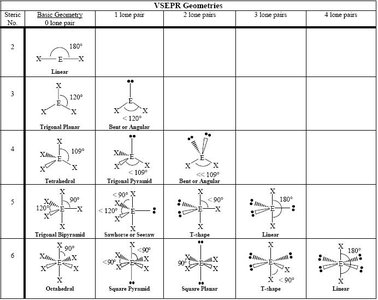
Valence Shell Electron Pair Repulsion (VSEPR) theory predicts molecular shapes based on electron pair repulsion around a central atom.
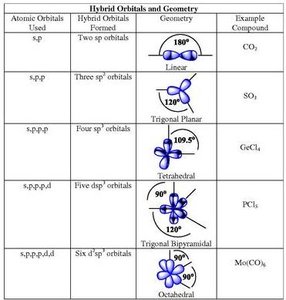
Hybridization
Atomic orbitals mix to form hybrid orbitals, which explain observed molecular geometries.
Intermolecular Forces and Properties
Types of Intermolecular Forces
Intermolecular forces are attractions between molecules, influencing physical properties like boiling and melting points.
London Dispersion Forces: Weak, temporary dipoles in all molecules.
Dipole-Dipole Interactions: Attractions between polar molecules.
Hydrogen Bonds: Strong dipole-dipole interactions involving H bonded to N, O, or F.
States of Matter
Solids, liquids, and gases differ in particle arrangement and intermolecular forces. Crystalline solids have ordered structures; amorphous solids lack order.
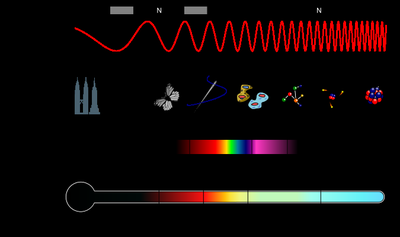
Spectroscopy and the Electromagnetic Spectrum
Atoms and molecules absorb or emit energy at specific wavelengths, which can be analyzed using spectroscopy.
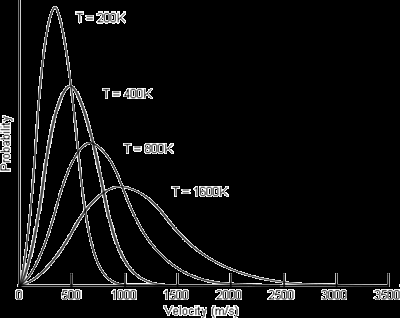
Kinetic Molecular Theory
Describes the motion of gas particles and explains gas laws. Higher temperatures increase average kinetic energy and reaction rates.
Chemical Reactions
Types of Chemical Reactions
Chemical reactions involve the transformation of reactants into products. Types include synthesis, decomposition, single replacement, double replacement, and combustion.
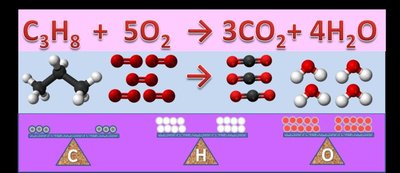
Balancing Chemical Equations
Equations must be balanced to obey the law of conservation of mass. Net ionic equations show only the species that participate in the reaction.
Stoichiometry
Stoichiometry uses balanced equations to relate quantities of reactants and products. Calculations involve moles, mass, and volume relationships.
Titration
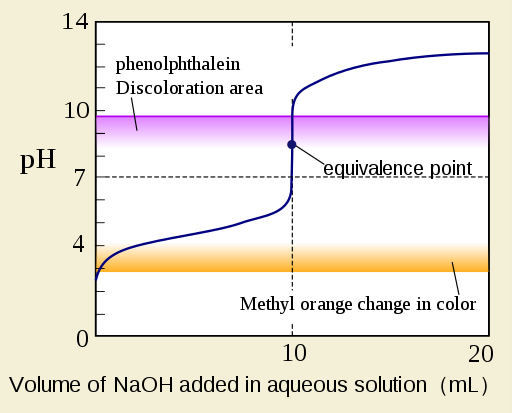
Titration determines the concentration of a solution using a reaction with a known titrant. The equivalence point is where stoichiometric amounts of acid and base have reacted.
Kinetics
Reaction Rates and Rate Laws
Kinetics studies the speed of chemical reactions and the factors affecting them. The rate law expresses the relationship between reactant concentrations and reaction rate.
Rate law:
Arrhenius equation:
Reaction Mechanisms and Energy Profiles
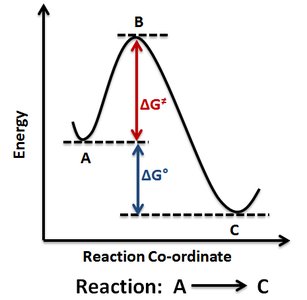
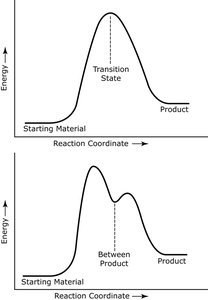
Complex reactions occur in multiple steps, each with its own activation energy. The slowest step determines the overall rate.
Catalysis
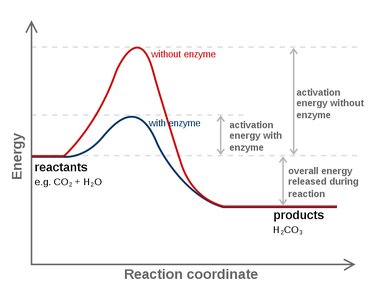
Catalysts increase reaction rates by lowering activation energy without being consumed.
Thermodynamics
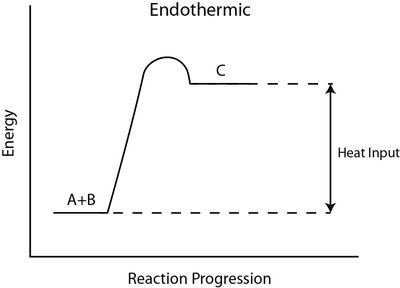
Endothermic and Exothermic Processes
Thermodynamics studies energy changes in chemical reactions. Exothermic reactions release heat; endothermic reactions absorb heat.
Enthalpy, Entropy, and Free Energy
Enthalpy (ΔH): Heat change at constant pressure.
Entropy (ΔS): Measure of disorder or randomness.
Gibbs Free Energy (ΔG): Determines spontaneity:
Equilibrium
Chemical Equilibrium
At equilibrium, the rates of forward and reverse reactions are equal, and concentrations remain constant. The equilibrium constant (K) quantifies the ratio of products to reactants at equilibrium.
Le Châtelier’s Principle
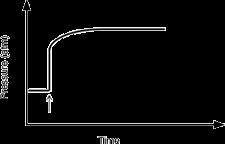
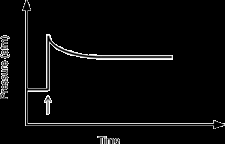
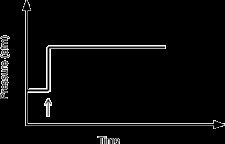
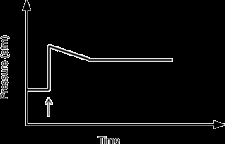
If a system at equilibrium is disturbed, it will shift to counteract the disturbance and restore equilibrium.
Equilibrium and Pressure Changes
Acids and Bases
Acid-Base Definitions and pH
Acids donate protons (H+); bases accept protons. The strength of acids and bases is measured by their dissociation in water and expressed as pH or pOH.
at 25°C
Titration Curves and Buffers
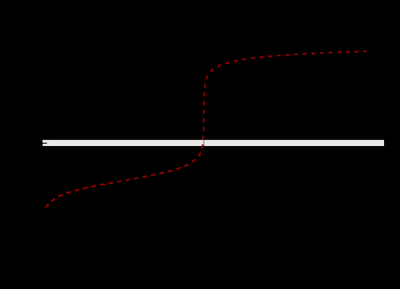
Titration curves show pH changes during acid-base titrations. Buffers resist changes in pH and are made from weak acids and their conjugate bases.
Applications of Thermodynamics
Entropy and Gibbs Free Energy
Entropy (S) measures disorder; the second law of thermodynamics states that entropy increases in spontaneous processes. Gibbs free energy (G) predicts spontaneity: .
Electrochemistry: Galvanic and Electrolytic Cells
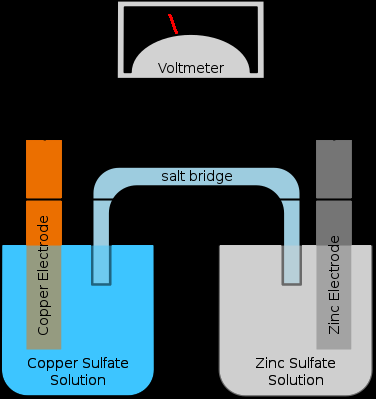
Electrochemical cells convert chemical energy to electrical energy (galvanic) or use electrical energy to drive nonspontaneous reactions (electrolytic). Cell potential (Ecell) is calculated from standard reduction potentials.
Nernst equation:
Additional info: This guide covers all foundational topics for an introductory college chemistry course, including atomic structure, bonding, periodic trends, chemical reactions, stoichiometry, thermodynamics, equilibrium, acids and bases, kinetics, and electrochemistry. Each section includes definitions, key equations, and relevant diagrams or tables to reinforce understanding.
