 Back
BackIntroductory Chemistry Exam & Worksheet Study Guide
Study Guide - Smart Notes
 Tailored notes based on your materials, expanded with key definitions, examples, and context.
Q1. Match the correct name of the polyatomic ions with the formulas given.
Background
Topic: Polyatomic Ions
This question tests your knowledge of common polyatomic ions, their names, and chemical formulas. Recognizing these ions is essential for naming compounds and writing chemical formulas correctly.
Key Terms and Formulas:
Polyatomic ion: An ion composed of two or more atoms covalently bonded, carrying a net charge.
Examples: (sulfate), (nitrate), (carbonate), (hydroxide), (ammonium)
Step-by-Step Guidance
Review the list of polyatomic ion formulas provided (e.g., , , , etc.).
Recall or look up the standard names for each formula. For example, is called sulfate.
Match each formula to its correct name from the options given.
Be careful with similar names (e.g., sulfate vs. sulfite, nitrate vs. nitrite) and check the number of oxygens and the charge.
Try solving on your own before revealing the answer!
Q2. The number of electron levels (not sublevels) in a magnesium atom is ___
Background
Topic: Electron Configuration and Atomic Structure
This question tests your understanding of how electrons are arranged in shells (energy levels) around the nucleus of an atom.
Key Terms and Formulas:
Electron level (shell): Main energy levels where electrons reside, labeled n = 1, 2, 3, ...
Magnesium atomic number: 12
Step-by-Step Guidance
Write the electron configuration for magnesium (atomic number 12).
Count how many principal energy levels (n) are occupied by electrons in magnesium.
Remember, each new value of n represents a new electron level.
Try solving on your own before revealing the answer!
Q3. The visible light spectrum covers the wavelength range ____
Background
Topic: Electromagnetic Spectrum
This question tests your knowledge of the range of wavelengths that make up visible light, which is the portion of the electromagnetic spectrum visible to the human eye.
Key Terms and Formulas:
Wavelength (): The distance between two consecutive peaks of a wave, measured in nanometers (nm).
Visible spectrum: The range of wavelengths that humans can see, typically between 400 nm and 700 nm.
Step-by-Step Guidance
Recall the typical wavelength range for visible light.
Compare the options given and select the one that matches the known range for visible light.
Try solving on your own before revealing the answer!
Q4. All electromagnetic radiation travels at the same ____
Background
Topic: Properties of Electromagnetic Radiation
This question tests your understanding of the fundamental properties of electromagnetic waves, specifically their speed in a vacuum.
Key Terms and Formulas:
Electromagnetic radiation: Includes radio waves, microwaves, infrared, visible light, ultraviolet, X-rays, and gamma rays.
Speed of light (): m/s in a vacuum.
Step-by-Step Guidance
Recall which property (velocity, wavelength, energy, frequency, color) is constant for all electromagnetic radiation in a vacuum.
Remember that wavelength and frequency can change, but one property remains the same for all types in a vacuum.
Try solving on your own before revealing the answer!
Q5. The energy of an infrared photon is ___ than that of ___
Background
Topic: Electromagnetic Spectrum and Photon Energy
This question tests your understanding of the relationship between photon energy and the type of electromagnetic radiation.
Key Terms and Formulas:
Photon energy: , where is Planck's constant, is frequency, is the speed of light, and is wavelength.
Shorter wavelength = higher energy; longer wavelength = lower energy.
Step-by-Step Guidance
Recall the order of electromagnetic radiation from lowest to highest energy: radio, microwave, infrared, visible, ultraviolet, X-ray, gamma ray.
Compare the energy of an infrared photon to that of the other types listed.
Try solving on your own before revealing the answer!
Q6. Which one of the following elements forms two or more ions with different ionic charges?
Background
Topic: Variable Oxidation States
This question tests your knowledge of elements (usually transition metals) that can form more than one type of ion with different charges.
Key Terms and Formulas:
Variable oxidation states: Some elements, especially transition metals, can lose different numbers of electrons to form ions with different charges.
Step-by-Step Guidance
Review the list of elements provided in the options.
Recall which elements are known for forming multiple ions (e.g., Fe and Fe).
Eliminate elements that only form one common ion.
Try solving on your own before revealing the answer!
Q7. Which of the following polyatomic ions has a positive charge?
Background
Topic: Polyatomic Ions and Their Charges
This question tests your ability to recognize the charge on common polyatomic ions.
Key Terms and Formulas:
Polyatomic ion: An ion made up of more than one atom.
Common positive polyatomic ion: Ammonium ()
Step-by-Step Guidance
Review the list of polyatomic ions given in the options.
Recall the charges for each ion (e.g., hydroxide is negative, ammonium is positive).
Identify the ion with a positive charge.
Try solving on your own before revealing the answer!
Q8. What is the formula of the nitrate ion?
Background
Topic: Polyatomic Ion Formulas
This question tests your ability to recall the correct formula for the nitrate ion, a common polyatomic ion.
Key Terms and Formulas:
Nitrate ion:
Be careful not to confuse nitrate with nitrite ().
Step-by-Step Guidance
Review the options and look for the formula that matches nitrate.
Recall the correct number of oxygen atoms and the charge for nitrate.
Try solving on your own before revealing the answer!
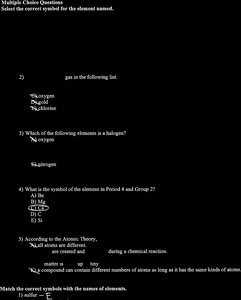
Q9. Select the correct symbol for the element named.
Background
Topic: Chemical Symbols
This question tests your ability to match element names to their correct chemical symbols.
Key Terms and Formulas:
Chemical symbol: One- or two-letter abbreviation for an element (e.g., Na for sodium, K for potassium).
Step-by-Step Guidance
Read the element name given in the question.
Recall or look up the correct chemical symbol for that element.
Choose the correct symbol from the options provided.
Try solving on your own before revealing the answer!
Q10. Which of the following is a halogen?
Background
Topic: Periodic Table Groups
This question tests your knowledge of the halogen group (Group 17) on the periodic table.
Key Terms and Formulas:
Halogens: Elements in Group 17 (e.g., F, Cl, Br, I, At).
Step-by-Step Guidance
Review the options and identify which element is in Group 17.
Recall the common halogens and their symbols.
Try solving on your own before revealing the answer!
Q11. What is the symbol of the element in Period 4 and Group 2?
Background
Topic: Periodic Table Organization
This question tests your ability to locate elements on the periodic table using period (row) and group (column) numbers.
Key Terms and Formulas:
Period: Horizontal row on the periodic table.
Group: Vertical column on the periodic table.
Step-by-Step Guidance
Find Period 4 (the fourth row) and Group 2 (second column) on the periodic table.
Identify the element located at this intersection.
Try solving on your own before revealing the answer!

Q12. According to the Atomic Theory, atoms are created and destroyed during a chemical reaction. True or False?
Background
Topic: Atomic Theory
This question tests your understanding of Dalton's Atomic Theory, specifically the conservation of atoms in chemical reactions.
Key Terms and Formulas:
Dalton's Atomic Theory: Atoms are not created or destroyed in chemical reactions; they are rearranged.
Step-by-Step Guidance
Recall the main points of Dalton's Atomic Theory.
Decide if atoms are created or destroyed during chemical reactions according to this theory.
Try solving on your own before revealing the answer!
Q13. A compound can contain different numbers of atoms as long as it has the same kinds of atoms. True or False?
Background
Topic: Compounds and Chemical Formulas
This question tests your understanding of what defines a chemical compound.
Key Terms and Formulas:
Compound: A substance made of two or more elements in a fixed ratio.
Step-by-Step Guidance
Recall the definition of a compound and whether the ratio of atoms can vary.
Decide if a compound can have different numbers of atoms as long as the types are the same.
Try solving on your own before revealing the answer!
Q14. Match the correct symbols with the names of elements.
Background
Topic: Chemical Symbols and Element Names
This question tests your ability to match element names to their correct symbols.
Key Terms and Formulas:
Element symbol: Abbreviation for an element (e.g., S for sulfur, Fe for iron).
Step-by-Step Guidance
Review the list of element names and their corresponding symbols.
Match each name to the correct symbol.
Try solving on your own before revealing the answer!
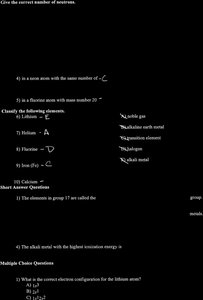
Q15. Give the correct number of neutrons.
Background
Topic: Atomic Structure
This question tests your ability to calculate the number of neutrons in an atom using its atomic number and mass number.
Key Terms and Formulas:
Number of neutrons = Mass number - Atomic number
Step-by-Step Guidance
Identify the atomic number (number of protons) and mass number for the atom in question.
Subtract the atomic number from the mass number to find the number of neutrons.
Try solving on your own before revealing the answer!
Q16. Is a neon atom with the same number of ___ as C?
Background
Topic: Atomic Structure Comparison
This question tests your understanding of atomic structure and how to compare the number of subatomic particles between different elements.
Key Terms and Formulas:
Atomic number: Number of protons in an atom.
Mass number: Number of protons + neutrons.
Step-by-Step Guidance
Determine what is being compared (protons, neutrons, or electrons).
Find the atomic numbers and/or mass numbers for neon and carbon.
Compare the relevant numbers for each element.
Try solving on your own before revealing the answer!
Q17. S in a fluorine atom with atomic number 20 = ___
Background
Topic: Atomic Number and Element Identification
This question tests your ability to identify elements based on their atomic numbers.
Key Terms and Formulas:
Atomic number: Number of protons in an atom, unique to each element.
Step-by-Step Guidance
Look up the element with atomic number 20 on the periodic table.
Identify the symbol for this element.
Try solving on your own before revealing the answer!
Q18. Classify the following elements: Lithium, Helium, Fluorine, Sodium
Background
Topic: Element Classification
This question tests your ability to classify elements as noble gases, alkali metals, halogens, or alkaline earth metals.
Key Terms and Formulas:
Noble gases: Group 18
Alkali metals: Group 1
Halogens: Group 17
Alkaline earth metals: Group 2
Step-by-Step Guidance
Identify the group for each element listed.
Classify each element based on its group (e.g., Li is an alkali metal).
Try solving on your own before revealing the answer!
Q19. The elements in group 17 are called the ___ group.
Background
Topic: Periodic Table Groups
This question tests your knowledge of the names of groups on the periodic table.
Key Terms and Formulas:
Group 17: Halogens
Step-by-Step Guidance
Recall the name for elements in Group 17.
Write the group name in the blank.
Try solving on your own before revealing the answer!
Q20. The alkali metal with the highest ionization energy is ___
Background
Topic: Periodic Trends
This question tests your understanding of ionization energy trends among alkali metals (Group 1).
Key Terms and Formulas:
Ionization energy: The energy required to remove an electron from an atom.
Trend: Ionization energy increases up a group.
Step-by-Step Guidance
List the alkali metals (Li, Na, K, Rb, Cs, Fr).
Recall which alkali metal is highest in the group and thus has the highest ionization energy.
Try solving on your own before revealing the answer!
Q21. What is the correct electron configuration for the lithium atom?
Background
Topic: Electron Configuration
This question tests your ability to write the electron configuration for lithium (atomic number 3).
Key Terms and Formulas:
Electron configuration: The arrangement of electrons in an atom's orbitals.
Step-by-Step Guidance
Recall the order in which orbitals are filled (1s, 2s, 2p, etc.).
Write the configuration for 3 electrons.
Try solving on your own before revealing the answer!
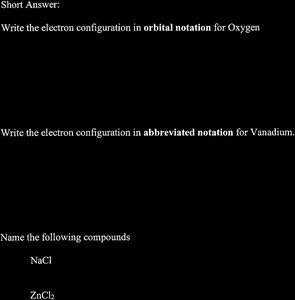
Q22. Write the electron configuration in orbital notation for Oxygen.
Background
Topic: Electron Configuration (Orbital Notation)
This question tests your ability to write the electron configuration for oxygen (atomic number 8) using orbital notation (boxes and arrows or lines and arrows).
Key Terms and Formulas:
Orbital notation: Shows electrons as arrows in boxes representing orbitals.
Step-by-Step Guidance
Recall the order of orbital filling (1s, 2s, 2p, etc.).
Draw boxes for each orbital and fill in arrows for each electron (up and down for paired electrons).
Try solving on your own before revealing the answer!
Q23. Write the electron configuration in abbreviated notation for Vanadium.
Background
Topic: Electron Configuration (Abbreviated Notation)
This question tests your ability to write the electron configuration for vanadium (atomic number 23) using noble gas core notation.
Key Terms and Formulas:
Abbreviated notation: Uses the symbol of the previous noble gas in brackets, followed by the remaining configuration.
Step-by-Step Guidance
Find the noble gas preceding vanadium (atomic number 18, argon).
Write [Ar] and then add the configuration for the remaining electrons.
Try solving on your own before revealing the answer!
Q24. Name the following compounds: NaCl, ZnCl2
Background
Topic: Naming Ionic Compounds
This question tests your ability to name binary ionic compounds using the names of the cation and anion.
Key Terms and Formulas:
NaCl: Sodium chloride
ZnCl2: Zinc chloride
Step-by-Step Guidance
Identify the cation (first element) and anion (second element) in each formula.
Name the cation first, then the anion (with -ide ending).
Try solving on your own before revealing the answer!
