 Back
BackIntroductory Chemistry Exam Study Guidance (Chapters 8, 9, 10)
Study Guide - Smart Notes
 Tailored notes based on your materials, expanded with key definitions, examples, and context.
Q29. For the compound BCl3, provide the Lewis Structure, Shape, and determine whether the molecule is Polar or Non-Polar.
Background
Topic: Molecular Structure and Polarity
This question tests your understanding of Lewis structures, molecular geometry (shape), and how to determine molecular polarity based on structure and symmetry.
Key Terms and Concepts:
Lewis Structure: A diagram showing the arrangement of atoms and valence electrons in a molecule.
Shape (Molecular Geometry): The three-dimensional arrangement of atoms in a molecule, determined by VSEPR theory.
Polarity: Whether a molecule has an uneven distribution of charge, resulting in a dipole moment.
Key Formula/Concepts:
VSEPR Theory: Valence Shell Electron Pair Repulsion theory predicts the shape of molecules based on electron pairs around the central atom.
Polarity: A molecule is polar if it has polar bonds and the shape does not cancel out the dipole moments.
Step-by-Step Guidance
Draw the Lewis structure for BCl3 by placing boron (B) in the center and connecting it to three chlorine (Cl) atoms. Each Cl atom should have three pairs of lone electrons.
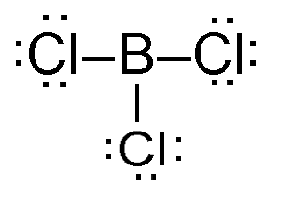
Count the total number of valence electrons: Boron has 3, each chlorine has 7, so electrons.
Assign electrons to form single bonds between B and each Cl, then distribute remaining electrons as lone pairs on Cl atoms.
Use VSEPR theory to determine the shape: Boron has three bonding pairs and no lone pairs, so the shape is trigonal planar.
Consider the symmetry: In a trigonal planar molecule with identical atoms, the dipole moments cancel, so the molecule is non-polar.
Try solving on your own before revealing the answer!
Final Answer:
Lewis Structure: See diagram above.
Shape: Trigonal Planar
Polarity: Non-Polar
BCl3 is non-polar because its trigonal planar shape allows the dipole moments to cancel out, resulting in no net dipole.
