 Back
BackIntroductory Chemistry Study Guide: Atomic Structure, Chemical Nomenclature, Reactions, and Mole Calculations
Study Guide - Smart Notes
 Tailored notes based on your materials, expanded with key definitions, examples, and context.
Atomic Structure and Quantum Numbers
Principal Energy Levels and Quantum Numbers
Atoms are structured with electrons occupying specific energy levels, described by quantum numbers. These numbers define the arrangement and behavior of electrons within an atom.
Principal quantum number (n): Indicates the main energy level or shell.
Letter notation: Specifies the type of orbital (s, p, d, f).
Orbital types: s, p, d, f (corresponding to l = 0, 1, 2, 3).
Electron Configuration
Electron configuration describes the distribution of electrons among the orbitals of an atom.
Notation: Numbers and letters indicate energy levels and orbital types (e.g., 1s2).
Order of filling: Electrons fill lower energy orbitals first (Aufbau principle).
Examples: 1s2, 2s2, 2p6
Electron Arrangement Rules
Hund's Rule: Electrons occupy orbitals singly before pairing.
Pauli Exclusion Principle: No two electrons in an atom can have the same set of quantum numbers.
Chemical Nomenclature
Binary Ionic Compounds
Binary ionic compounds consist of two elements: a metal and a nonmetal. The metal forms a positive ion (cation), and the nonmetal forms a negative ion (anion).
Naming: Name the cation first, then the anion with the suffix '-ide'.
Examples: NaCl (sodium chloride), MgO (magnesium oxide)
Binary Molecular Compounds
Binary molecular compounds are formed between two nonmetals. Prefixes indicate the number of atoms of each element.
Prefixes: mono-, di-, tri-, tetra-, penta-, etc.
Naming: First element keeps its name; second element gets '-ide' suffix and appropriate prefix.
Examples: CO2 (carbon dioxide), SF6 (sulfur hexafluoride)
Binary Acids
Binary acids consist of hydrogen and one other nonmetal element.
Naming: 'Hydro-' prefix, root of nonmetal, '-ic' suffix, followed by 'acid'.
Examples: HCl (hydrochloric acid), HBr (hydrobromic acid)
Chemical Reactions
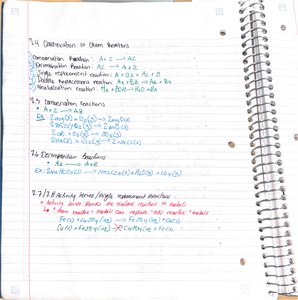
Classification of Chemical Reactions
Chemical reactions can be classified into several types based on the reactants and products.
Combination (Synthesis) Reaction: Two or more substances combine to form one product.
Decomposition Reaction: One substance breaks down into two or more products.
Single Replacement Reaction: An element replaces another in a compound.
Double Replacement Reaction: Two compounds exchange ions.
Examples of Reaction Types
Combination:
Decomposition:
Single Replacement:
Double Replacement:
The Mole Concept
Definition and Importance
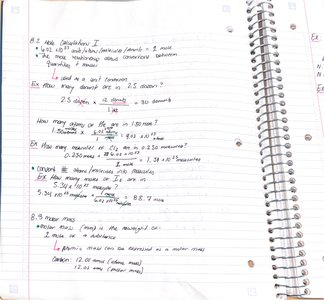
The mole is a fundamental unit in chemistry used to count particles (atoms, molecules, ions) in a substance. One mole contains Avogadro's number of particles.
Avogadro's Number: particles per mole
Application: Used to relate mass, number of particles, and volume in chemical calculations
Mole Calculations
Mole calculations involve converting between mass, number of particles, and moles using molar mass and Avogadro's number.
Mass to moles:
Moles to particles:
Example: How many moles in 12 g of carbon?
Molar Mass
Molar mass is the mass of one mole of a substance, usually expressed in grams per mole (g/mol).
Calculation: Sum the atomic masses of all atoms in a formula.
Example: Molar mass of H2O = 2(1.0) + 16.0 = 18.0 g/mol
Summary Table: Types of Chemical Reactions
The following table summarizes the main types of chemical reactions and their general forms:
Type | General Equation | Example |
|---|---|---|
Combination | ||
Decomposition | ||
Single Replacement | ||
Double Replacement |
Summary Table: Prefixes for Molecular Compounds
This table shows the prefixes used in naming binary molecular compounds:
Prefix | Number |
|---|---|
Mono- | 1 |
Di- | 2 |
Tri- | 3 |
Tetra- | 4 |
Penta- | 5 |
Hexa- | 6 |
Hepta- | 7 |
Octa- | 8 |
Additional info:
Some context and examples were inferred to clarify brief points and ensure completeness.
Images included only where they directly reinforce the explanation of chemical reactions and mole calculations.
