 Back
BackIntroductory Chemistry Test 4 Study Guidance
Study Guide - Smart Notes
 Tailored notes based on your materials, expanded with key definitions, examples, and context.
Q1. Which of the following is not a property of gases?
Background
Topic: Properties of Gases
This question tests your understanding of the physical properties that distinguish gases from solids and liquids, such as compressibility, expansion, and the effect of pressure and temperature.
Key Terms:
Compressibility: Ability of a gas to decrease in volume under pressure.
Expansion: Ability of a gas to increase in volume when pressure decreases.
Fluidity: Ability to flow.
Density: Mass per unit volume; gases generally have lower density than solids or liquids.
Step-by-Step Guidance
Review the properties of gases: compressibility, expansion, fluidity, and low density.
Compare these properties to those of solids and liquids to identify which property does not belong to gases.
Consider how gases behave in containers and under changes in pressure and temperature.
Try solving on your own before revealing the answer!
Q2. Convert 450 mmHg to atm.
Background
Topic: Gas Pressure Units
This question tests your ability to convert between different units of pressure, specifically millimeters of mercury (mmHg) and atmospheres (atm).
Key formula:
Step-by-Step Guidance
Write down the conversion factor: .
Set up the conversion: .
Plug in the value: .
Try solving on your own before revealing the answer!
Q4. Calculate the number of moles and the mass of gas in 10.2 L of O2 at STP.
Background
Topic: Gas Laws and Molar Volume
This question tests your ability to use the molar volume of a gas at STP (Standard Temperature and Pressure) to calculate the number of moles and mass.
Key formula:
Step-by-Step Guidance
Identify the volume given: .
Use the molar volume at STP: per mole.
Calculate moles: .
Find the molar mass of O2: .
Calculate mass: .
Try solving on your own before revealing the answer!
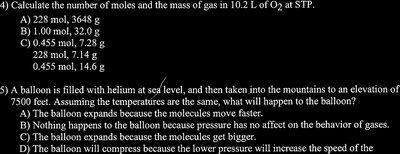
Q5. A balloon is filled with helium at sea level, and then taken into the mountains to an elevation of 7500 feet. Assuming the temperatures are the same, what will happen to the balloon?
Background
Topic: Gas Laws and Atmospheric Pressure
This question tests your understanding of how changes in atmospheric pressure affect the volume of a gas, according to Boyle's Law.
Key formula:
(Boyle's Law, for constant temperature)
Step-by-Step Guidance
Recall that atmospheric pressure decreases with elevation.
According to Boyle's Law, if pressure decreases and temperature is constant, volume increases.
Consider the effect on the balloon's size as it moves to higher elevation.
Try solving on your own before revealing the answer!
Q7. A molecule contains a central atom with three identical bonds to other atoms and one lone pair. The shape of this molecule is:
Background
Topic: Molecular Geometry (VSEPR Theory)
This question tests your ability to use the Valence Shell Electron Pair Repulsion (VSEPR) theory to determine molecular shape based on bonding and lone pairs.
Key Terms:
Central atom
Lone pair
Bonding pairs
VSEPR theory
Step-by-Step Guidance
Count the total electron domains (bonds + lone pairs) around the central atom.
Use VSEPR theory to determine the shape based on the number of domains.
Recall common shapes: tetrahedral, trigonal pyramidal, trigonal planar, etc.
Try solving on your own before revealing the answer!
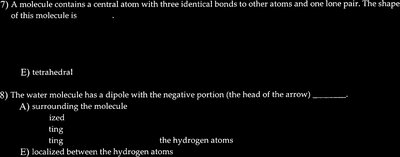
Q8. The water molecule has a dipole with the negative portion (the head of the arrow) __________.
Background
Topic: Molecular Polarity and Dipole Moments
This question tests your understanding of the polarity of water and the direction of its dipole moment.
Key Terms:
Dipole moment
Electronegativity
Polarity
Step-by-Step Guidance
Recall the structure of water: two hydrogen atoms bonded to an oxygen atom.
Oxygen is more electronegative than hydrogen, so the negative end of the dipole points toward oxygen.
Consider where the negative charge is localized in the molecule.
Try solving on your own before revealing the answer!
Q9. The strongest intermolecular forces in hydrogen chloride are examples of:
Background
Topic: Intermolecular Forces
This question tests your knowledge of the types of intermolecular forces, such as ion-ion, dipole-dipole, hydrogen bonding, and dispersion forces.
Key Terms:
Intermolecular forces
Dipole-dipole
Hydrogen bonding
Dispersion forces
Step-by-Step Guidance
Identify the type of molecule: HCl is polar.
Recall the types of intermolecular forces present in polar molecules.
Determine which force is strongest for HCl.
Try solving on your own before revealing the answer!
Q11. Which of the following substances is a strong electrolyte?
Background
Topic: Electrolytes
This question tests your understanding of strong electrolytes, which dissociate completely in water to produce ions.
Key Terms:
Strong electrolyte
Dissociation
Ions
Step-by-Step Guidance
Recall the definition of a strong electrolyte.
Identify which substances dissociate completely in water.
Compare the options to determine which is a strong electrolyte.
Try solving on your own before revealing the answer!
Q15. When a 25.00 mL sample of H2SO4 is titrated with 0.2453 M NaOH, 32.47 mL of NaOH solution is used. What is the concentration of the H2SO4?
Background
Topic: Acid-Base Titration
This question tests your ability to use stoichiometry and molarity in titration calculations.
Key formula:
(for monoprotic acids, adjust for polyprotic acids)
Balanced equation:
Step-by-Step Guidance
Write the balanced equation for the reaction.
Calculate the moles of NaOH used: (convert mL to L).
Use the stoichiometry from the balanced equation to find moles of H2SO4.
Calculate the concentration of H2SO4 using .
Try solving on your own before revealing the answer!



Final Answer: See below for solutions.
Each question's answer is based on the step-by-step guidance above. For example, for Q4, use and .
For Q15, use the balanced equation and stoichiometry to solve for the concentration of H2SO4.
