 Back
Liquids, Solids, and Intermolecular Forces: Study Guide for Introductory Chemistry
Study Guide - Smart Notes
 Tailored notes based on your materials, expanded with key definitions, examples, and context.
Liquids, Solids, and Intermolecular Forces
Interactions Between Molecules
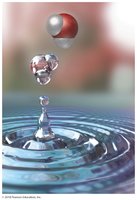
Intermolecular forces are the attractive forces that exist among molecules and atoms, playing a crucial role in determining the physical state of matter. These forces are responsible for phenomena such as the spherical shape of water droplets and the existence of liquids and solids.
Intermolecular forces are essential for physiological processes in living organisms.
They are less specific between all molecules and atoms, but still significant for the properties of matter.
The balance between intermolecular forces and thermal energy determines whether a substance is a solid, liquid, or gas.
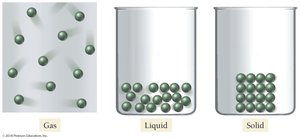
States of Matter: Gas, Liquid, and Solid
The physical state of a substance depends on the magnitude of intermolecular forces relative to thermal energy. Molecules and atoms are in constant motion, and their arrangement and movement differ in gases, liquids, and solids.
Gases: Molecules are far apart, have low density, indefinite shape and volume, and weak intermolecular forces.
Liquids: Molecules are close together, have high density, indefinite shape, definite volume, and moderate intermolecular forces.
Solids: Molecules are tightly packed, have high density, definite shape and volume, and strong intermolecular forces.
Properties of Liquids and Solids
Liquids and solids differ mainly in the freedom of movement of their constituent molecules or atoms. In liquids, molecules can move around each other, while in solids, they are fixed but vibrate about a point.
Liquids: Flow and assume the shape of their container.
Solids: Maintain a fixed shape and volume.
Manifestations of Intermolecular Forces: Surface Tension and Viscosity
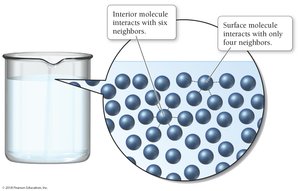
Intermolecular forces are responsible for surface tension and viscosity in liquids.
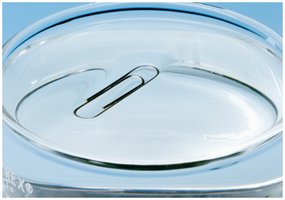
Surface tension: The tendency of liquid surfaces to resist external force, allowing objects like paper clips to float on water.
Viscosity: The resistance of a liquid to flow; higher viscosity means slower flow, as seen in maple syrup compared to water.

Evaporation, Condensation, and Thermal Energy
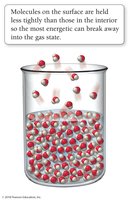
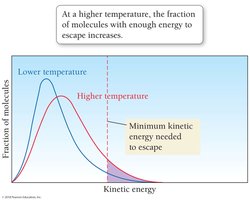
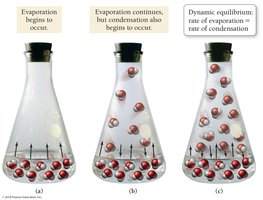
Evaporation and condensation are physical changes involving the transition between liquid and gas states. The rate of vaporization depends on surface area, temperature, and intermolecular force strength.
Evaporation: Molecules on the surface with enough energy escape into the gas phase.
Condensation: Gas molecules lose energy and return to the liquid phase.
Dynamic equilibrium: Occurs when the rates of evaporation and condensation are equal.
Vapor pressure: The partial pressure of vapor in equilibrium with its liquid.
Boiling and Heating Curves
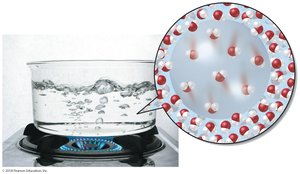
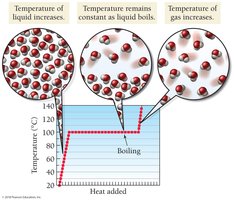
Boiling occurs when thermal energy allows molecules in the interior of a liquid to become gaseous. Heating curves illustrate temperature changes as heat is added to a substance.
During boiling, temperature remains constant until all liquid is converted to gas.
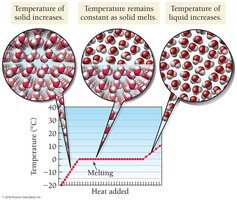
Heating curves show plateaus at phase transitions.
Energetics of Evaporation and Condensation
Evaporation is endothermic, requiring heat to break intermolecular forces. Condensation is exothermic, releasing heat as gas turns to liquid.
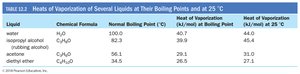
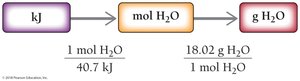
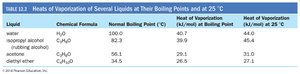
Heat of vaporization (ΔHvap): Amount of heat required to vaporize 1 mol of liquid.
ΔHvap for water at 100°C is 40.7 kJ/mol.
Evaporation absorbs heat; condensation releases heat.
Melting and Freezing
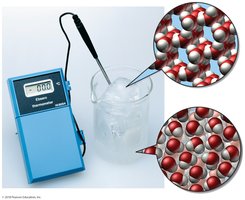
Melting occurs when thermal energy overcomes intermolecular forces in a solid, turning it into a liquid. Freezing is the reverse process.
Melting is endothermic; freezing is exothermic.
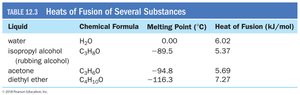
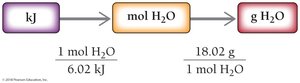
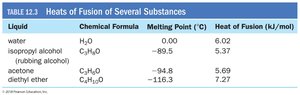
Heat of fusion (ΔHfus): Amount of heat required to melt 1 mol of solid.
ΔHfus for water is 6.02 kJ/mol.
Sublimation
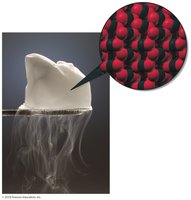
Sublimation is the direct transition from solid to gas without passing through the liquid phase. Dry ice (solid CO2) is a common example.
Occurs when molecules on the surface of a solid gain enough energy to escape directly into the gas phase.
Regular ice can also sublime at temperatures below 0°C.
Types of Intermolecular Forces
The strength and type of intermolecular forces determine the physical properties of substances.
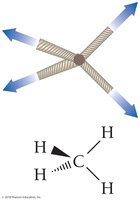
Dispersion forces: Present in all molecules and atoms; caused by temporary dipoles due to electron fluctuations.
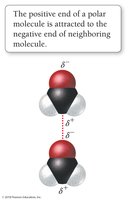
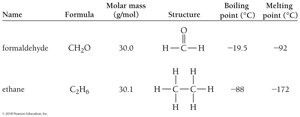
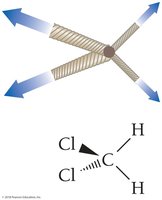
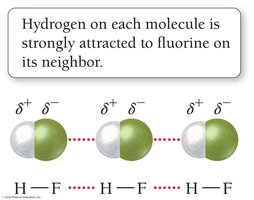
Dipole–dipole forces: Occur in polar molecules; permanent dipoles attract each other.
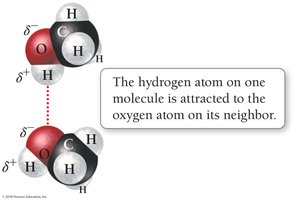
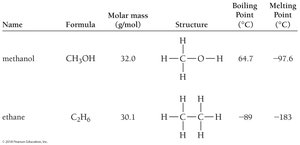
Hydrogen bonding: Strongest type; occurs when hydrogen is bonded directly to F, O, or N.
Ion–dipole forces: Occur between ions and polar molecules.
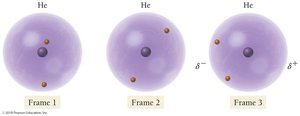
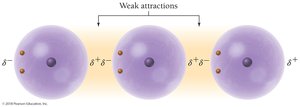
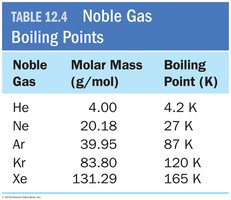
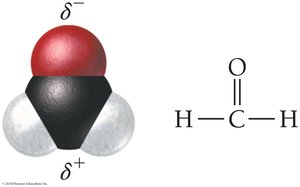

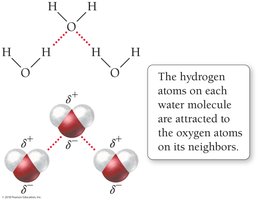
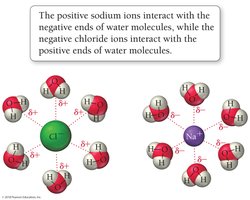
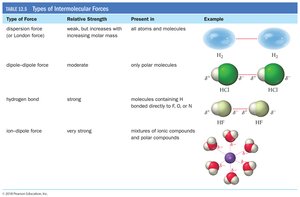
Type of Force | Relative Strength | Present In | Example |
|---|---|---|---|
Dispersion | Weak, increases with molar mass | All atoms and molecules | He, I2 |
Dipole–Dipole | Moderate | Only polar molecules | HCl |
Hydrogen Bond | Strong | Molecules with H bonded to F, O, or N | HF, H2O |
Ion–Dipole | Very strong | Mixtures of ionic and polar compounds | Na+ in water |
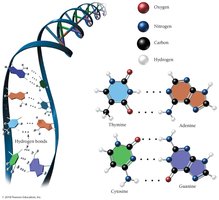
Hydrogen Bonding in DNA
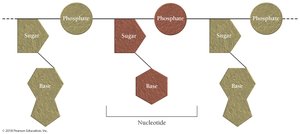
Hydrogen bonding is crucial for the structure and replication of DNA. The double helix is held together by hydrogen bonds between complementary bases.
Adenine (A) pairs with Thymine (T); Cytosine (C) pairs with Guanine (G).
Hydrogen bonds ensure specificity and enable DNA replication.
Types of Crystalline Solids
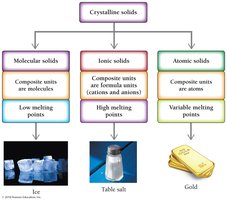
Solids can be crystalline or amorphous. Crystalline solids are classified based on their composite units: molecular, ionic, or atomic.
Molecular solids: Composite units are molecules; held together by intermolecular forces; low melting points.
Ionic solids: Composite units are formula units (cations and anions); held together by ionic bonds; high melting points.
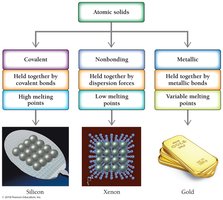
Atomic solids: Composite units are atoms; can be covalent, nonbonding, or metallic.
Atomic Solids
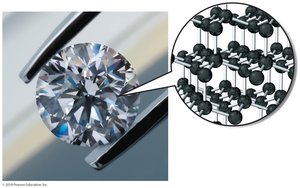
Covalent atomic solids: Held together by covalent bonds; high melting points (e.g., diamond).
Nonbonding atomic solids: Held together by dispersion forces; low melting points (e.g., xenon).
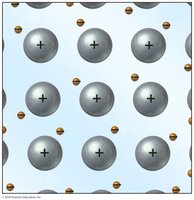
Metallic atomic solids: Held together by metallic bonds; variable melting points (e.g., iron, gold).
Water: A Remarkable Molecule
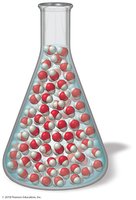
Water's unique properties stem from its strong hydrogen bonding and polar nature. It is a liquid at room temperature, expands upon freezing, and is an excellent solvent for polar and ionic compounds.
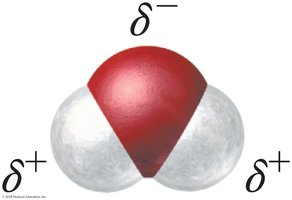
Water's bent geometry and polar O–H bonds result in a significant dipole moment.
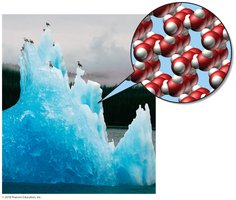
Ice is less dense than liquid water, allowing it to float and insulate aquatic life.
Water is essential for life and plays a critical role in environmental chemistry.
Summary Table: Types of Crystalline Solids
Type | Composite Unit | Forces | Melting Point | Example |
|---|---|---|---|---|
Molecular | Molecules | Intermolecular | Low | Ice |
Ionic | Formula units | Ionic bonds | High | NaCl |
Atomic | Atoms | Covalent, dispersion, metallic | Variable | Diamond, Xe, Fe |
Chemical Skills Learning Objectives
Use the heat of vaporization in calculations.
Use the heat of fusion in calculations.
Determine the types of intermolecular forces in a compound.
Use intermolecular forces to determine melting and/or boiling points.
Additional info: This study guide expands on brief points with academic context, definitions, and examples to ensure completeness and clarity for exam preparation.
