 Back
BackLiquids, Solids, and Intermolecular Forces: Study Notes
Study Guide - Smart Notes
 Tailored notes based on your materials, expanded with key definitions, examples, and context.
Liquids, Solids, and Intermolecular Forces
Concept: Intermolecular and Intramolecular Forces
Understanding the forces that hold matter together is essential in chemistry. These forces are classified as intramolecular (within molecules) and intermolecular (between molecules), each influencing different properties of substances.
Intramolecular Forces: Exist within a molecule, bonding atoms together. They determine the chemical properties of a substance.
Types: Ionic bonds and covalent bonds.
Intramolecular forces are stronger than intermolecular forces.
Intermolecular Forces: Exist between molecules and influence physical properties such as boiling point, melting point, and solubility.
These forces hold liquid and solid molecules together.
Example:
Forces allowing silver to tarnish: Intramolecular
Forces preventing butter from melting in a refrigerator: Intermolecular
Forces preventing oil from evaporating at room temperature: Intermolecular
Forces preventing O2 in air from forming O atoms: Intramolecular
Types of Intermolecular Forces
There are four main types of intermolecular forces that hold molecules together. The polarity of compounds plays a significant role in determining the type of force present. London dispersion forces are present in all molecules.
Type of Force | Exists Between | Strength | Example |
|---|---|---|---|
London Dispersion (van der Waals) | All molecules | Weakest; increases with mass | CH4, CCl4 |
Dipole-Dipole | Polar covalent compounds | Moderate | HCl, SO2 |
Hydrogen Bonding | Compounds with H directly bonded to F, O, or N | Strong (for intermolecular) | H2O, NH3 |
Ion-Dipole | Ions and polar compounds | Strongest | NaCl & H2O |
Example: Major intermolecular forces in:
N2: London dispersion
CH3OH: Hydrogen bonding
CH3Cl: Dipole-dipole
KCl & CH3OH: Ion-dipole
Intermolecular Forces and Physical Properties
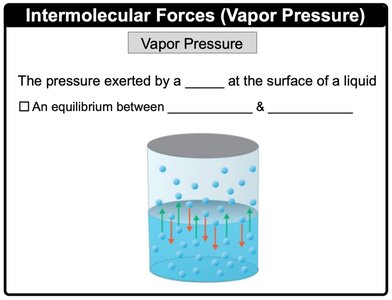
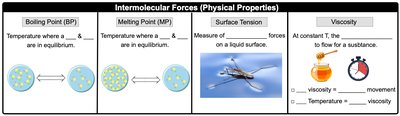
Intermolecular forces significantly affect the physical properties of substances, such as boiling point, melting point, vapor pressure, viscosity, and surface tension.
Direct Relationships: Stronger intermolecular forces lead to higher boiling points, melting points, and surface tension.
Indirect Relationships: Stronger intermolecular forces lead to lower vapor pressure and lower volatility.
Example:
Highest melting point: CaS in H2O (ionic solid, strong forces)
Highest vapor pressure: Kr (weakest intermolecular forces)
Classification of Solids
Solids are classified based on the arrangement of their particles and the types of forces holding them together.
Crystalline solids: Atoms, ions, or molecules are arranged in a highly ordered, repeating pattern.
Amorphous solids: Particles are randomly arranged with no long-range order (e.g., glass, plastics).
Solid Type | Smallest Unit | Electrostatic Forces | Properties | Examples |
|---|---|---|---|---|
Ionic | Ions | Attraction between + & - ions | Hard, high MP, brittle | NaCl, AlF3 |
Molecular | Molecules | Intermolecular forces | Low MP, soft | CO2, I2 |
Covalent Network | Atoms | Covalent bonds | Very hard, high MP | Diamond, graphite |
Metallic | Metal atoms | Metallic bonds (electron pooling) | Shiny, conductive | Fe, Cu, alloys |
Amorphous | Atoms, ions, molecules, or polymers | Any of the above | No definite MP, irregular texture | Glass, plastics |
Example:
Steel: Alloy (metallic)
CO2: Molecular solid
Graphite: Covalent network
CaCO3: Ionic solid
Bronze: Alloy (metallic)
Heating and Cooling Curves
Heating and cooling curves graphically represent the amount of heat absorbed or released during phase changes. Plateaus on the curve indicate phase changes where temperature remains constant as energy is used to break or form intermolecular forces.
Specific heat: The amount of energy required to raise the temperature of 1 gram of a substance by 1°C.
Heat of fusion (ΔHfusion): Energy required to melt 1 gram (or 1 mole) of a solid at its melting point.
Heat of vaporization (ΔHvaporization): Energy required to vaporize 1 gram (or 1 mole) of a liquid at its boiling point.
Key Equations:
Heat for temperature change:
Heat for phase change:
Example: To calculate the energy required to convert a mass of a substance from one phase to another, sum the energy for each step (heating, melting, vaporizing, etc.) using the appropriate specific heat and enthalpy values.
Example Calculation:
How much energy (kJ) is required to convert 76.4 g acetone (molar mass = 58.08 g/mol) as a liquid at -30°C to a solid at -115.0°C? (Apply the equations above for each step: cooling liquid, freezing, cooling solid.)
Additional info: For water: Specific heat of ice = 2.09 J/g·°C, ΔHfusion = 334 J/g, Specific heat of water = 4.184 J/g·°C, ΔHvaporization = 2260 J/g, Specific heat of steam = 1.84 J/g·°C.
