 Back
BackLiquids, Solids, and Intermolecular Forces: Study Notes
Study Guide - Smart Notes
 Tailored notes based on your materials, expanded with key definitions, examples, and context.
Liquids, Solids, and Intermolecular Forces
Introduction to Intermolecular Forces
Intermolecular forces are the attractive forces that exist between molecules and atoms. These forces are responsible for the physical properties of substances, such as their state (solid, liquid, or gas), melting and boiling points, surface tension, and viscosity. The existence of liquids and solids is a direct result of intermolecular forces.
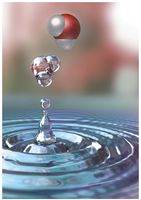
States of Matter and Intermolecular Forces
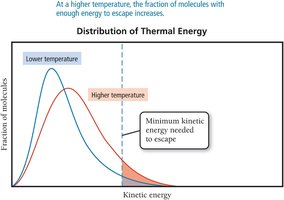
The state of a substance—solid, liquid, or gas—depends on the balance between intermolecular forces and thermal energy. As temperature increases, thermal energy increases, causing molecules to move more rapidly and potentially overcome intermolecular attractions.
Solids: Particles are closely packed in fixed positions and vibrate about these positions. Strong intermolecular forces dominate.
Liquids: Particles are close together but can move past one another. Moderate intermolecular forces are present.
Gases: Particles are far apart and move freely. Intermolecular forces are weak compared to thermal energy.
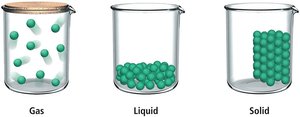
Properties of Gases, Liquids, and Solids
Gases: Low density, indefinite shape and volume, easily compressed, weak intermolecular forces.
Liquids: High density (compared to gases), indefinite shape, definite volume, not easily compressed, moderate intermolecular forces.
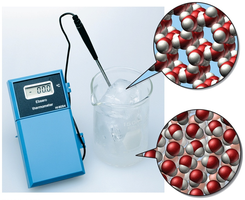
Solids: High density, definite shape and volume, not easily compressed, strong intermolecular forces. Can be crystalline (ordered) or amorphous (disordered).
Shape and Movement in Liquids and Solids
Liquids flow and take the shape of their container because their molecules can move around each other. In solids, molecules are fixed in place but vibrate about their positions.
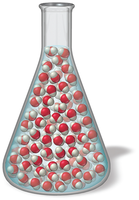
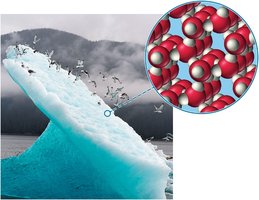
Manifestations of Intermolecular Forces
Surface Tension
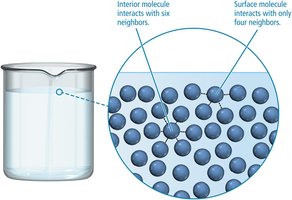
Surface tension is the tendency of a liquid to minimize its surface area, resulting in a "skin" that resists penetration. It is a direct result of intermolecular forces at the surface of a liquid.

Viscosity
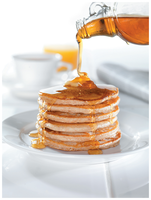
Viscosity is the resistance of a liquid to flow. Liquids with strong intermolecular forces or long, entangled molecules (like motor oil or maple syrup) are more viscous.
Phase Changes: Evaporation, Condensation, Boiling, Melting, Freezing, and Sublimation
Evaporation and Condensation
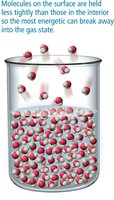
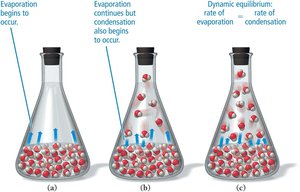
Evaporation is the process by which molecules at the surface of a liquid gain enough energy to enter the gas phase. Condensation is the reverse process, where gas molecules lose energy and become liquid. At equilibrium, the rates of evaporation and condensation are equal, and the vapor pressure is constant.
Boiling
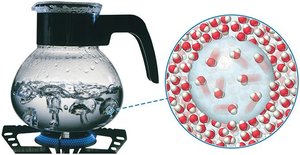
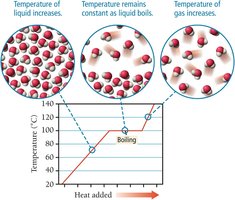
Boiling occurs when the vapor pressure of a liquid equals the external pressure. At this point, bubbles of vapor form within the liquid. The temperature remains constant during boiling until all the liquid has vaporized.
Energetics of Phase Changes
Evaporation: Endothermic (absorbs heat).
Condensation: Exothermic (releases heat).
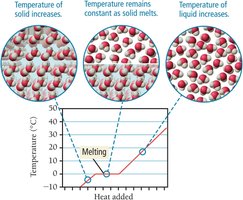
Melting (Fusion): Endothermic (absorbs heat).
Freezing: Exothermic (releases heat).
Sublimation: Endothermic (solid to gas).
Heat of Vaporization and Fusion
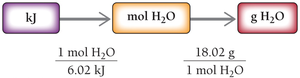
The heat of vaporization () is the amount of heat required to vaporize 1 mole of a liquid. For water at 100°C, kJ/mol. The heat of fusion () is the heat required to melt 1 mole of a solid; for water, kJ/mol.
These values can be used as conversion factors in stoichiometric calculations.

Sublimation
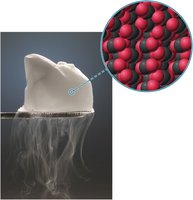
Sublimation is the direct transition from solid to gas without passing through the liquid phase. Dry ice (solid CO2) is a common example.
Types of Intermolecular Forces
Dispersion Forces (London Forces)
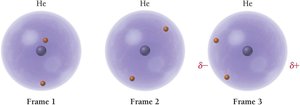
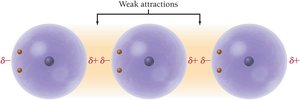
Dispersion forces are present in all molecules and atoms due to temporary fluctuations in electron distribution, creating instantaneous dipoles. The strength of dispersion forces increases with molar mass and polarizability.
Dipole–Dipole Forces
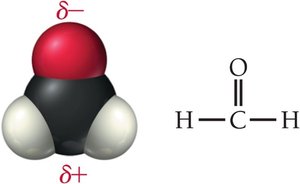
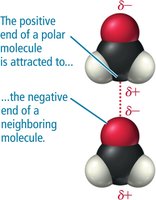
Dipole–dipole forces exist between polar molecules, where the positive end of one molecule is attracted to the negative end of another. These forces raise melting and boiling points compared to nonpolar molecules of similar mass.
Polarity and Miscibility
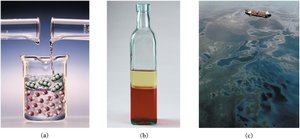
Miscibility is the ability of liquids to mix without separating. Polar liquids mix with other polar liquids but not with nonpolar liquids (e.g., water and oil do not mix).
Determining Dipole–Dipole Forces
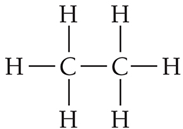
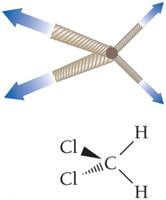
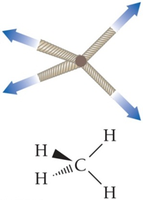
To determine if a molecule has dipole–dipole forces, check for polar bonds and whether the molecular geometry results in a net dipole moment.
Hydrogen Bonding
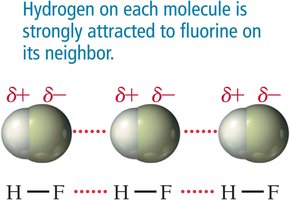
Hydrogen bonding is a strong type of dipole–dipole interaction that occurs when hydrogen is bonded directly to fluorine, oxygen, or nitrogen. This leads to unusually high boiling points for substances like water, HF, and NH3.
Types of Crystalline Solids
Molecular Solids
Molecular solids are composed of molecules held together by intermolecular forces (dispersion, dipole–dipole, hydrogen bonds). Examples: ice (H2O), dry ice (CO2).
Ionic Solids
Ionic solids are composed of cations and anions held together by ionic bonds. They have high melting points due to strong electrostatic attractions. Example: NaCl.
Atomic Solids
Atomic solids are composed of individual atoms. They can be covalent (diamond), nonbonding (solid xenon), or metallic (iron).
Water: A Remarkable Molecule
Water is unique due to its strong hydrogen bonding, high polarity, and ability to dissolve many substances. It has a high boiling point for its molar mass and expands upon freezing, making ice less dense than liquid water.
Summary Table: Types of Intermolecular Forces
Type of Force | Occurs Between | Relative Strength |
|---|---|---|
Dispersion (London) | All molecules/atoms | Weakest |
Dipole–Dipole | Polar molecules | Intermediate |
Hydrogen Bond | H bonded to F, O, or N | Strong |
Ion–Dipole | Ions and polar molecules | Strongest |
Key Learning Objectives
Describe the properties of solids and liquids and relate them to their constituent atoms and molecules.
Explain surface tension and viscosity as manifestations of intermolecular forces.
Describe and explain evaporation, condensation, melting, freezing, and sublimation.
Use heats of vaporization and fusion in calculations.
Compare and contrast dispersion, dipole–dipole, hydrogen bonding, and ion–dipole forces.
Identify types of crystalline solids and the unique properties of water.
