 Back
Matter and Energy: Classification, Properties, and Thermochemistry
Study Guide - Smart Notes
 Tailored notes based on your materials, expanded with key definitions, examples, and context.
Classification of Matter
Types of Matter
Chemistry is the study of matter and the changes it undergoes. Matter is anything that occupies space and has mass. Matter can be classified into three main types:
Element: The simplest type of matter, composed of one kind of atom. Examples include gold (Au) and oxygen (O2).
Compound: Matter composed of two or more different elements that are chemically bonded together. Examples include water (H2O) and ammonia (NH3).
Mixture: Matter composed of elements and/or compounds that are physically mixed together. Mixtures can be homogeneous (uniform composition, e.g., saline solution) or heterogeneous (variable composition, e.g., trail mix).
Key Point: Pure substances (elements and compounds) have uniform composition, while mixtures can be separated into simpler substances by physical means.
Physical and Chemical Changes
Physical Changes
Physical changes alter the physical state of a substance without changing its chemical composition. Common examples include melting, boiling, dissolving, and tearing.
Example: Dissolving sugar in water is a physical change.
Chemical Changes
Chemical changes involve changes in chemical composition, resulting in new substances with new chemical bonds. Examples include burning, rusting, and cooking.
Example: Cooking an egg is a chemical change.
Reversible and Irreversible Changes
Reversible changes can be undone to restore the original structure (e.g., phase changes like melting and freezing). Irreversible changes are permanent (e.g., chemical reactions).
Properties of Matter
Chemical Properties
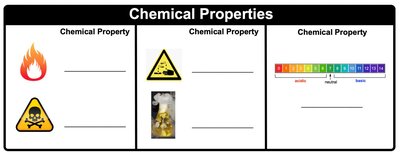
Chemical properties are observed during a chemical reaction and result in the formation of new substances. Examples include flammability, reactivity with acids or bases, and toxicity.
Physical Properties
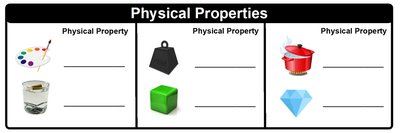
Physical properties can be measured or observed without changing the chemical structure of a substance. Examples include color, density, melting point, and hardness.
Intensive and Extensive Properties
Intensive Properties
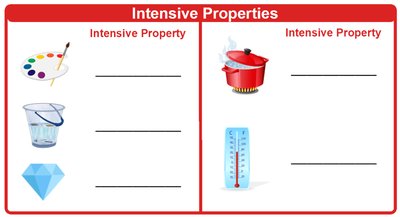
Intensive properties do not depend on the size or amount of substance present. Examples include color, boiling point, density, and temperature.
Extensive Properties
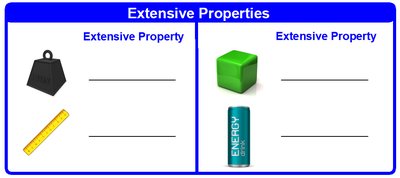
Extensive properties depend on the size or amount of substance present. Examples include mass, volume, and energy.
Temperature and Heat
Thermal Energy, Temperature, and Heat
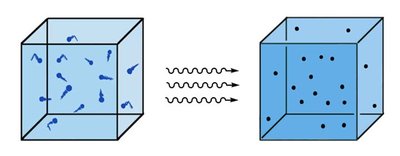
Thermal energy is the sum of kinetic and potential energies of all atoms in an object. Temperature is the average kinetic energy, and heat is the transfer of thermal energy from a higher temperature object to a lower temperature object.
Temperature Conversions
Celsius to Kelvin:
Celsius to Fahrenheit:
Law of Conservation of Mass
The Law of Conservation of Mass states that in a chemical reaction, matter is neither created nor destroyed, but changes form. The total mass of reactants equals the total mass of products.
Example:
Nature of Energy
Types of Energy
Energy is the capacity to do work or produce heat. It can be classified as:
Kinetic Energy: Energy due to motion of atoms.
Potential Energy: Energy due to position of atoms.
Chemical Energy: Energy stored in chemical bonds.
Thermal Energy: Energy generated by motion of atoms.
The SI unit for energy is the joule (J).
Kinetic and Potential Energy
Formulas
Kinetic Energy:
Potential Energy:
Where m is mass (kg), v is velocity (m/s), g is acceleration due to gravity (9.8 m/s2), and h is height (m).
First Law of Thermodynamics
Energy Transfer
The First Law states that energy cannot be created nor destroyed, only transferred between system and surroundings. Heat (q) is the transfer of thermal energy, and work (w) is the movement of molecules against a force.
Internal Energy
Internal Energy Formula
Internal energy (E) is the total energy from all forms of kinetic and potential energy in a system. It can be calculated as:
Work formula:
Where P is pressure and V is volume.
Endothermic and Exothermic Reactions
Endothermic Reactions
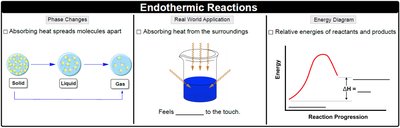
Endothermic reactions absorb thermal energy from the surroundings. As molecules absorb heat, they speed up and may break bonds. These reactions feel cold to the touch.
Exothermic Reactions
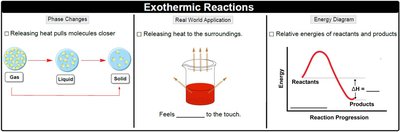
Exothermic reactions release thermal energy to the surroundings. As molecules release heat, they slow down and may form bonds. These reactions feel warm to the touch.
Heat Capacity
Specific and Molar Heat Capacity
Heat capacity is the amount of heat required to change the temperature of a substance. Specific heat capacity is the amount of heat required to change the temperature of 1 gram of a substance by 1 K. Molar heat capacity is the amount of heat required to change the temperature of 1 mole of a substance by 1 K.
Specific Heat Formula:
Where q is heat (J), m is mass (g), c is specific heat capacity (J/g·ºC), and ΔT is temperature change (ºC).
Thermal Equilibrium
Thermal equilibrium occurs when two substances in physical contact reach the same temperature and no longer exchange thermal energy. Heat moves from the hotter object to the cooler object until equilibrium is reached.
Heat Transfer Formula:
Example: If a hot metal is placed in water, the final temperature will be between the initial temperatures of the metal and water.
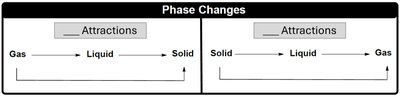
Phase Changes
Phase changes involve the transformation between solid, liquid, and gas states. These changes are driven by the absorption or release of energy, affecting molecular attractions.
 Additional info: Academic context and explanations have been expanded for completeness and clarity.
