 Back
BackMeasurement and Problem Solving in Introductory Chemistry
Study Guide - Smart Notes
 Tailored notes based on your materials, expanded with key definitions, examples, and context.
Measurement and Problem Solving
Scientific Notation
Scientific notation is a method used to express very large or very small numbers in a concise form. It consists of two parts: a decimal part (between 1 and 10) and an exponential part (10 raised to an integer power).
Positive exponent: Indicates multiplication by 10 for each exponent value.
Negative exponent: Indicates division by 10 for each exponent value.
Conversion steps: Move the decimal to create a number between 1 and 10, then multiply by 10 raised to the number of places moved (left = positive, right = negative).
Example: 0.00052 = 5.2 × 10⁻⁴
Uncertainty in Measurement
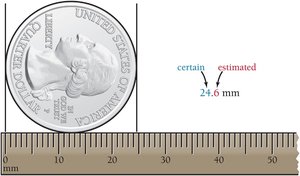
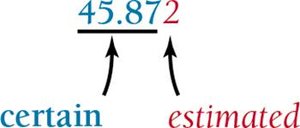
All measurements have some degree of uncertainty, which is reflected in the last reported digit. The more digits reported, the greater the precision. The last digit is always an estimate.
Precision: More digits indicate higher precision.
Reporting: The last digit is uncertain; all others are certain.
Example: Reporting a temperature increase as 0.6°C means the actual value could range from 0.5°C to 0.7°C.
Significant Figures
Significant figures (sig figs) are the digits in a measurement that are known with certainty plus one estimated digit. The rules for determining significant figures are essential for reporting and calculating with measured values.
All nonzero digits are significant.
Interior zeros (between nonzero digits) are significant.
Trailing zeros after a decimal point are significant.
Leading zeros (before the first nonzero digit) are not significant.
Exact numbers (from counting or definitions) have unlimited significant figures.
Estimating Measurements
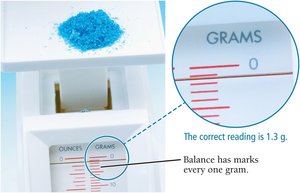
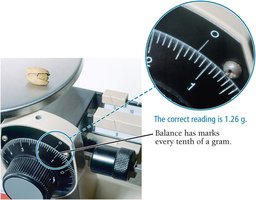
When reading instruments, estimate one digit beyond the smallest marked unit. This estimated digit reflects the uncertainty in the measurement.
Example: A balance marked every 1 gram allows estimation to the tenths place (e.g., 1.3 g).
Example: A balance marked every 0.1 gram allows estimation to the hundredths place (e.g., 1.26 g).
Significant Figures in Calculations
Rules for significant figures must be followed in calculations to ensure that results reflect the precision of the measurements used.
Multiplication/Division: The result has the same number of significant figures as the factor with the fewest significant figures.
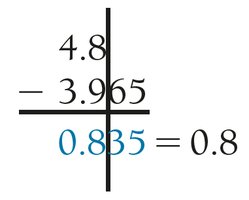
Addition/Subtraction: The result has the same number of decimal places as the quantity with the fewest decimal places.
Rounding: Round only the final answer, not intermediate steps. If the last digit dropped is 5 or more, round up; if 4 or less, round down.
SI Units and Prefixes
The International System of Units (SI) is the standard for scientific measurements. It includes base units for length (meter), mass (kilogram), and time (second). Prefix multipliers are used to express quantities that are much larger or smaller than the base unit.
Length: Meter (m) – defined by the distance light travels in a vacuum in a specific time interval.
Mass: Kilogram (kg) – defined using Planck’s constant.
Time: Second (s) – defined by the frequency of radiation from cesium-133.
Prefix multipliers: kilo- (103), centi- (10-2), milli- (10-3), micro- (10-6), nano- (10-9), pico- (10-12), etc.
Mass vs. Weight
Mass is the measure of the amount of matter in an object, while weight is the force of gravity acting on that mass. Mass is constant regardless of location, but weight varies with gravitational field strength.
Derived Units: Volume
Volume is a derived unit, calculated as length cubed. Common units include cubic meters (m3), cubic centimeters (cm3), and liters (L).
1 L = 1 dm3
1 mL = 1 cm3
Unit Conversions and Dimensional Analysis
Unit conversions are performed using conversion factors, which are ratios of equivalent quantities. Dimensional analysis is the systematic approach to solving problems by tracking units throughout calculations.
Conversion factor: A ratio equal to 1, used to change units (e.g., 1 in = 2.54 cm).
Solution map: A visual outline of the steps needed to convert from one unit to another.
Multistep conversions: Each step uses a conversion factor; units cancel appropriately.
Units raised to a power: Conversion factors must also be raised to the same power (e.g., (1 in = 2.54 cm) implies 1 in2 = (2.54 cm)2).
Density
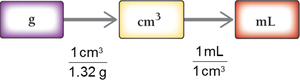
Density is a physical property defined as the mass of a substance divided by its volume. It is commonly used to identify substances and as a conversion factor between mass and volume.
Formula:
Units: g/cm3 or g/mL
Example: A liquid with mass 27.2 g and volume 22.5 mL has density
Density as a conversion factor: Used to convert between mass and volume.
Problem-Solving Strategies
Effective problem solving in chemistry involves identifying the given information, determining what is to be found, and devising a logical sequence of steps (solution map) to reach the answer. Always check that the answer makes physical sense and that units are correct.
Sort: Organize the information provided.
Strategize: Plan the steps needed to solve the problem.
Solve: Perform calculations, keeping track of significant figures and units.
Check: Ensure the answer is reasonable and units are correct.
Importance of Units in Science
Using correct units is critical in scientific calculations. Failure to communicate or convert units properly can lead to significant errors, as illustrated by the loss of the Mars Climate Orbiter due to a unit conversion mistake.

Summary Table: SI Prefix Multipliers
Prefix | Symbol | Multiplier |
|---|---|---|
kilo- | k | 103 |
centi- | c | 10-2 |
milli- | m | 10-3 |
micro- | μ | 10-6 |
nano- | n | 10-9 |
pico- | p | 10-12 |
Learning Outcomes
Express numbers in scientific notation.
Report measurements with the correct number of significant figures.
Apply rules for significant figures in calculations.
Convert between units, including those raised to a power.
Calculate and use density as a conversion factor.
