 Back
Models of the Atom: Structure, Subatomic Particles, and Electron Arrangement
Study Guide - Smart Notes
 Tailored notes based on your materials, expanded with key definitions, examples, and context.
Models of the Atom
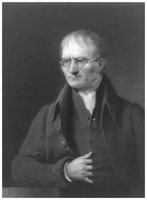
Dalton Atomic Theory
The Dalton Atomic Theory, proposed in 1803, was the first comprehensive model describing the nature of atoms. Dalton's theory laid the foundation for modern chemistry by introducing the concept of atoms as fundamental building blocks of matter.
Postulate 1: An element is composed of tiny, indivisible, indestructible particles called atoms.
Postulate 2: All atoms of an element are identical and have the same properties.
Postulate 3: Atoms of different elements combine to form compounds.
Postulate 4: Compounds contain atoms in small whole-number ratios.
Postulate 5: Atoms can combine in more than one ratio to form different compounds.
Thomson Model of the Atom
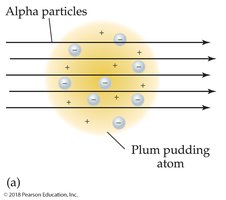
J. J. Thomson's experiments with cathode rays led to the discovery of the electron in 1897. He proposed the "plum pudding" model in 1903, which described the atom as a sphere of positive charge with electrons embedded throughout.
Discovery: Electrons are negatively charged particles found within atoms.
Plum Pudding Model: Electrons are distributed evenly in a positively charged sphere.
Robert Millikan later determined the charge of the electron in 1911, further refining the understanding of atomic structure.
Rutherford Model of the Atom
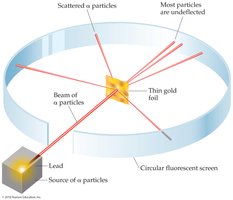
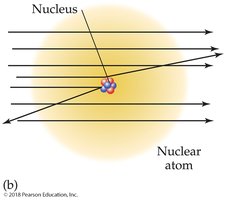
Ernest Rutherford's gold foil experiment in 1906 revealed that atoms are mostly empty space, with a dense, positively charged nucleus at the center. This experiment disproved the plum pudding model and led to the nuclear model of the atom.
Gold Foil Experiment: Alpha particles were fired at thin gold foil; most passed through, but some were deflected.
Conclusion: Atoms have a small, dense nucleus containing protons; electrons occupy the surrounding space.
Rutherford predicted the existence of neutral particles (neutrons), which were discovered by James Chadwick in 1932.
Subatomic Particles
Types and Properties
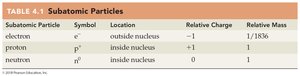
Atoms are composed of three main subatomic particles: electrons, protons, and neutrons. Each has distinct properties and locations within the atom.
Subatomic Particle | Symbol | Location | Relative Charge | Relative Mass |
|---|---|---|---|---|
electron | e- | outside nucleus | -1 | 1/1836 |
proton | p+ | inside nucleus | +1 | 1 |
neutron | n0 | inside nucleus | 0 | 1 |
Atomic Notation and Isotopes
Atomic Notation
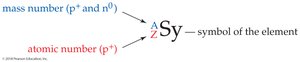
Atomic notation is used to represent the composition of an atom, including its atomic number (Z), mass number (A), and element symbol.
Atomic Number (Z): Number of protons in the nucleus.
Mass Number (A): Total number of protons and neutrons.
Element Symbol: One or two letters representing the element.
Isotopes
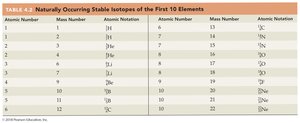
Isotopes are atoms of the same element with different numbers of neutrons, resulting in different mass numbers. Isotopes have identical chemical properties but differ in mass.
Example: Carbon-12 and Carbon-14 are isotopes of carbon.
Notation: Isotopes are often written as the element name followed by the mass number (e.g., Carbon-14).
Atomic Number | Mass Number | Atomic Notation | Atomic Number | Mass Number | Atomic Notation |
|---|---|---|---|---|---|
1 | 1 | 11H | 11 | 23 | 1123Na |
2 | 3 | 23He | 12 | 24 | 1224Mg |
3 | 6 | 36Li | 13 | 27 | 1327Al |
4 | 9 | 49Be | 14 | 28 | 1428Si |
5 | 10 | 510B | 15 | 31 | 1531P |
6 | 12 | 612C | 16 | 32 | 1632S |
7 | 14 | 714N | 17 | 35 | 1735Cl |
8 | 16 | 816O | 18 | 40 | 1840Ar |
9 | 19 | 919F | 19 | 39 | 1939K |
10 | 20 | 1020Ne | 20 | 40 | 2040Ca |
Atomic Mass
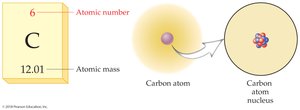
The atomic mass of an element is the weighted average mass of all its naturally occurring isotopes, taking into account their percent abundance.
Formula:
Example: Gallium has two isotopes: (68.926 amu, 60.11%) and (70.925 amu, 39.89%). amu
The Wave Nature of Light
Wavelength and Frequency
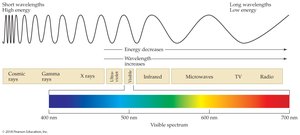
Light exhibits wave-like properties, characterized by wavelength and frequency. The speed of light is constant at m/s.
Wavelength (λ): The distance a wave travels in one cycle.
Frequency (ν): The number of cycles per second.
Relationship:
Inverse Relationship: Longer wavelength means lower frequency; shorter wavelength means higher frequency.
Continuous Spectrum
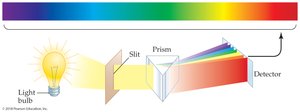
The radiant energy spectrum is a continuous band, with visible light ranging from 400 to 700 nm. Light can be separated into its component wavelengths using a prism.
The Quantum Concept
Quantization of Energy
The quantum concept states that energy is not continuous, but exists in discrete bundles called quanta. This is analogous to a tennis ball losing energy in steps when rolling down stairs, rather than continuously down a ramp.
Energy Levels: Electrons in atoms occupy specific energy levels; energy changes are quantized.

Bohr Model of the Atom
Energy Levels
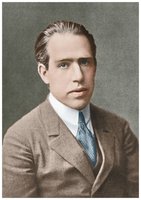
Niels Bohr proposed that electrons orbit the nucleus in fixed energy levels. Electrons can only exist in these quantized levels, not between them.
Quantized Levels: Electrons move between levels by absorbing or emitting energy.
Electron Configuration: Electrons fill the lowest available energy levels first.
Energy Levels and Sublevels
Sublevel Designations
Each main energy level contains sublevels designated as s, p, d, and f. The number of sublevels increases with the energy level.
First energy level: 1s
Second energy level: 2s, 2p
Third energy level: 3s, 3p, 3d
Electron Occupancy
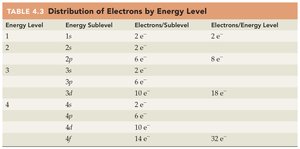
The maximum number of electrons in each sublevel is fixed:
s sublevel: 2 electrons
p sublevel: 6 electrons
d sublevel: 10 electrons
f sublevel: 14 electrons
Energy Level | Energy Sublevel | Electrons/Sublevel | Electrons/Energy Level |
|---|---|---|---|
1 | 1s | 2 | 2 |
2 | 2s, 2p | 2, 6 | 8 |
3 | 3s, 3p, 3d | 2, 6, 10 | 18 |
4 | 4s, 4p, 4d, 4f | 2, 6, 10, 14 | 32 |
Electron Configurations
Filling Order and Notation
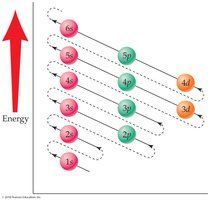
Electrons fill sublevels in order of increasing energy, starting with the lowest. The electron configuration is written as the sublevel followed by a superscript indicating the number of electrons.
Example: Bromine (Br) has 35 electrons: 1s2 2s2 2p6 3s2 3p6 4s2 3d10 4p5
Order of filling: 1s < 2s < 2p < 3s < 3p < 4s < 3d < 4p < 5s < 4d ...
Quantum Mechanical Model of the Atom
Atomic Orbitals
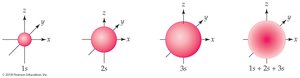
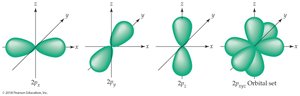
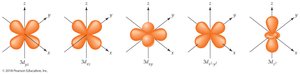
Orbitals are regions of space with a high probability of finding electrons. The shape and size of orbitals depend on their energy and type.
s orbitals: Spherical shape
p orbitals: Dumbbell shape; three orientations
d orbitals: Clover-leaf and complex shapes; five orientations
Chapter Summary
Atoms are composed of protons, neutrons, and electrons.
Protons and neutrons are located in the nucleus; electrons are outside the nucleus.
Atoms are mostly empty space.
The atomic number is the number of protons in the atom.
Isotopes have the same number of protons but different numbers of neutrons.
The mass number is the sum of protons and neutrons.
The atomic mass is the weighted average of all naturally occurring isotopes.
Light has properties of both waves and particles; photons are quantized energy packets.
Electrons exist in discrete, quantized energy levels and fill sublevels starting with the lowest energy.
