 Back
BackMolecules, Compounds, and Chemical Nomenclature: Study Notes for Introductory Chemistry
Study Guide - Smart Notes
 Tailored notes based on your materials, expanded with key definitions, examples, and context.
Module 5: Molecules & Compounds
Elements and Compounds
In chemistry, elements are pure substances consisting of only one type of atom. Elements can exist as single atoms (atomic elements, e.g., Ne) or as molecules made of the same atom (molecular elements, e.g., O2). Compounds are substances composed of two or more different types of atoms chemically bonded together (e.g., CO2, H3O+).
Diatomic elements: Seven elements naturally exist as diatomic molecules: H2, N2, O2, Cl2, F2, I2, Br2.
First 36 elements: Students should be familiar with the names and symbols of the first 36 elements on the periodic table.
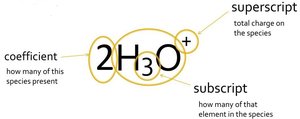
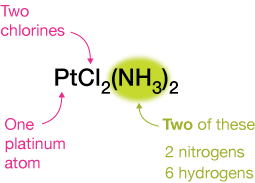
Chemical notation is used to represent the composition of molecules and ions, indicating the number and type of atoms, their arrangement, and the charge on the species.
Module 5: Molecular vs. Ionic Compounds
Types of Compounds
Compounds are classified based on the types of elements they contain and the nature of their bonding:
Ionic Compounds: Composed of metals and nonmetals. Metals tend to lose electrons (forming cations), while nonmetals gain electrons (forming anions). Ionic compounds are electrically neutral overall. Examples: NaCl, ZnCl2, FeS.
Molecular Compounds: Consist only of nonmetals. Atoms are bonded by sharing electrons (covalent bonds) and exist as discrete molecules. Examples: CO2, H2O, CCl4.
All compounds are neutral with respect to charge, meaning the total positive and negative charges balance.
Module 5: Naming Molecular Compounds
Rules for Naming Molecular Compounds
Molecular compounds are named using a system of prefixes to indicate the number of each type of atom present. The following steps are used:
Write the name of the first element in the formula.
Write the name of the second element, changing its ending to -ide.
Use prefixes to indicate the number of atoms of each element (except 'mono-' is only used for the second element).
Avoid two vowels in a row; some prefixes drop a vowel (e.g., 'tetra' becomes 'tetr').

Example: Cl2O is named dichlorine monoxide.
Module 5: Naming Ionic Compounds
Naming Binary Ionic Compounds
Ionic compounds are named based on the ions present. The rules differ depending on whether the metal forms only one type of ion (invariant charge) or can form multiple ions (variable charge):
Binary Ionic Compounds with Metal of Invariant Charge: Name the metal (cation) first, then the nonmetal (anion) with the ending changed to -ide.
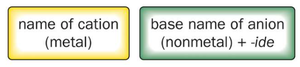
Binary Ionic Compounds with Metal of Variable Charge: Name the metal, indicate its charge with Roman numerals in parentheses, then name the anion with -ide.

Examples:
LiCl: lithium chloride
CrCl3: chromium(III) chloride
Naming Ionic Compounds with Polyatomic Ions
When a compound contains a polyatomic ion, use the name of the polyatomic ion as it appears. The same rules for cations and anions apply, but the polyatomic ion name is used whenever it occurs.
Module 5: Naming Polyatomic Ionic Compounds
Polyatomic Ions and Their Naming Conventions
Polyatomic ions are ions composed of more than one atom. Their names often reflect the number of oxygen atoms present, using specific prefixes and suffixes:
Prefix | Suffix | # of Oxygen Atoms | Example |
|---|---|---|---|
hypo | ite | –2 (relative to base) | hypochlorite: ClO– |
ite | –1 (relative to base) | chlorite: ClO2– | |
ate | base | chlorate: ClO3– | |
per | ate | +1 (relative to base) | perchlorate: ClO4– |
Common polyatomic ions to know include:
ammonium NH4+
acetate C2H3O2–
hydroxide OH–
hydrogen carbonate (bicarbonate) HCO3–
carbonate CO32–
perchlorate ClO4–
chlorate ClO3–
chlorite ClO2–
hypochlorite ClO–
hydrogen phosphate HPO42–
dihydrogen phosphate H2PO4–
phosphate PO43–
phosphite PO33–
nitrate NO3–
nitrite NO2–
permanganate MnO4–
hydrogen sulfate (bisulfate) HSO4–
sulfate SO42–
sulfite SO32–
Additional Practice and Resources
Students are encouraged to practice naming and writing formulas for compounds and to use online simulations such as the "Isotopes and Atomic Mass" simulation from PhET for further understanding.
