 Back
BackNuclear Chemistry: Principles, Applications, and Impacts
Study Guide - Smart Notes
 Tailored notes based on your materials, expanded with key definitions, examples, and context.
Nuclear Chemistry
Introduction to Nuclear Chemistry
Nuclear chemistry is the study of the chemical and physical properties of elements as influenced by changes in the structure of the atomic nucleus. This field explores the processes of radioactive decay, nuclear reactions, and the applications and consequences of nuclear phenomena in medicine, energy, and the environment.
Background Radiation and Radiation Exposure
Sources of Radiation
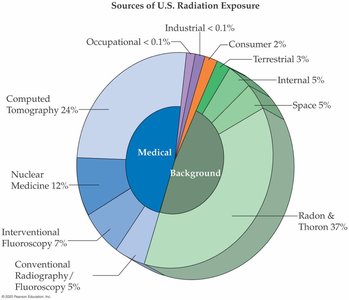
Background radiation accounts for approximately three-fourths of all radiation exposure, originating from natural sources such as cosmic rays, rocks, and soil.
The remaining exposure is primarily from medical irradiation (e.g., X-rays, CT scans).
Radiation Damage to Cells
Ionizing Radiation and Cellular Effects
Ionizing radiation removes electrons from molecules, forming ions and free radicals that can disrupt cellular processes.
Fastest-growing cells (e.g., white blood cells, bone marrow) are most affected.
Radiation can damage DNA, leading to mutations and potentially cancer.
Nuclear Equations and Types of Radiation
Balancing Nuclear Equations
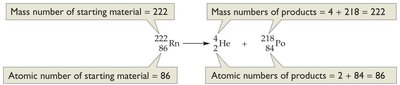
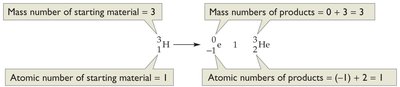
Nuclear equations must conserve both the atomic number (protons) and the mass number (protons + neutrons). The sum of atomic and mass numbers on both sides of the equation must be equal.
Alpha Decay
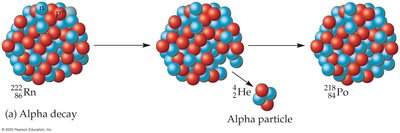
Alpha decay emits an alpha particle (α), which is a helium-4 nucleus (4He).
The parent nucleus loses 2 protons and 2 neutrons.
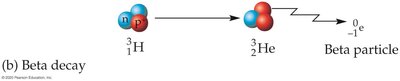
Beta Decay
Beta decay emits a beta particle (β), which is an electron (0e-1).
A neutron in the nucleus converts to a proton, increasing the atomic number by 1.
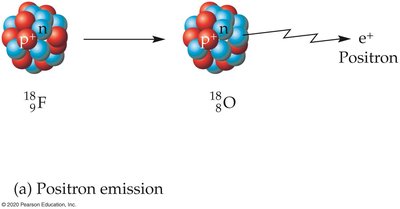
Positron Emission
A positron (β+) is emitted, which is the antimatter counterpart of the electron.
A proton in the nucleus converts to a neutron, decreasing the atomic number by 1.
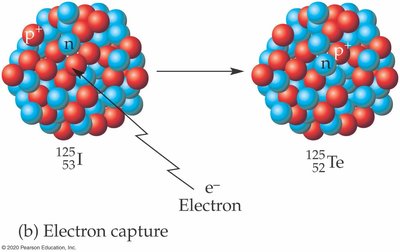
Electron Capture
The nucleus absorbs an inner-shell electron, which combines with a proton to form a neutron.
The atomic number decreases by 1.
Types of Radiation: Properties and Penetrating Power
Radiation | Mass (u) | Charge | Identity | Velocity | Penetrating Power |
|---|---|---|---|---|---|
Alpha (α) | 4 | 2+ | He2+ | 0.1c | Very low |
Beta (β) | 0.00055 | 1− | e− | <0.9c | Moderate |
Gamma (γ) | 0 | 0 | High-energy photon | c | Extremely high |
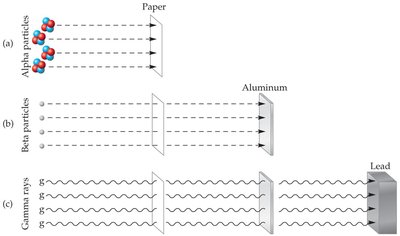
Penetrating Power of Radiation
Alpha particles are stopped by paper or skin.
Beta particles penetrate skin but are stopped by aluminum foil.
Gamma rays require thick lead or concrete for shielding.
Comparing Chemical and Nuclear Reactions
Chemical Reactions | Nuclear Reactions |
|---|---|
Atoms retain their identity | Atoms usually change identity (element changes) |
Involve electrons (mainly outermost) | Involve protons and neutrons |
Rates affected by temperature | Rates unaffected by temperature |
Small energy changes | Large energy changes |
Mass conserved | Measurable mass changes (E = mc2) |
Symbols for Subatomic Particles
Particle | Symbol | Nuclear Symbol |
|---|---|---|
Proton | p | 11H or p |
Neutron | n | 10n |
Electron | e− or β− | 0−1e |
Positron | e+ or β+ | 0+1e |
Alpha particle | α | 42He |
Gamma ray | γ | γ |
Half-Life and Radioactive Decay
Definition and Calculation
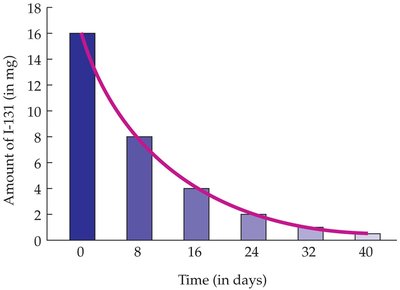
The half-life is the time required for half of a radioactive sample to decay.
The fraction remaining after n half-lives:
Radioisotopic Dating
Principles and Applications
Radioisotopic dating uses the known half-lives of isotopes to determine the age of materials.
Carbon-14 dating is used for organic materials up to about 50,000 years old.
Other isotopes (e.g., potassium-40, uranium-238) are used for dating rocks and the Earth's crust.
Artificial Transmutation
Artificial transmutation is the process of bombarding stable nuclei with particles (e.g., alpha particles, neutrons) to create new elements or isotopes. This is a key method for producing radioactive isotopes for research and medicine.
Uses of Radioisotopes
Tracers and Medical Applications
Radioisotopes are used as tracers to detect leaks, study wear in machinery, and track nutrient uptake in plants.
In medicine, radioisotopes are used for both diagnosis (e.g., imaging, blood volume determination) and therapy (e.g., cancer treatment).
Isotope | Half-life | Medical Use |
|---|---|---|
11C | 20.39 min | Brain scans |
60Co | 5.271 y | Radiation cancer therapy |
131I | 8.040 d | Thyroid diagnoses and therapy |
99mTc | 6.0 h | Imaging of organs |
3H (Tritium) | 12.26 y | Determining total body water |
... (see full table in source) |
Protection from Radiation
Distance: Radiation intensity decreases with distance from the source.
Shielding: Materials such as lead are used to block or reduce radiation exposure.
Energy from the Nucleus
Mass-Energy Equivalence
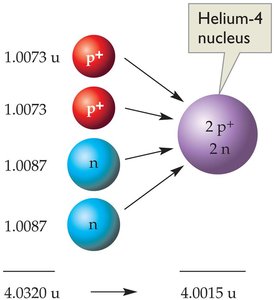
Einstein's equation: (where E = energy, m = mass, c = speed of light).
When nucleons combine to form a nucleus, some mass is converted to binding energy.
Nuclear Fission and Chain Reactions
Nuclear Fission
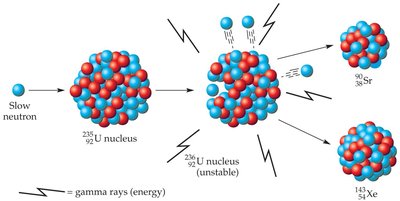
Fission is the splitting of a large nucleus into smaller nuclei, releasing energy and neutrons.
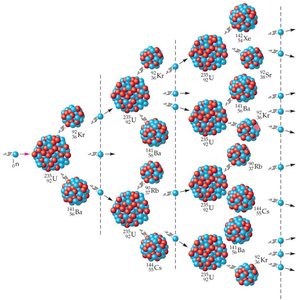
Fission can lead to a chain reaction if released neutrons induce further fission events.
The Manhattan Project and Atomic Bombs
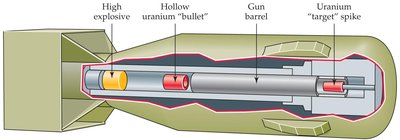
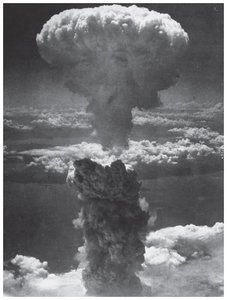
The Manhattan Project (1939) was a U.S. effort to develop nuclear weapons during World War II.
Key goals: sustain fission, enrich uranium, produce plutonium-239, and construct atomic bombs.
Radioactive Fallout
Nuclear explosions produce harmful isotopes such as strontium-90 (accumulates in bone) and iodine-131 (concentrates in the thyroid).
These isotopes pose long-term health risks due to their chemical similarity to essential elements.
Nuclear Power Plants
Civilian nuclear power plants use controlled fission of uranium-235 to generate heat, which is converted to electricity.
Fuel is less enriched than weapons-grade uranium.
Thermonuclear Reactions (Fusion)
Nuclear fusion is the process of combining small nuclei to form larger ones, releasing vast amounts of energy.
Fusion is the primary energy source of the sun and stars.
