 Back
BackOxidation and Reduction: Introductory Chemistry Study Guide
Study Guide - Smart Notes
 Tailored notes based on your materials, expanded with key definitions, examples, and context.
Oxidation and Reduction Reactions
Definition and Basic Principles
Oxidation-reduction (redox) reactions are fundamental chemical processes involving the transfer of electrons, oxygen, or hydrogen atoms between substances. These reactions are essential in both inorganic and organic chemistry, as well as in biological systems.
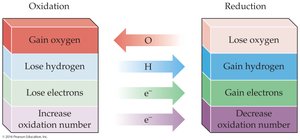
Oxidation: The loss of electrons, gain of oxygen, or loss of hydrogen by an atom or ion.
Reduction: The gain of electrons, loss of oxygen, or gain of hydrogen by an atom or ion.
Oxidation and reduction always occur together; when one substance is oxidized, another is reduced.
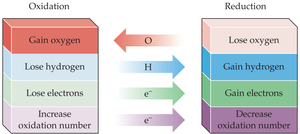
Electron Transfer in Redox Reactions
Most redox reactions involve the transfer of electrons. The substance losing electrons is oxidized, while the substance gaining electrons is reduced.
Oxidation: Loss of electrons (e.g., Zn → Zn2+ + 2e-)
Reduction: Gain of electrons (e.g., Fe3+ + e- → Fe2+)
Identifying Oxidation and Reduction
Gain or Loss of Oxygen and Hydrogen
Redox reactions can also be identified by changes in oxygen or hydrogen content:
Oxidation: Gain of oxygen or loss of hydrogen
Reduction: Loss of oxygen or gain of hydrogen
Oxidation Numbers
Oxidation numbers are assigned to atoms in compounds to track electron transfer and determine if a redox reaction has occurred.
Elements in their elemental form have an oxidation number of 0.
The oxidation number of a monatomic ion equals its charge.
The sum of oxidation numbers in a neutral compound is 0; in a polyatomic ion, it equals the ion's charge.
Group 1A metals: +1; Group 2A metals: +2; Nonmetals follow specific rules (e.g., oxygen is usually -2).
Examples of Redox Reactions
Combustion of Methane
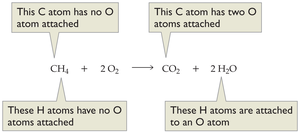
Combustion reactions are classic examples of redox processes. For instance, the burning of methane:
CH4 + 2 O2 → CO2 + 2 H2O
Carbon in methane is oxidized (gains oxygen), and oxygen is reduced (gains hydrogen).
Iron and Carbon Reaction
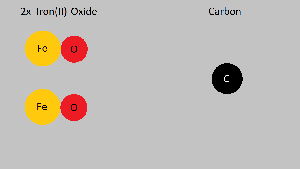
Reduction of iron(II) oxide by carbon is a key industrial redox reaction:
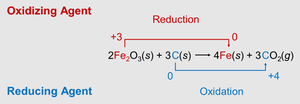
2 FeO + C → 2 Fe + CO2
Iron(II) oxide is reduced to iron metal, and carbon is oxidized to carbon dioxide.
Oxidizing and Reducing Agents
Definitions
The substance that causes oxidation (by accepting electrons) is called the oxidizing agent, while the substance that causes reduction (by donating electrons) is the reducing agent.
Oxidizing Agent: Is reduced itself (gains electrons).
Reducing Agent: Is oxidized itself (loses electrons).
Electrochemical Cells and Batteries
Principles of Electrochemical Cells
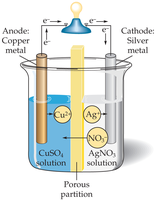
Electrochemical cells use redox reactions to generate electricity. The cell consists of two electrodes:
Anode: Electrode where oxidation occurs.
Cathode: Electrode where reduction occurs.
Balancing Redox Equations
Half-Reactions and Balancing
Redox equations are often balanced by separating them into half-reactions for oxidation and reduction, then ensuring the number of electrons lost equals the number gained.
Write the oxidation and reduction half-reactions.
Balance atoms and charges by adding electrons, water, and hydrogen ions as needed.
Combine the half-reactions, adjusting coefficients to equalize electron transfer.
Example:

Applications of Redox Reactions
Photochromic Glass
Photochromic lenses darken in sunlight due to the reduction of silver ions, forming clusters of silver atoms.


Corrosion and Tarnish
Corrosion, such as silver tarnish, is a redox process where silver reacts with hydrogen sulfide to form silver sulfide. Polishing removes the tarnish, but alternative methods use aluminum as a reducing agent to restore silver.
Biological Importance of Redox Reactions
Energy Production and Photosynthesis
Redox reactions are essential for life, providing energy through the oxidation of glucose and producing oxygen via photosynthesis.
Cellular respiration: Glucose is oxidized to produce energy.
Photosynthesis: Carbon dioxide is reduced to form glucose, releasing oxygen.
Summary Table: Oxidation vs. Reduction
Oxidation | Reduction |
|---|---|
Gain oxygen | Lose oxygen |
Lose hydrogen | Gain hydrogen |
Lose electrons | Gain electrons |
Increase oxidation number | Decrease oxidation number |
Additional info: Academic context and examples were expanded for clarity and completeness. Only images directly relevant to the chemical concepts and processes were included.
