 Back
BackOxidation and Reduction (Redox) Reactions: Study Guide
Study Guide - Smart Notes
 Tailored notes based on your materials, expanded with key definitions, examples, and context.
Oxidation and Reduction
Introduction to Redox Reactions
Oxidation-reduction (redox) reactions are fundamental chemical processes involving the transfer of electrons, oxygen, or hydrogen atoms between substances. These reactions are essential in both inorganic and organic chemistry, as well as in biological systems.
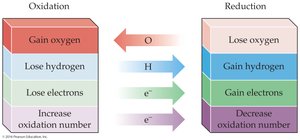
Oxidation: The loss of electrons, gain of oxygen, or loss of hydrogen by an atom or ion.
Reduction: The gain of electrons, loss of oxygen, or gain of hydrogen by an atom or ion.
Oxidation and reduction always occur together; one substance is oxidized while another is reduced.
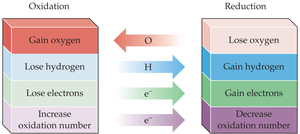
Types of Redox Processes
Redox as Gain or Loss of Oxygen
Many redox reactions involve the transfer of oxygen atoms. The gain of oxygen is considered oxidation, while the loss of oxygen is reduction.
Example: Lead gains oxygen and is oxidized; tin loses oxygen and is reduced.
Redox as Gain or Loss of Hydrogen
Redox reactions can also be described in terms of hydrogen atom transfer. The loss of hydrogen is oxidation, and the gain of hydrogen is reduction.
Example: A molecule losing hydrogen atoms is oxidized; a molecule gaining hydrogen atoms is reduced.
Redox as Gain or Loss of Electrons
The most general definition of redox reactions involves electron transfer. The loss of electrons is oxidation, and the gain of electrons is reduction.
Example: Zn loses electrons to form Zn2+ (oxidized); Fe3+ gains electrons to become Fe2+ (reduced).

Rules for Determining Oxidation Numbers
Assigning Oxidation Numbers
Oxidation numbers are used to track electron transfer in redox reactions. The following rules help assign oxidation numbers:
Rule 1: Elements in their elemental form have an oxidation number of 0.
Rule 2: The oxidation number of a monatomic ion equals its charge.
Rule 3: The sum of oxidation numbers in a neutral compound is 0; in a polyatomic ion, it equals the ion's charge.
Rule 4: Metals in compounds have positive oxidation states; Group 1A metals are +1, Group 2A metals are +2.
Rule 5: Nonmetals are assigned oxidation states according to a precedence table (e.g., oxygen is usually -2, hydrogen is +1).
Examples of Oxidation Number Calculations
To determine if a redox reaction has occurred, assign oxidation numbers to each element and compare before and after the reaction.
Example: In SO2, S + 2(-2) = 0, so S = +4.
Example: In NO3-, N + 3(-2) = -1, so N = +5.
Identifying Redox Reactions
Oxidizing and Reducing Agents
The oxidizing agent is the species that is reduced (gains electrons), while the reducing agent is the species that is oxidized (loses electrons).
Example: In the reaction between carbon and oxygen, carbon is oxidized (reducing agent), oxygen is reduced (oxidizing agent).
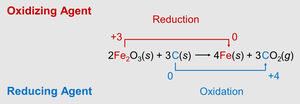
Electrochemical Cells and Batteries
Electrochemical Cells
Redox reactions can be used to generate electricity in electrochemical cells. These cells consist of two electrodes:
Anode: Electrode where oxidation occurs.
Cathode: Electrode where reduction occurs.
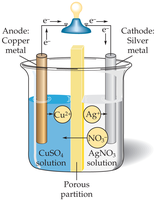
Half-Reactions
Redox reactions can be split into two half-reactions: one for oxidation and one for reduction. These are balanced separately and then combined.
Oxidation half-reaction: Shows the loss of electrons.
Reduction half-reaction: Shows the gain of electrons.

Applications of Redox Reactions
Photochromic Glass
Photochromic lenses darken in sunlight due to the reduction of silver ions, forming clusters of silver atoms.
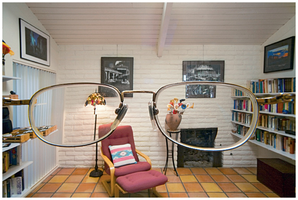

Corrosion and Tarnish
Corrosion, such as silver tarnish, is a redox process where silver reacts with hydrogen sulfide to form silver sulfide. Polishing removes the tarnish, but alternative methods use aluminum as a reducing agent to restore silver.
Oxidizing Agents
Common oxidizing agents include oxygen, ozone, hydrogen peroxide, potassium dichromate, benzyl peroxide, chlorine, and bleaches. These substances are used in disinfection, bleaching, and industrial processes.
Reducing Agents
Reducing agents such as coke (carbon), aluminum, and hydrogen are used in metallurgy and other chemical processes to reduce metal oxides to metals.
Redox Reactions in Living Systems
Biological Importance
Oxidation and reduction reactions are vital for life. Energy is obtained from food by oxidizing glucose, and photosynthesis involves reduction reactions that produce oxygen.
Example: Oxidation of glucose:
Example: Photosynthesis (reverse reaction):
Summary Table: Oxidation vs. Reduction
Oxidation | Reduction |
|---|---|
Gain oxygen | Lose oxygen |
Lose hydrogen | Gain hydrogen |
Lose electrons | Gain electrons |
Increase oxidation number | Decrease oxidation number |
Example: Redox Reaction in Metallurgy
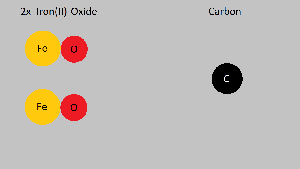
Iron(III) oxide reacts with carbon to produce iron and carbon dioxide. This is a classic redox reaction used in metallurgy.
Oxidation: Carbon is oxidized to carbon dioxide.
Reduction: Iron(III) oxide is reduced to iron.
Example: Redox Reaction with Calcium and Oxygen
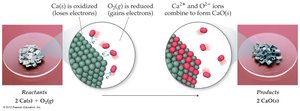
Calcium reacts with oxygen to form calcium oxide. Calcium is oxidized (loses electrons), and oxygen is reduced (gains electrons).
Example: Combustion of Methane
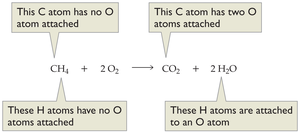
In the combustion of methane, carbon and hydrogen atoms are oxidized as they gain oxygen atoms.
Equation:
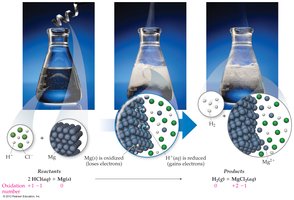
Example: Magnesium and Hydrochloric Acid
Magnesium reacts with hydrochloric acid to produce hydrogen gas and magnesium chloride. Magnesium is oxidized, and hydrogen ions are reduced.
Example: Copper and Silver Nitrate
When copper wire is placed in silver nitrate solution, silver metal deposits on the wire, and the solution turns blue as Cu2+ ions increase. Silver ions are reduced, and copper is oxidized.




Example: Balancing Redox Equations
Redox equations are balanced by ensuring both atoms and charges are balanced. Electron loss and gain must be equal.
Conclusion
Oxidation and reduction reactions are central to chemistry, with applications ranging from industrial processes to biological systems. Understanding how to identify, balance, and apply redox reactions is essential for success in introductory chemistry.
