 Back
Periodic Properties of the Elements: Structure, Trends, and Electron Configurations
Study Guide - Smart Notes
 Tailored notes based on your materials, expanded with key definitions, examples, and context.
Periodic Properties of the Elements
Introduction to the Periodic Table
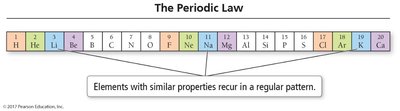
The periodic table is a fundamental tool in chemistry, organizing elements according to their atomic structure and recurring chemical properties. Its arrangement reflects the periodic law, which states that when elements are ordered by increasing atomic number, certain sets of properties recur periodically.
Periodic Law: Elements with similar properties recur in a regular pattern.
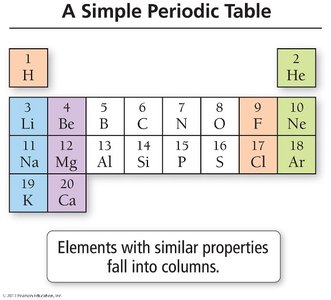
Groups (Columns): Elements in the same group have similar properties.
Periods (Rows): Elements in the same period have increasing atomic number from left to right.
Alternative Periodic Table Representations
While the standard periodic table is rectangular, alternative representations, such as spiral or circular tables, highlight relationships between element families and periodicity in unique ways. 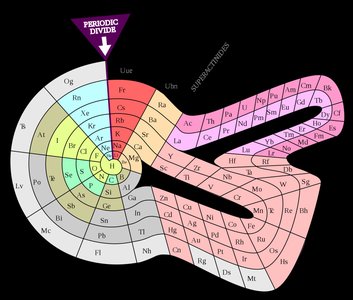
Historical Development and Predictions
Dmitri Mendeleev developed the first periodic table, predicting properties of undiscovered elements based on observed periodic trends. Later, Henry Moseley refined the table by ordering elements by atomic number rather than atomic mass, correcting inaccuracies.
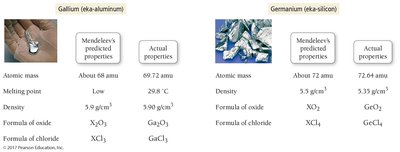
Mendeleev’s Predictions: He predicted properties of elements such as gallium and germanium before their discovery.
Actual Properties: The actual properties closely matched Mendeleev’s predictions, validating the periodic law.
Organization of the Modern Periodic Table
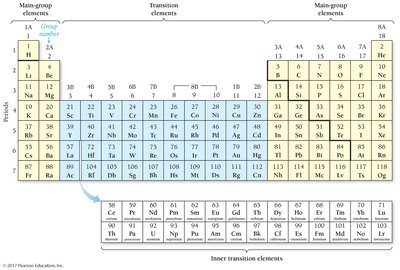
The modern periodic table is organized into main-group elements, transition elements, and inner transition elements.
Main-group elements: Groups 1A–8A (s and p blocks).
Transition elements: Groups 3B–2B (d block).
Inner transition elements: Lanthanides and actinides (f block).
Electron Configurations and Quantum Mechanical Principles
Electron Configuration Notation
Electron configuration describes the arrangement of electrons in an atom’s orbitals.
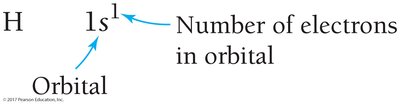
Notation: Uses numbers and letters to indicate energy levels and sublevels, with superscripts showing the number of electrons.
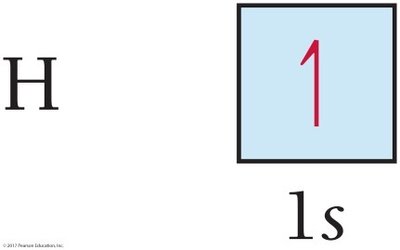
Example: Hydrogen:
Quantum Numbers and the Pauli Exclusion Principle
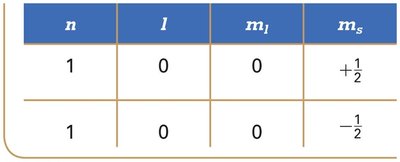
Each electron in an atom is described by four quantum numbers: principal (), angular momentum (), magnetic (), and spin (). The Pauli exclusion principle states that no two electrons in an atom can have the same set of four quantum numbers.
Quantum Numbers Table:
n | l | m_l | m_s |
|---|---|---|---|
1 | 0 | 0 | +\frac{1}{2} |
1 | 0 | 0 | -\frac{1}{2} |
Orbital Energy Levels, Shielding, and Penetration
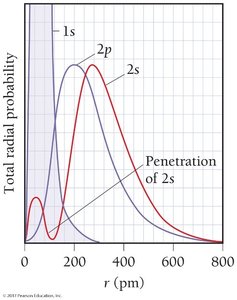
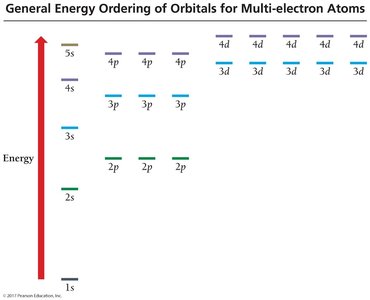
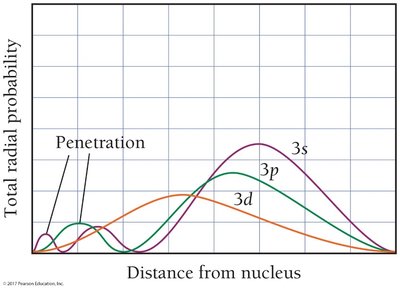
In multi-electron atoms, orbital energies are affected by shielding and penetration.
Shielding: Inner electrons reduce the effective nuclear charge felt by outer electrons.
Penetration: Orbitals that penetrate closer to the nucleus (e.g., s orbitals) experience higher effective nuclear charge and lower energy.
Energy Ordering:
Aufbau Principle, Hund’s Rule, and Orbital Filling
Aufbau Principle: Electrons fill orbitals from lowest to highest energy.
Hund’s Rule: When filling degenerate orbitals, place one electron in each before pairing.
Pauli Exclusion Principle: No more than two electrons per orbital, and they must have opposite spins.
Valence Electrons, Core Electrons, and Periodic Table Blocks
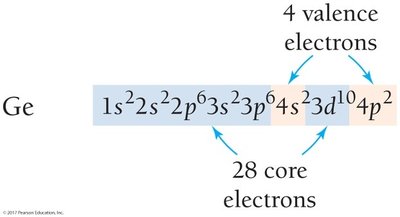
Core vs. Valence Electrons
Core Electrons: Electrons in lower-energy shells.
Valence Electrons: Electrons in the outermost principal energy level (main-group elements) or outermost principal energy level plus d electrons (transition metals).
Periodic Table Blocks and Electron Configurations
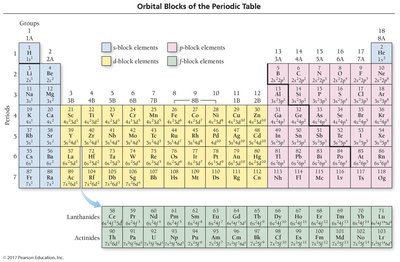
The periodic table is divided into s, p, d, and f blocks, corresponding to the type of orbital being filled.
s-block: Groups 1A and 2A
p-block: Groups 3A–8A
d-block: Transition metals
f-block: Inner transition metals
Periodic Trends and Elemental Properties
Atomic Radius
Atomic radius is defined differently for metals and nonmetals.
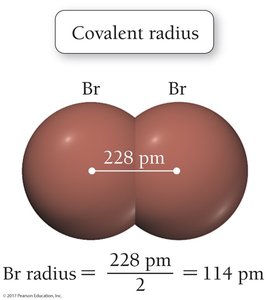
Covalent radius: Half the distance between two bonded atoms.
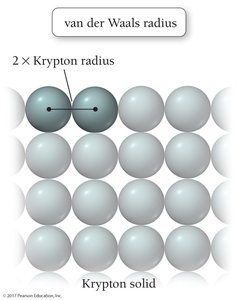
Van der Waals radius: Half the distance between two non-bonded atoms in a crystal.
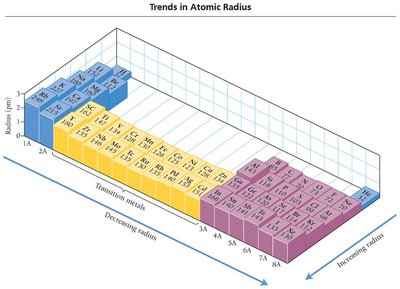
Trends in Atomic Radius
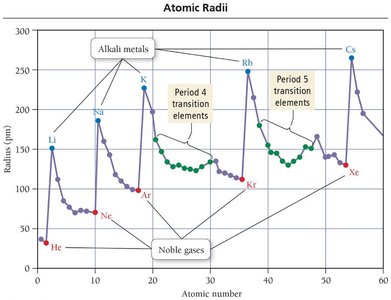
Atomic radius decreases across a period (left to right) due to increasing effective nuclear charge.
Atomic radius increases down a group due to higher principal energy levels.
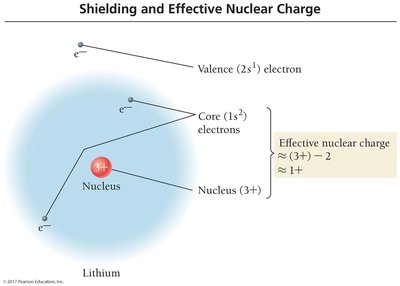
Effective Nuclear Charge (Zeff)
Effective nuclear charge is the net positive charge experienced by valence electrons, accounting for shielding by core electrons.
Formula: (where is atomic number, is shielding constant)
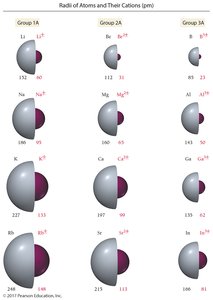
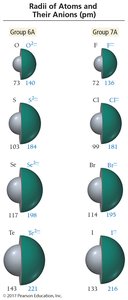
Trends in Ionic Radii
Cations are smaller than their parent atoms due to increased effective nuclear charge.
Anions are larger than their parent atoms due to increased electron-electron repulsion.
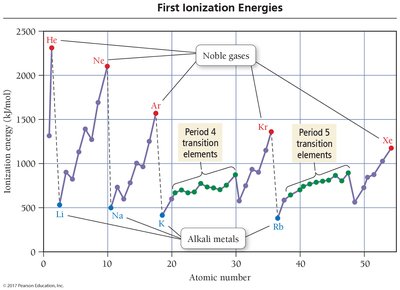
Ionization Energy
Ionization energy is the minimum energy required to remove an electron from an atom in the gas phase.
First ionization energy increases across a period and decreases down a group.
Exceptions occur due to subshell arrangements and electron repulsion.
Electron Affinity
Electron affinity is the energy change when an atom gains an electron.
Generally becomes more negative across a period.
Group 2A and 8A elements have low or positive electron affinities due to filled or half-filled subshells.
Metallic Character
Metallic character increases down a group and decreases across a period.
Elements with low ionization energies tend to be metals.
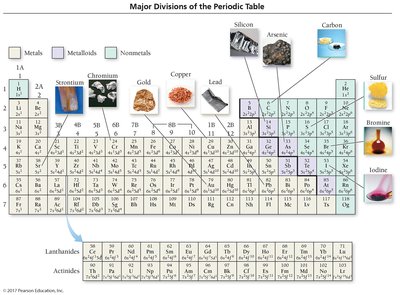
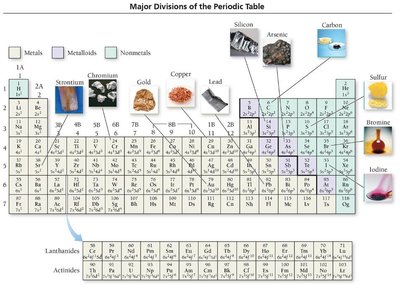
Major Divisions and Families of the Periodic Table
Metals: Good conductors, malleable, ductile, shiny, tend to lose electrons.
Nonmetals: Poor conductors, tend to gain electrons.
Metalloids: Intermediate properties, semiconductors.
Families: Alkali metals (1A), alkaline earth metals (2A), halogens (7A), noble gases (8A).
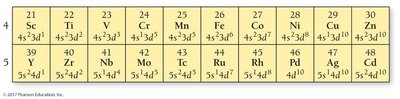
Electron Configurations of Transition Metals and Exceptions
Some transition metals have irregular electron configurations due to stability associated with half-filled or fully filled d sublevels.
Examples: Chromium (Cr), Copper (Cu), Silver (Ag), Molybdenum (Mo)
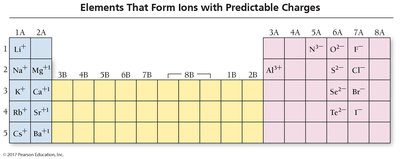
Formation of Ions and Predictable Charges
Main-group metals lose electrons to form cations, while nonmetals gain electrons to form anions.
Predictable Charges: Group 1A: +1, Group 2A: +2, Group 7A: -1, Group 6A: -2, etc.
Summary Table: Periodic Trends
Property | Trend | Reason |
|---|---|---|
Atomic Radius | Decreases across period, increases down group | Increasing Zeff across period, higher energy levels down group |
Ionization Energy | Increases across period, decreases down group | Increasing Zeff across period, electrons farther from nucleus down group |
Electron Affinity | Becomes more negative across period | Atoms more likely to gain electrons across period |
Metallic Character | Decreases across period, increases down group | Lower ionization energy and higher atomic radius |
Practice Problems and Applications
Write electron configurations and orbital diagrams for given elements.
Predict core and valence electrons, and noble gas configurations.
Rank elements by atomic radius, ionization energy, and metallic character.
Conclusion
Understanding the periodic table and its trends is essential for predicting the properties and behaviors of elements. Mastery of electron configurations, periodic trends, and the organization of the table provides a foundation for further study in chemistry.
