 Back
BackPhase Changes, Energy, and Intermolecular Forces: Study Notes for Introductory Chemistry
Study Guide - Smart Notes
 Tailored notes based on your materials, expanded with key definitions, examples, and context.
Physical Properties of Materials
States of Matter
The three primary states of matter are solid, liquid, and gas. Each state is characterized by the arrangement and movement of its particles, as well as the strength of the forces holding them together.
Solids: Particles are closely packed in a fixed arrangement and vibrate in place.
Liquids: Particles are close together but can move past one another, allowing liquids to flow.
Gases: Particles are far apart and move freely, filling the container they occupy.
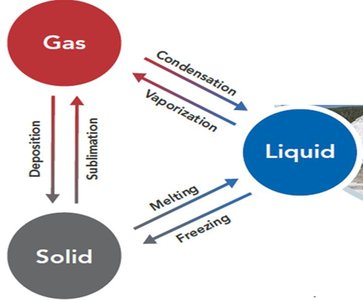
Phase Changes
Types of Phase Changes
Phase changes are physical processes in which a substance transitions between solid, liquid, and gas states. These changes involve energy transfer but do not alter the chemical composition of the substance.
Melting (Fusion): Solid to liquid (heat added).
Freezing: Liquid to solid (heat removed).
Vaporization (Boiling/Evaporation): Liquid to gas (heat added).
Condensation: Gas to liquid (heat removed).
Sublimation: Solid to gas (heat added, skipping liquid phase).
Deposition: Gas to solid (heat removed, skipping liquid phase).
Key Idea: Adding heat generally moves matter from solid → liquid → gas; removing heat reverses this order.
Energy and Phase Change
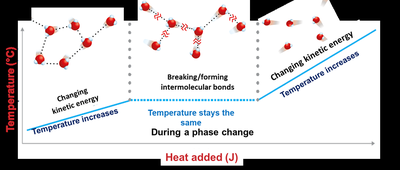
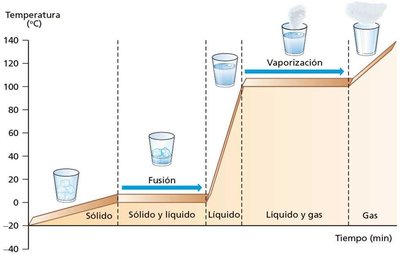
During a phase change, the temperature of a substance remains constant even as heat is added or removed. This is because the energy is used to break or form intermolecular forces rather than increasing kinetic energy.
Before/After Phase Change: Temperature increases as kinetic energy increases.
During Phase Change: Temperature remains constant; energy is used to break/form intermolecular bonds.
Intermolecular Forces and Boiling
When water boils, hydrogen bonds (intermolecular forces) between water molecules are broken, but the covalent bonds within each H2O molecule remain intact. This is why the chemical composition does not change during boiling—only the state changes.
Sublimation and Deposition
Sublimation
Sublimation is the direct transition from solid to gas without passing through the liquid phase. This occurs in substances with weak intermolecular forces, allowing particles to escape directly into the gas phase.
Examples: Solid carbon dioxide (dry ice), solid iodine.
Conditions: Weak intermolecular forces, high vapor pressure relative to atmospheric pressure.
Table: Intermolecular Forces and Sublimation at STP
Compound | Type of Intermolecular Forces | Sublime at STP? | Justification |
|---|---|---|---|
CO2 | London dispersion | Yes | Weak forces allow particles to escape easily into gas |
HF | Hydrogen bonding | No | Strong hydrogen bonds hold particles tightly |
CaCl2 | Ionic bonds | No | Very strong ionic forces prevent particles from escaping |
C10H8 (Naphthalene) | London dispersion | Yes | Weak forces allow sublimation |
I2 | London dispersion | Yes | Weak forces allow particles to enter gas phase |
NaCl | Ionic bonds | No | Very strong ionic forces prevent sublimation |
H2O | Hydrogen bonding | No | Strong hydrogen bonds prevent direct transition to gas |
Deposition
Deposition is the process in which a substance changes directly from gas to solid without passing through the liquid state. It is the reverse of sublimation.
Example: Frost forming on glass (water vapor → ice), iodine deposition.
Evaporation and Vaporization
Evaporation vs. Vaporization (Boiling)
Evaporation and vaporization are both processes where a liquid turns into a gas, but they differ in their mechanisms and conditions.
Evaporation: Slow change at the surface of a liquid, occurs below the boiling point, only some particles escape.
Vaporization (Boiling): Rapid change throughout the liquid, occurs at the boiling point, bubbles form as most particles gain enough energy to escape.
Table: Comparison of Evaporation and Vaporization
Comparison Point | Evaporation | Vaporization (Boiling) |
|---|---|---|
Definition | Slower change at surface | Rapid change throughout liquid |
Temperature | Below boiling point | At boiling point |
Where It Occurs | Surface only | Throughout liquid |
Energy of Particles | Some surface particles escape | Most particles overcome forces |
Bubble Formation | No bubbles | Bubbles form |
Example | Wet clothes drying | Boiling water |
Kinetic Energy and Evaporation
There is a direct relationship between temperature and evaporation. As temperature increases, more particles have enough kinetic energy to overcome attractive forces and evaporate.
Higher temperature: Faster evaporation.
Lower temperature: Slower evaporation.
Vapor Pressure and Dynamic Equilibrium
Vapor Pressure
Vapor pressure is the pressure exerted by gas particles above a liquid in a sealed container. It forms as some liquid particles evaporate and gas particles collide with the container walls.
More vapor particles → higher vapor pressure.
Dynamic Equilibrium
In a closed container, evaporation and condensation occur at equal rates, resulting in dynamic equilibrium. The amount of liquid and vapor remains constant, though particles continue to move between phases.
Table: Open vs. Closed Container
Comparison Point | Open Container | Closed Container |
|---|---|---|
Vapor Particles | Escape into air | Remain trapped |
Condensation | Not significant | Occurs |
Amount of Liquid | Decreases over time | Stays nearly constant |
Dynamic Equilibrium | Does not form | Eventually forms |
Particle Movement | Escape only | Evaporate and condense |
Example | Open bottle of water | Sealed bottle of water |
Boiling Point and Atmospheric Pressure
Boiling Point
The boiling point is the temperature at which a liquid’s vapor pressure equals the external (atmospheric) pressure. The normal boiling point is defined at 101.3 kPa (1 atm).
At higher altitudes (lower pressure), water boils at a lower temperature.
Cooking takes longer at high altitudes due to lower boiling temperatures.
A pressure cooker increases pressure, raising the boiling point and speeding up cooking.
Melting Point and Heating a Solid
Melting Point
The melting point is the temperature at which a solid changes into a liquid. The normal melting point is defined at standard atmospheric pressure (101.3 kPa).
For pure water, the melting and freezing points are both 0°C at 1 atm.
During melting, energy is used to overcome intermolecular forces, not to increase temperature.
Molecular vs. Ionic Solids
Molecular solids: Intermolecular forces (hydrogen bonds, dipole-dipole, dispersion) are overcome during melting; covalent bonds remain intact.
Ionic solids: Ionic bonds between ions must be overcome for melting to occur.
Phase Diagrams
Understanding Phase Diagrams
A phase diagram is a graph showing the physical state of a substance at different temperatures and pressures. It includes regions for solid, liquid, and gas, as well as boundary lines for phase changes.
Triple point: Unique temperature and pressure where all three states coexist in equilibrium.
Normal melting/freezing point: Where solid and liquid coexist at 1 atm.
Normal boiling/condensation point: Where liquid and gas coexist at 1 atm.
For water:
Normal melting point: 0°C, 101.3 kPa
Normal boiling point: 100°C, 101.3 kPa
Triple point: 0.016°C, 0.61 kPa
Example: On a phase diagram, the solid region is where the substance exists as a solid, the liquid region as a liquid, and the gas region as a gas. The triple point is where all three meet.
*Additional info: Phase diagrams are essential for predicting the state of a substance under various conditions and for understanding the relationships between temperature, pressure, and phase changes.*
