 Back
BackPhysical Properties of Materials: Ionic, Molecular, and Covalent Network Compounds
Study Guide - Smart Notes
 Tailored notes based on your materials, expanded with key definitions, examples, and context.
Physical Properties of Materials
States of Matter and Representative Units
Understanding the physical properties of materials requires knowledge of their basic building blocks and how these units interact. The smallest unit that represents a substance is called a representative unit. This can be a molecule (for molecular compounds) or a formula unit (for ionic compounds).
Molecule: Two or more atoms chemically bonded together, acting as a single unit. Example: Water molecule (H2O).
Formula Unit: The lowest whole-number ratio of ions in an ionic compound. Example: Sodium chloride (NaCl).
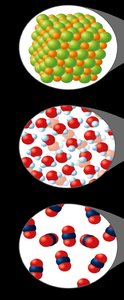
Additional info: The image above visually compares the arrangement of particles in a solid ionic compound, a liquid molecular compound, and a gaseous molecular compound, illustrating how structure relates to state of matter.
Types of Compounds: Ionic vs. Molecular (Covalent)
Compounds can be classified based on the types of elements involved and the nature of their chemical bonds:
Ionic Compounds: Formed from metals and nonmetals via ionic bonds (e.g., NaCl, MgO).
Molecular (Covalent) Compounds: Formed from nonmetals via covalent bonds (e.g., H2O, CO2).
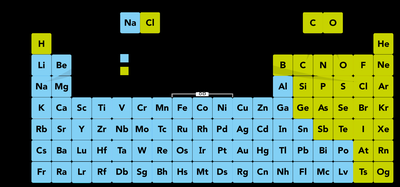
Additional info: The periodic table above highlights the typical locations of metals and nonmetals, aiding in the prediction of compound types.
Classification of Common Compounds
The following table summarizes the classification of several compounds as ionic or molecular:
Compound | Name | Types of Elements | Compound Type |
|---|---|---|---|
LiF | Lithium fluoride | Metal + Nonmetal | Ionic |
CaCl2 | Calcium chloride | Metal + Nonmetal | Ionic |
NaCl | Sodium chloride | Metal + Nonmetal | Ionic |
CuO | Copper(II) oxide | Metal + Nonmetal | Ionic |
CaO | Calcium oxide | Metal + Nonmetal | Ionic |
H2O | Water | Nonmetal + Nonmetal | Molecular (Covalent) |
CO2 | Carbon dioxide | Nonmetal + Nonmetal | Molecular (Covalent) |
CO | Carbon monoxide | Nonmetal + Nonmetal | Molecular (Covalent) |
Properties of Ionic and Molecular Compounds
The physical properties of compounds are determined by the types of bonds and intermolecular forces present:
Property | Nonpolar Molecular Compounds | Polar Molecular Compounds | Ionic Compounds |
|---|---|---|---|
Type of Attraction | Weak dispersion forces | Dipole-dipole or hydrogen bonds | Strong ionic bonds |
Examples | CO2, N2 | H2O, NH3 | NaCl, MgO |
State at STP | Usually gases or liquids | Usually liquids or soft solids | Hard crystalline solids |
Melting & Boiling Points | Very low | Moderate | High |
Volatility | High (evaporate easily) | Moderate | Low |
Electrical Conductivity | Poor in all states | Poor in all states | Conduct electricity when molten or dissolved in water |
Additional info: The image above summarizes the relative strength of forces and typical states at standard temperature and pressure (STP).
Examples: Physical States and Forces
Carbon dioxide (CO2): Usually a gas at STP due to weak dispersion forces.
Water (H2O): A liquid at STP because hydrogen bonds are stronger than dispersion forces.
Sodium chloride (NaCl): A solid at STP due to strong ionic bonds forming a rigid crystal lattice.
Boiling Points and Intermolecular Forces
The boiling point of a substance is closely related to the strength of the forces holding its particles together:
N2O: Polar molecular compound, dipole-dipole and dispersion forces, boiling point: −88°C
H2O: Polar molecular compound, hydrogen bonding, boiling point: 100°C
NaF: Ionic compound, strong ionic bonds, boiling point: 1704°C
Ranking (Lowest to Highest Boiling Point): N2O < H2O < NaF
Explanation: Weaker intermolecular forces (dispersion, dipole-dipole) result in lower boiling points, while strong ionic bonds result in much higher boiling points.
Hydrogen Bonding and Boiling Points
Hydrogen bonding is a particularly strong type of intermolecular force, especially when hydrogen is bonded to highly electronegative atoms (O, F, N). The strength of hydrogen bonding affects boiling points:
NH3 (Ammonia): Weakest hydrogen bonding, lowest boiling point
HF (Hydrogen fluoride): Stronger hydrogen bonding, higher boiling point
H2O (Water): Strongest hydrogen bonding, highest boiling point
Ranking (Lowest to Highest Boiling Point): NH3 < HF < H2O
Covalent Network Solids
Definition and Properties
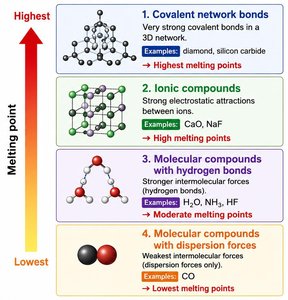
A covalent network solid is a solid in which atoms are connected in a continuous network by strong covalent bonds. Unlike ordinary molecular compounds, these solids do not rely on weak intermolecular forces; instead, strong covalent bonds extend throughout the entire structure.
Examples: Diamond, graphite, silicon dioxide (SiO2), silicon carbide (SiC)
Properties: Extremely high melting points, great hardness, and strong structures
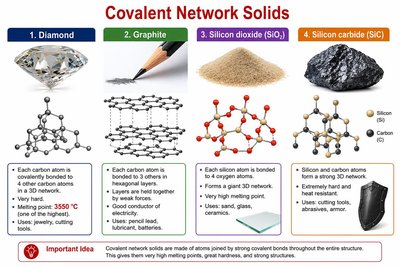
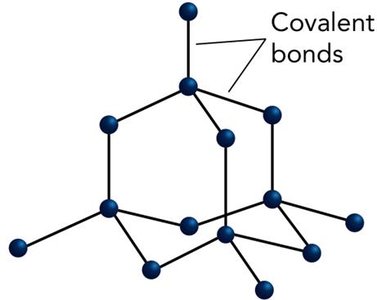
Comparison of Melting Points Based on Bonding Types
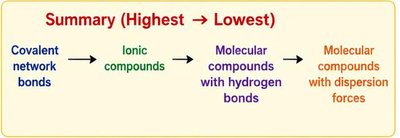
The type of bonding in a compound determines its melting point. The general trend is:
Type of Compound | Bonding | Examples | Melting Point |
|---|---|---|---|
Covalent network solids | Very strong covalent bonds | Diamond, SiC | Highest |
Ionic compounds | Strong ionic bonds | CaO, NaF | High |
Molecular compounds with hydrogen bonds | Hydrogen bonds | H2O, NH3, HF | Moderate |
Molecular compounds with dispersion forces | Dispersion forces | CO | Lowest |
Allotropes
Definition and Examples
Allotropes are different physical forms of the same element, where the atoms are identical but their arrangement (structure) is different, resulting in different properties.

For example, carbon exists as diamond, graphite, carbon nanotubes, and buckminsterfullerene (C60), each with unique structures and properties due to different atomic arrangements.
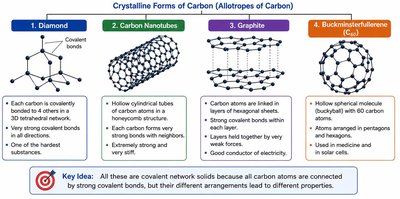
Additional info: Allotropes demonstrate how the same element can have vastly different physical properties depending on atomic structure.
