 Back
BackPolyatomic Ions, Acids, Bases, and Solution Chemistry: Essential Concepts for Introductory Chemistry
Study Guide - Smart Notes
 Tailored notes based on your materials, expanded with key definitions, examples, and context.
Polyatomic Ions
Definition and Structure
Polyatomic ions are fundamental chemical species encountered in introductory chemistry. They consist of two or more atoms covalently bonded, carrying a net positive or negative charge, and act as a single unit in chemical reactions.
Definition: A polyatomic ion is a charged group of covalently bonded atoms.
Net Charge: The entire group behaves as a single ion with a net charge, despite containing multiple atoms.
Nomenclature: Polyatomic ions often have names ending in -ate or -ite (e.g., sulfate, nitrate).
Example: Sulfate (SO42-), Nitrate (NO3-), Carbonate (CO32-)
Occurrence in Compounds
Polyatomic ions are commonly found in metal salts and acids.
Metal Salts: Examples include copper sulfate, magnesium carbonate, and iron nitrate.
Acids: Sulfuric acid, phosphoric acid, and nitric acid contain polyatomic ions.
Acids and Bases
Arrhenius Definition
The Arrhenius definition is a classical approach to acids and bases, focusing on their behavior in aqueous solutions.
Acid: Increases the concentration of hydrogen ions (H+) in water.
Base: Increases the concentration of hydroxide ions (OH-) in water.
Example: Hydrochloric acid (HCl) dissociates to produce H+ ions; sodium hydroxide (NaOH) produces OH- ions.
Acidic, Basic, and Neutral Solutions
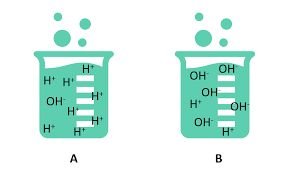
The relative concentrations of H+ and OH- ions determine whether a solution is acidic, basic, or neutral.
Acidic: More H+ ions than OH- ions.
Basic: More OH- ions than H+ ions.
Neutral: Equal concentrations of H+ and OH- ions.
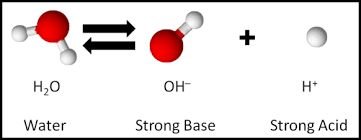
Dissociation of Water
Water undergoes a slight dissociation, producing equal amounts of H+ and OH- ions, making it neutral.
Equation:
Concentration: In pure water, [H+] = 0.0000001 mol/dm3 (1 x 10⁻⁷ mol/L).
The Mole Concept
Definition and Avogadro's Number
The mole is a fundamental unit in chemistry, representing a specific number of particles.
Definition: One mole contains 6.02 x 10²³ particles (Avogadro's number).
Application: 1 mole of hydrogen atoms, oxygen atoms, water molecules, or copper(II) sulfate pentahydrate all contain the same number of particles.
pH and Acidity
Definition of pH
pH is a scale used to measure the acidity or alkalinity of a solution, based on the concentration of hydrogen ions.
Formula:
Interpretation: A pH of 7 is neutral; values below 7 are acidic, and above 7 are basic (alkaline).
Logarithmic Scale: The pH scale compresses large ranges of [H+] into manageable numbers.
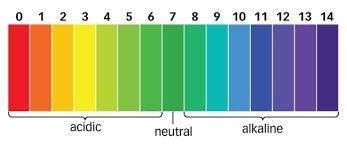
pH and Hydrogen Ion Concentration
pH 1: [H+] = 0.1 mol/dm3
pH 10: [H+] = 0.0000000001 mol/dm3
Acidity & Dissociation
Acidity as Hydrogen Ion Concentration
Acidity is determined by the concentration of free hydrogen ions in a solution.
Dissociation Process of Acids
When acids dissolve in water, they dissociate into ions.
Strong Acids: Ionize completely (100%), producing maximum H+ ions. The reaction is irreversible and results in high conductivity.
Weak Acids: Ionize partially (<5%), establishing equilibrium with most molecules intact. Conductivity is lower.
Example: Sulfuric acid (H2SO4) is a strong acid; acetic acid (CH3COOH) is a weak acid. 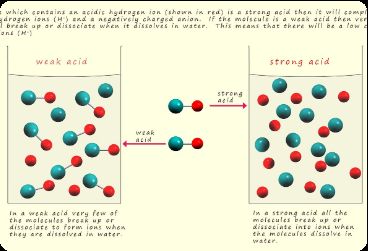
Concentration vs. Strength
Definitions and Distinctions
Strength: Refers to the degree of ionization of an acid or base (strong = complete, weak = partial).
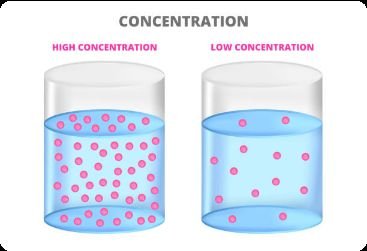
Concentration: Refers to the amount of solute per unit volume (molarity, M).
Key Point: A strong acid can be dilute, and a weak acid can be concentrated.
Changing Concentration: Dilution
Dilution Process
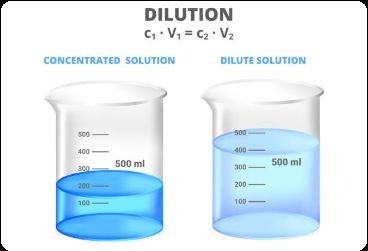
Dilution is the process of reducing the concentration of a solution by adding solvent (usually water).
Stock Solution: The original, more concentrated solution.
Final Solution: The diluted solution after adding solvent.
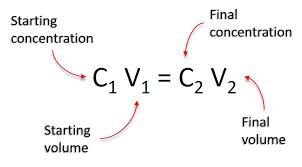
Formula: Where C1 = initial concentration, V1 = initial volume, C2 = final concentration, V2 = final volume.
Summary Table: Strong vs. Weak Acids
Property | Strong Acid | Weak Acid |
|---|---|---|
Degree of Ionization | 100% (Complete) | <5% (Partial) |
Conductivity | High | Low |
Reaction | Irreversible | Equilibrium |
Example | Sulfuric Acid (H2SO4) | Acetic Acid (CH3COOH) |
Summary Table: Concentration vs. Strength
Property | Concentration | Strength |
|---|---|---|
Definition | Amount of solute per unit volume | Degree of ionization |
Units | Molarity (mol/L) | Percentage (%) |
Example | 0.1 M HCl | Strong acid (HCl), Weak acid (CH3COOH) |
Practice and Application
Worksheet and Answer Key
Practice problems and answer keys are essential for mastering these concepts. Additional info: The worksheet and answer key are referenced but not included in the notes.
