 Back
BackPolymers: Structure, Types, Properties, and Environmental Impact
Study Guide - Smart Notes
 Tailored notes based on your materials, expanded with key definitions, examples, and context.
Water: Unique Properties
Density and Expansion Upon Freezing
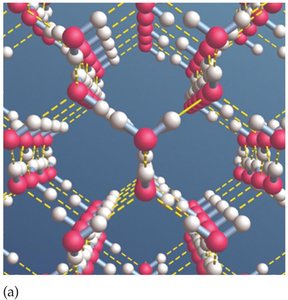
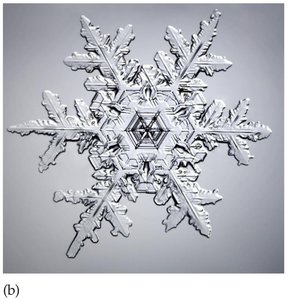
Water is a remarkable substance with several unique physical properties. Unlike most liquids, water expands when it freezes, resulting in a lower density for ice compared to liquid water. This is why ice floats on water.
High Density (Liquid): Water has a relatively high density as a liquid.
Expansion Upon Freezing: The molecular structure of ice causes it to occupy more space than liquid water.
Example: Icebergs float in the ocean due to the lower density of ice.
Hydrogen Bonding and Solvent Properties
Water's ability to form hydrogen bonds makes it a universal solvent, capable of dissolving a wide range of substances. It is also amphoteric, meaning it can act as both an acid and a base.
Hydrogen Bonding: Water molecules are attracted to each other via hydrogen bonds, which are responsible for many of its unique properties.
Universal Solvent: Water dissolves ionic and polar substances efficiently.
Amphoteric Nature: Water can donate or accept protons, acting as an acid or a base.
Heat of Vaporization
Water has a high heat of vaporization, meaning a large amount of energy is required to convert liquid water into vapor.
High Heat of Vaporization: This property is important for temperature regulation in living organisms and the environment.
Example: Sweating cools the body as water evaporates, absorbing heat.
Specific Heat
Specific heat is the amount of energy needed to raise the temperature of 1 gram of a substance by 1°C. Water has a very high specific heat, which allows it to moderate Earth's climate and stabilize temperatures in organisms.
Specific Heat of Water: 1.00 cal/g°C or 4.184 J/g·K.
Heat Equation: where q is heat, m is mass, C is specific heat, and \Delta T is change in temperature.
Example: To raise 225 g of water from 25.0°C to 100.0°C: cal J
Table: Specific Heat Capacity of Common Substances
Substance | Specific Heat Capacity (cal/g°C) | Specific Heat Capacity (J/g·K) |
|---|---|---|
Aluminum (Al) | 0.216 | 0.902 |
Copper (Cu) | 0.0920 | 0.385 |
Ethanol (CH3CH2OH) | 0.588 | 2.46 |
Iron (Fe) | 0.107 | 0.449 |
Ethylene glycol | 0.561 | 2.35 |
Magnesium (Mg) | 0.245 | 1.025 |
Mercury (Hg) | 0.0332 | 0.139 |
Lead (Pb) | 0.0306 | 0.128 |
Silver (Ag) | 0.0562 | 0.235 |
Water (liquid) | 1.00 | 4.184 |
Water in Nature
Distribution of Water on Earth
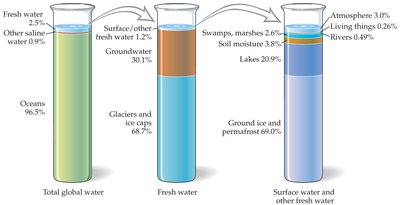
Water covers about 75% of Earth's surface, with most of it found in oceans. Only a small fraction is available as fresh water.
Seawater: 98% of Earth's water is in oceans.
Frozen Water: About 2% is locked in polar ice caps.
The Water Cycle
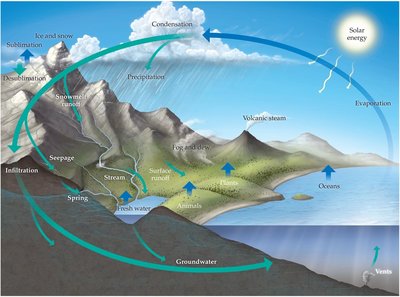
The water cycle describes the continuous movement of water on, above, and below the surface of the Earth. It involves processes such as evaporation, condensation, precipitation, infiltration, and runoff.
Evaporation: Water changes from liquid to vapor due to solar energy.
Condensation: Water vapor forms clouds.
Precipitation: Water returns to Earth as rain, snow, etc.
Infiltration and Runoff: Water moves into the ground or flows over land.
Natural and Chemical Contaminants in Water
Natural Contaminants
Water in nature contains various contaminants, including gases, dissolved minerals, and organic matter.
Gases: Radon, nonmetal oxides, and others.
Dissolved Minerals: Calcium, magnesium, and iron salts cause hard water.
Organic Matter: Bacteria, microorganisms, and animal wastes.
Table: Substances Found in Natural Waters
Substance | Formula | Source |
|---|---|---|
Carbon dioxide | CO2 | Atmosphere |
Nitrogen | N2 | Atmosphere |
Oxygen | O2 | Atmosphere |
Nitric acid | HNO3 | Atmosphere (thunderstorms) |
Sodium ions | Na+ | Soil and rocks |
Potassium ions | K+ | Soil, rocks, fertilizer |
Calcium ions | Ca2+ | Limestone rocks |
Magnesium ions | Mg2+ | Dolomite rocks |
Iron(III) ions | Fe3+ | Soil and rocks |
Chloride ions | Cl- | Soil, rocks, fertilizer |
Sulfate ions | SO42- | Soil, rocks, fertilizer |
Bicarbonate ions | HCO3- | Soil and rocks |
Radon | Rn | Radioactive decay |
Chemical and Biological Contamination
Water can be contaminated by pathogenic organisms, leading to waterborne diseases. Chemical contamination includes acid rain and sewage, which can cause environmental damage and health risks.
Waterborne Disease: Pathogenic organisms threaten water supplies.
Acid Rain: Sulfur and nitrogen oxides lower pH, corrode metals, and dissolve rocks.
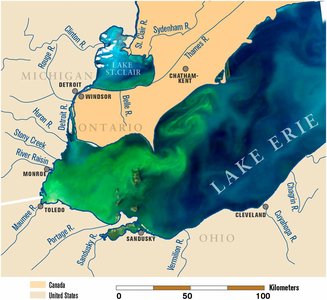
Sewage and Eutrophication: Organic matter increases biochemical oxygen demand (BOD), leading to lake aging and decay.
Groundwater Contamination
Nitrates
Nitrate contamination is a significant issue, especially in rural areas. Nitrates are highly soluble and difficult to remove. In infants, nitrates can cause methemoglobinemia (blue baby syndrome).
Sources: Fertilizers, animal wastes.
Health Risk: Nitrates convert to nitrites, which interfere with oxygen transport in blood.
Volatile Organic Chemicals (VOCs)
VOCs contaminate groundwater, often causing odor and posing carcinogenic risks. Sources include industrial activity, landfills, and leaking storage tanks.
Health Risk: Many VOCs are carcinogenic.
Making Water Fit to Drink
Safe Drinking Water Act
The U.S. Safe Drinking Water Act authorizes the EPA to set and enforce standards for contaminants in municipal water supplies.
Primary Standards: Health-based limits for inorganic and organic contaminants.
Secondary Standards: Nonenforceable guidelines for taste, odor, and appearance.
Table: EPA Drinking Water Standards (Selected Substances)
Substance | Maximum Contaminant Level (mg/L) |
|---|---|
Arsenic | 0.010 |
Barium | 2 |
Copper | 1.3 |
Cyanide ion | 0.2 |
Fluoride ion | 4.0 |
Lead | 0.015 |
Nitrate ion | 10 |
Atrazine | 0.003 |
Benzene | 0.005 |
Chloride ion (secondary) | 250 |
Iron (secondary) | 0.3 |
Sulfate ion (secondary) | 250 |
Total dissolved solids (secondary) | 500 |
Parts per Million (ppm) and Parts per Billion (ppb)
Concentration of contaminants is often measured in ppm or ppb.
ppm:
ppb:
Water Treatment Plants
Coagulation and Filtration
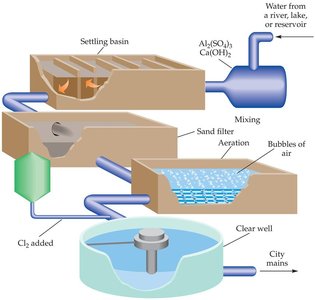
Water treatment begins with the addition of slaked lime (calcium hydroxide) and alum (aluminum sulfate), which form aluminum hydroxide to coagulate particles and bacteria.
Coagulation Reaction:
Filtration: Water is filtered through sand and gravel; charcoal removes odors.
Aeration: Improves taste.

Chemical Disinfection
Chlorine is added to kill bacteria, and ozone may be used for additional disinfection. Ultraviolet (UV) light is effective for small-scale applications but does not provide residual protection.
Fluoridation
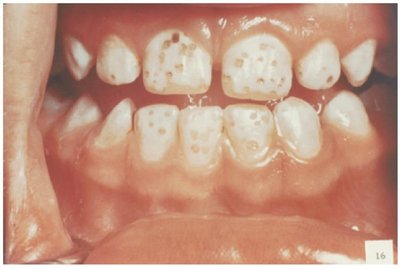
Fluoride is added to municipal water supplies to prevent tooth decay. Excessive fluoride can discolor teeth.
Fluoridation Reaction:
Concentration: 0.7–1.0 ppm fluoride is added.
Effect: Reduces dental caries by 50–70%.

Wastewater Treatment
Primary Treatment
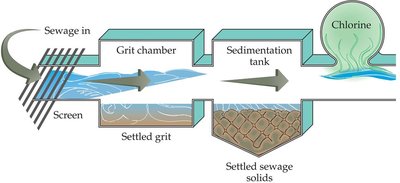
Sewage is held in settling ponds to allow solids to precipitate as sludge.
Secondary Treatment
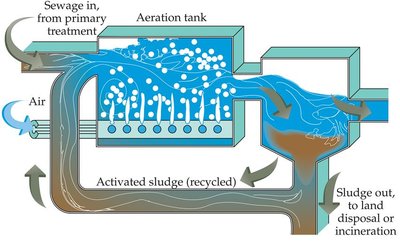
Effluent from primary treatment is filtered through sand and gravel, and aerobic bacteria break down organic matter. The activated sludge method uses aeration tanks to further treat sewage.
Tertiary Treatment
Tertiary treatment includes charcoal filtration, reverse osmosis, further filtration, and distillation to remove remaining contaminants.
Alternative Systems: Sludge can be used as fertilizer; marshes and composting toilets are sustainable options.
Additional info: Expanded explanations and context were added to ensure completeness and academic quality for introductory chemistry students.
