 Back
BackQuantitative Composition of Compounds: The Mole, Molar Mass, Percent Composition, Empirical and Molecular Formulas
Study Guide - Smart Notes
 Tailored notes based on your materials, expanded with key definitions, examples, and context.
Quantitative Composition of Compounds
The Mole
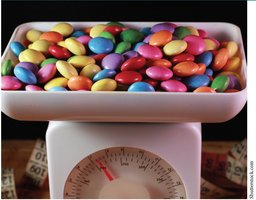
The concept of the mole is fundamental in chemistry for quantifying atoms, molecules, or ions. Because individual atoms are extremely small and have minuscule masses, chemists use the mole as a convenient counting unit, similar to how items like fruit are counted by weighing.
Definition: 1 mole = objects (Avogadro's number).
Applications: Moles can describe elements, molecules, or electrons.
Conversion: Avogadro’s number is used as a conversion factor between the number of particles and moles.
Example: 1 mol of atoms = atoms; 1 mol of molecules = molecules.
Analogy: Counting candies by weighing is similar to counting atoms by mass.
Moles and Mass
One mole of any element contains the same number of atoms, but the mass varies depending on the element. The mass of 1 mole of an element is defined as the amount containing the same number of particles as exactly 12 g of carbon-12 ().
Atomic Mass: Different elements have different atomic masses, so 1 mole of each element has a unique mass.
Example: 12 quarters do not weigh the same as 12 dimes, just as 1 mole of lead does not weigh the same as 1 mole of hydrogen.
Molar Mass of Compounds
Molar Mass
Molar mass is the mass (in grams) of one mole of a substance, whether an element or a compound. It is calculated by summing the atomic masses of all atoms in the formula unit.
Formula: Molar mass (MM) = sum of atomic masses of all atoms in the compound.
Example: For water ():
Significant Figures: Molar masses are typically expressed to four significant figures.
Molar Mass in the Laboratory
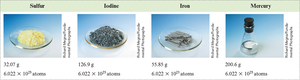
Different elements have different molar masses, which correspond to the mass of atoms of each element.
Element | Molar Mass (g) | Number of Atoms |
|---|---|---|
Sulfur | 32.07 | |
Iodine | 126.9 | |
Iron | 55.85 | |
Mercury | 200.6 |
Conversions Using Molar Mass
Molar mass is used as a conversion factor between grams and moles. The process involves:
Converting grams to moles:
Converting moles to grams:
Converting moles to number of particles:
Example: To find the number of atoms in a given mass, use two conversion factors: grams to moles, then moles to atoms.
Percent Composition of Compounds
Percent Composition
Percent composition is the mass percent of each element in a compound. It is independent of sample size and can be determined from the compound’s formula or experimental data.
Formula:
Example: For , calculate the percent composition of oxygen:
Step 1: Calculate molar mass of
Step 2:
Percent Composition from Experimental Data
Percent composition can also be determined experimentally by measuring the masses of elements that react to form a compound.
Formula:
Example: If 1.63 g Zn reacts with 0.40 g O to form ZnO, total mass = 2.03 g. Percent Zn = ; Percent O = .
Empirical and Molecular Formulas
Empirical Formula
The empirical formula is the simplest whole-number ratio of atoms in a compound. The molecular formula gives the actual number of atoms in one molecule or formula unit and is a whole-number multiple of the empirical formula.
Example: Acetylene () and Benzene () both have the empirical formula CH.
Compounds with the same empirical formula have the same percent composition.
Calculating Empirical Formulas
To determine the empirical formula:
Assume a starting mass (usually 100.0 g) and express the mass of each element.
Convert grams to moles using molar mass.
Divide each mole amount by the smallest value to get subscripts.
If fractions result, multiply by a common factor to obtain whole numbers.
Example: A compound with 11.19% H and 88.79% O yields the empirical formula .
Calculating Molecular Formulas
If the molar mass is known, the molecular formula can be calculated from the empirical formula.
Formula:
Find by dividing the molar mass of the compound by the molar mass of the empirical formula:
Example: If empirical formula is and molar mass is 92.00 g, then , so molecular formula is .
Summary Table: Empirical and Molecular Formulas
Compound | Empirical Formula | Molecular Formula |
|---|---|---|
Acetylene | CH | C2H2 |
Benzene | CH | C6H6 |
Propylene | CH2 | C3H6 |
Nitrogen Compound | NH2 | N2H4 |
Carbon Compound | CH3 | C2H6 |
Learning Objectives
Apply the concept of the mole, molar mass, and Avogadro’s number to solve chemistry problems.
Calculate the molar mass of a compound.
Calculate the percent composition of a compound from its chemical composition and from experimental data.
Determine the empirical formula for a compound from its percent composition.
Compare an empirical formula to a molecular formula and calculate a molecular formula from an empirical formula, using the molar mass.
