 Back
BackSolutions and Colloids: Structure, Properties, and Calculations
Study Guide - Smart Notes
 Tailored notes based on your materials, expanded with key definitions, examples, and context.
Solutions and Colloids
Types of Solutions
Solutions are homogeneous mixtures composed of a solvent and one or more solutes. The solvent is the component present in the greater amount, while the solute is dissolved in the solvent. Solutions can exist in various physical states depending on the nature of the solute and solvent.
Gas in Liquid: Example: Carbonated water
Liquid in Liquid: Example: Wine
Solid in Liquid: Example: Salt water
Gas in Gas: Example: Air
Solid in Solid: Example: 14-carat gold
Solute | Solvent | Example |
|---|---|---|
Gas | Liquid | Carbonated water |
Liquid | Liquid | Wine |
Solid | Liquid | Salt water |
Gas | Gas | Air |
Solid | Solid | 14-carat gold |
Characteristics of Solutions
The distribution of particles is uniform.
Components do not separate on standing.
Cannot be separated by filtration.
Solutions can have various compositions for a given solute-solvent pair.
Usually transparent (except solid solutions).
Separation into pure components is a physical change.
Solubility
Definition and Types
Solubility is the maximum amount of solute that dissolves in a given amount of solvent at a specific temperature. Solubility is a physical constant and varies for each solute-solvent pair.
Saturated Solution: Contains the maximum amount of solute at equilibrium.
Unsaturated Solution: Contains less than the maximum solute.
Supersaturated Solution: Contains more than the equilibrium amount; excess solute will precipitate if disturbed.
Example: If 0.32 g of aspartic acid is dissolved in 115.0 mL of water and a white powder forms after two days, the solution became saturated as water evaporated, causing excess aspartic acid to precipitate.


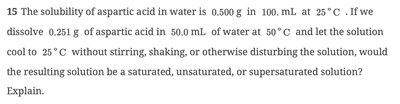
Example: Dissolving 0.251 g aspartic acid in 50.0 mL water at 50°C and cooling to 25°C without disturbance results in a supersaturated solution, as the solubility at 25°C is 0.250 g/50.0 mL.

Factors Affecting Solubility
Nature of Solvent and Solute: "Like dissolves like"—polar solutes dissolve in polar solvents, nonpolar in nonpolar.
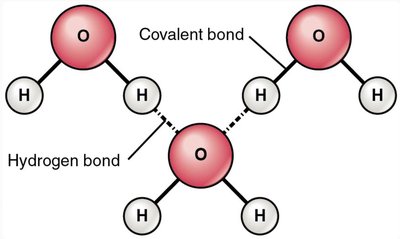
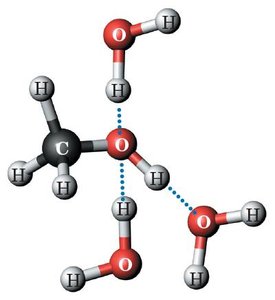
Hydrogen Bonding: Molecules with O, N, or F atoms can form hydrogen bonds, increasing solubility in water.
Temperature and Pressure Effects
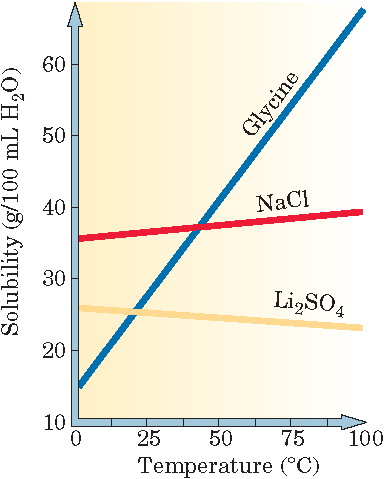
Temperature: Solubility of solids in liquids generally increases with temperature; for gases, it decreases.
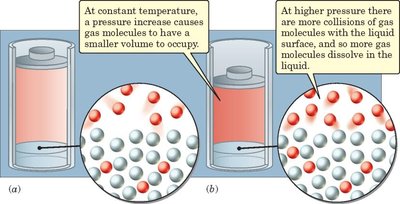
Pressure: Has little effect on solids/liquids, but increases gas solubility in liquids (Henry's Law).
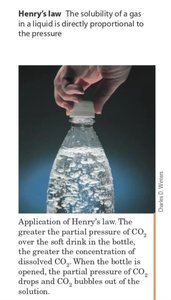
Concentration of Solutions
Percent Composition
Weight/Volume Percent (w/v):
Weight/Weight Percent (w/w):
Volume/Volume Percent (v/v):
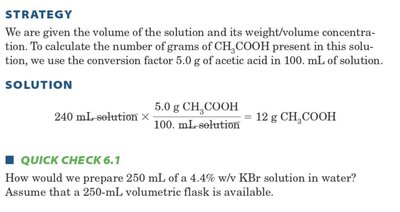
Example: 5.0% w/v acetic acid in 240 mL vinegar contains 12 g acetic acid.

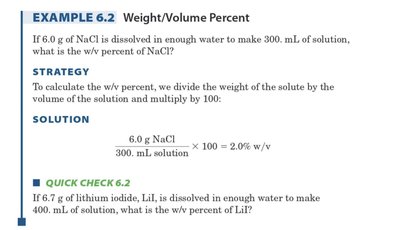
Example: 6.0 g NaCl in 300 mL solution is 2.0% w/v.
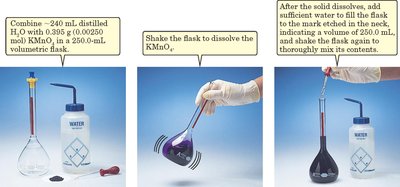
Molarity (M)
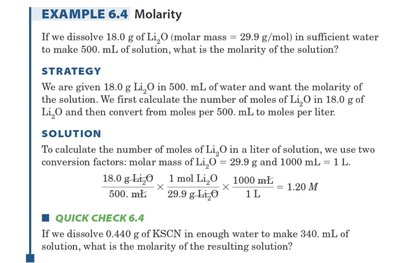
Molarity is the number of moles of solute per liter of solution.
Example: 18.0 g Li2O (molar mass = 29.9 g/mol) in 500 mL water gives 1.20 M solution.
Dilution of Solutions
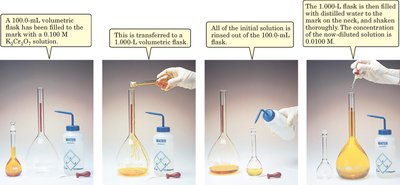
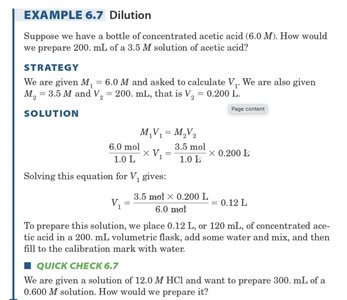
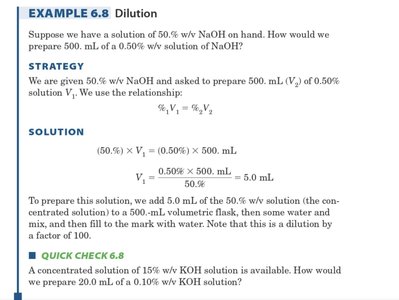
When diluting a solution, the number of moles of solute remains constant:
Example: To prepare 200 mL of 3.5 M acetic acid from 6.0 M stock, use 120 mL of stock and dilute to 200 mL.

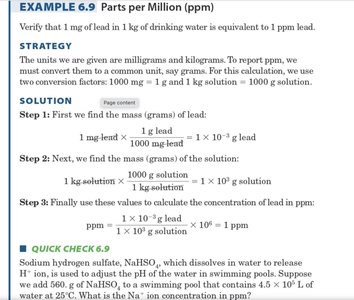
Parts per Million (ppm) and Parts per Billion (ppb)
Used for very dilute solutions:
Water as a Solvent
Dissolving Ionic Compounds
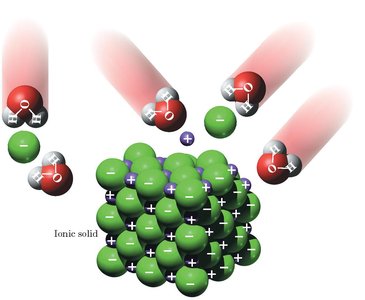
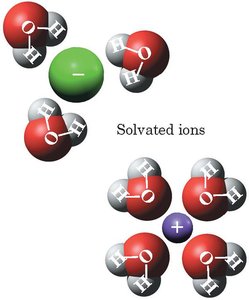
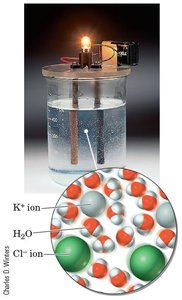
Water, a polar molecule, dissolves ionic solids by surrounding ions with water molecules (hydration), preventing them from recombining.
Dissolving Covalent Compounds
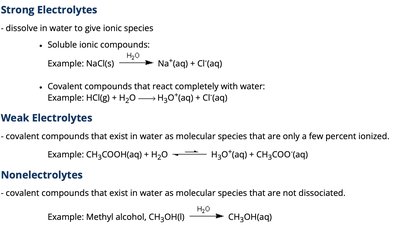
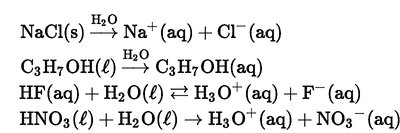
Some covalent compounds react with water (e.g., HCl, SO3), while others (e.g., methanol) are simply solvated without reaction.


Electrolytes
Types of Electrolytes
Strong Electrolytes: Completely dissociate into ions (e.g., NaCl, HCl).
Weak Electrolytes: Partially dissociate (e.g., CH3COOH).
Nonelectrolytes: Do not dissociate (e.g., CH3OH).
Colloids and Suspensions
Colloids
Colloids are mixtures with particle sizes between 1 nm and 1000 nm. They do not settle out and exhibit the Tyndall effect (scattering of light).
Type | Example |
|---|---|
Gas in liquid | Whipped cream |
Liquid in liquid | Milk, mayonnaise |
Solid in liquid | Jelly |
Solid in solid | Dried paint |
Suspensions have larger particles (>1000 nm) and will settle out.
Properties of Mixtures
Property | Solutions | Colloids | Suspensions |
|---|---|---|---|
Particle size (nm) | 0.1–1.0 | 1–1000 | >1000 |
Filterable | No | No | Yes |
Homogeneous | Yes | Borderline | No |
Settles on standing | No | No | Yes |
Behavior to light | Transparent | Tyndall effect | Translucent/opaque |
Colligative Properties
Freezing Point Depression
The freezing point of a solvent decreases when a solute is dissolved in it. The decrease depends only on the number of solute particles, not their identity.
Kf for water: 1.86 °C/mol particles

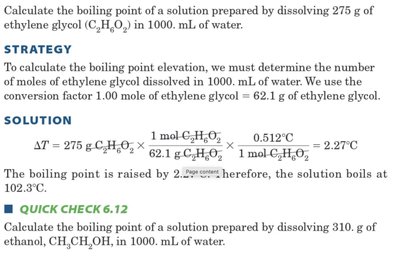
Boiling Point Elevation
The boiling point of a solvent increases when a solute is dissolved in it.
Kb for water: 0.512 °C/mol particles

Osmosis and Osmotic Pressure
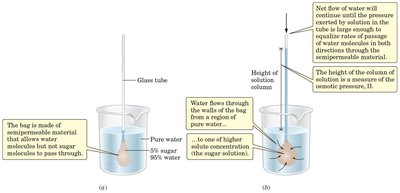
Osmosis is the movement of solvent through a semipermeable membrane from lower to higher solute concentration. Osmotic pressure is the pressure required to stop osmosis.
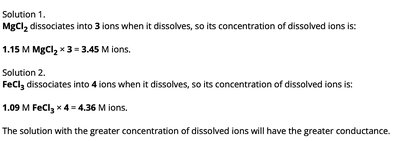
Osmolarity: (where i is the number of particles per formula unit)
Biological Importance of Osmosis
Isotonic Solution: Same osmolarity as blood plasma; no net water movement.
Hypotonic Solution: Lower osmolarity; cells swell and may burst (hemolysis).
Hypertonic Solution: Higher osmolarity; cells shrink (crenation).
Dialysis
Dialysis uses a membrane that allows small solute and solvent molecules to pass but retains larger molecules. Hemodialysis is a medical application for patients with kidney failure.
Additional info: This summary covers the essential concepts of solutions and colloids, including their types, properties, calculations, and biological relevance, as required for an introductory college chemistry course.
