 Back
BackSolutions: Concentration Calculations and Dilution in Chemistry
Study Guide - Smart Notes
 Tailored notes based on your materials, expanded with key definitions, examples, and context.
Solutions and Their Concentrations
Electrolyte Concentration Calculations
Electrolyte concentrations in solutions are often measured in equivalents (Eq) or milliequivalents (mEq), especially in biological and medical contexts. The calculation of moles of ions from a given volume and concentration involves several conversion factors.
Given: Volume of solution and concentration in mEq/L
Need: Moles of the ion (e.g., Ca2+)
Connect: Use the relationships: 1 Eq = 1000 mEq, and for Ca2+, 1 mole = 2 Eq

The calculation plan involves converting liters of solution to moles of Ca2+ using the provided concentration and conversion factors.

Key conversion factors:
1 L solution = 8.8 mEq Ca2+
1 Eq = 1000 mEq
1 mole Ca2+ = 2 Eq Ca2+
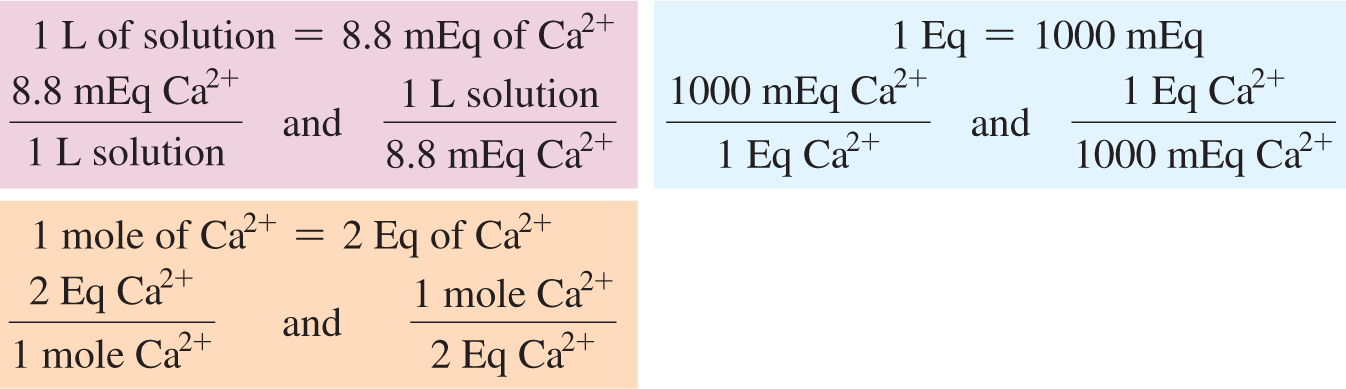
Calculation:

Example: Calculating moles of Ca2+ in a blood sample using mEq/L.
Saturated Solutions and Solubility
The solubility of a compound in water determines how much of it can dissolve at a given temperature. If more solute is added than can dissolve, the solution is saturated and excess solute remains undissolved.
Given: Mass of solute and solvent, solubility data
Need: Maximum mass that can dissolve, and whether the solution is saturated
Calculation:

Example: If 75 g KCl is added to 200 g water at 20°C, only 68 g dissolves; the solution is saturated and 7 g remains undissolved.
Mass Percent (m/m) Concentration
Mass percent expresses the concentration of a solution as the mass of solute divided by the total mass of solution, multiplied by 100%.
Given: Mass of solute and solvent
Need: Mass percent (m/m)
Connect:

Formula:

Example calculation:

Using Mass Percent to Calculate Mass of Solute
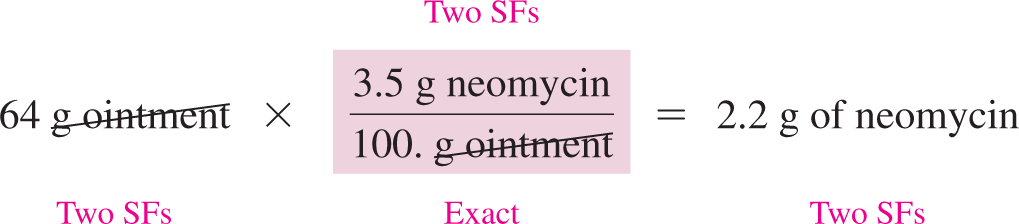
To find the mass of solute in a given mass of solution, use the mass percent as a conversion factor.
Given: Mass of solution and mass percent
Need: Grams of solute
Connect:

Example calculation:
Volume Percent (v/v) Concentration
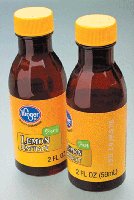
Volume percent is used for solutions where both solute and solvent are liquids. It is calculated as the volume of solute divided by the total volume of solution, multiplied by 100%.
Given: Volume of solute and solution
Need: Volume percent (v/v)
Connect:

Example calculation:

Mass/Volume Percent (m/v) Concentration
Mass/volume percent is commonly used in medical and laboratory settings, expressing the mass of solute per 100 mL of solution.
Given: Mass of solute and volume of solution
Need: Mass/volume percent (m/v)
Connect:

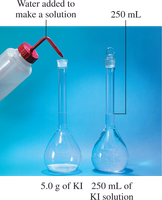
Example calculation:

Using Mass/Volume Percent to Calculate Mass of Solute
To determine the mass of solute in a given volume of solution, use the (m/v) percent as a conversion factor.
Given: Volume of solution and (m/v) percent
Need: Grams of solute
Connect:

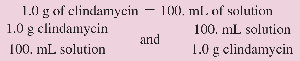
Example calculation:
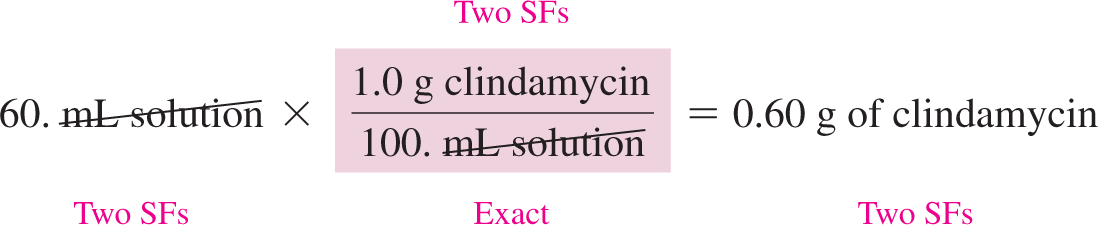
Molarity (M) Calculations
Molarity is a measure of concentration, defined as moles of solute per liter of solution. It is widely used in chemistry for solution preparation and stoichiometric calculations.
Given: Mass of solute and volume of solution
Need: Molarity (M)
Connect: Use molar mass to convert grams to moles, then divide by liters of solution

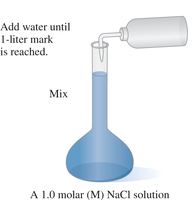
Example calculation:

Using Molarity to Calculate Volume of Solution
To find the volume of solution needed to provide a specific mass of solute, use the molarity and molar mass as conversion factors.
Given: Mass of solute and molarity
Need: Volume of solution
Connect: Use molar mass to convert grams to moles, then use molarity to convert moles to liters


Example calculation:

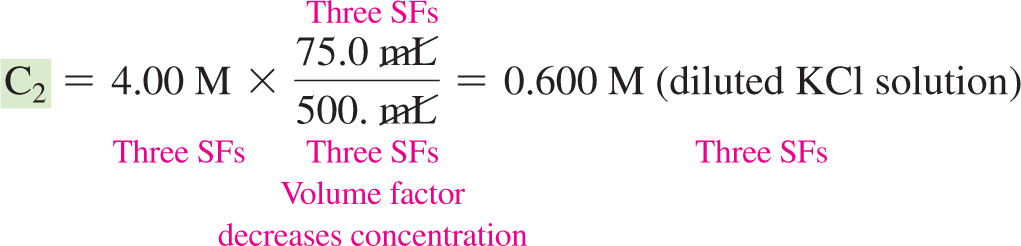
Molarity of a Diluted Solution
Dilution involves adding solvent to a solution, decreasing its concentration. The relationship is given by , where is concentration and is volume.
Given: Initial concentration and volume, final volume
Need: Final concentration
Connect:

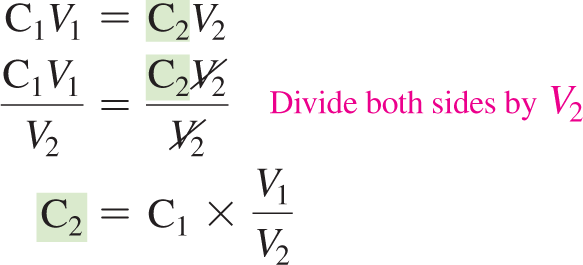
Example calculation:
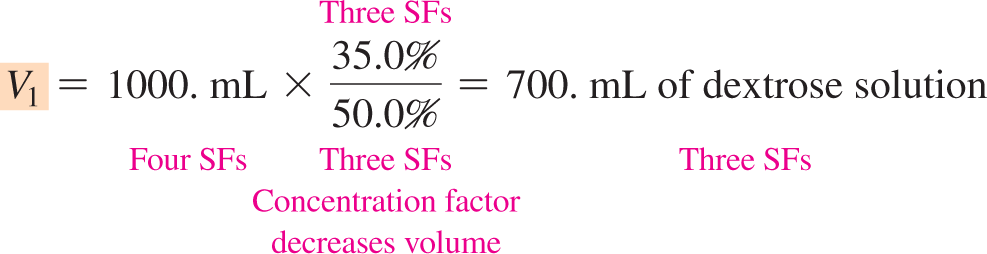
Dilution of a Solution (Percent Concentration)
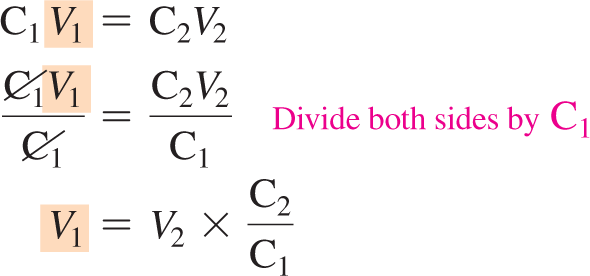
When diluting solutions with concentrations expressed as percent (m/v), the same dilution equation applies: .
Given: Initial and final concentrations, final volume
Need: Initial volume required
Connect:

Example calculation:
Summary Table: Common Concentration Units
Unit | Expression | Typical Use |
|---|---|---|
Mass percent (m/m) | grams solute / grams solution × 100% | Solid in solid/liquid |
Volume percent (v/v) | mL solute / mL solution × 100% | Liquid in liquid |
Mass/volume percent (m/v) | grams solute / mL solution × 100% | Medical/lab solutions |
Molarity (M) | moles solute / liters solution | Chemical reactions |
