 Back
BackStoichiometry and Chemical Equation Calculations: Study Notes
Study Guide - Smart Notes
 Tailored notes based on your materials, expanded with key definitions, examples, and context.
Chemical Equation Calculations
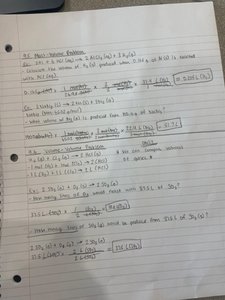
Stoichiometry: Mass-Mass Problems
Stoichiometry is the calculation of reactants and products in chemical reactions using balanced equations. Mass-mass problems involve determining the mass of a product or reactant from a given mass of another substance.
Definition: Stoichiometry uses the quantitative relationships between substances as described by a balanced chemical equation.
Key Steps:
Write the balanced chemical equation.
Convert the given mass to moles using molar mass.
Use the mole ratio from the equation to find moles of the desired substance.
Convert moles of the desired substance to mass using its molar mass.
Example: If 4.5 g of AgNO3 reacts with excess NaCl, how many grams of AgCl are produced?
Balanced equation: AgNO3 + NaCl → AgCl + NaNO3
Step 1: Convert 4.5 g AgNO3 to moles:
Step 2: Use mole ratio (1:1):
Step 3: Convert moles AgCl to grams:
Stoichiometry: Mass-Mass Problems with Limiting Reactant
When two reactants are given, the limiting reactant determines the maximum amount of product formed. The limiting reactant is the substance that is completely consumed first.
Definition: The limiting reactant is the reactant that limits the amount of product formed in a chemical reaction.
Key Steps:
Calculate moles of each reactant.
Determine which reactant produces less product (the limiting reactant).
Use the limiting reactant to calculate the mass of product.
Example: If 25.0 g of Na2CO3 reacts with 25.0 g of AgNO3, how many grams of Ag2CO3 are produced?
Balanced equation: 2 AgNO3 + Na2CO3 → Ag2CO3 + 2 NaNO3
Step 1: Convert masses to moles:
Step 2: Use mole ratios to determine limiting reactant:
From equation: 2 mol AgNO3 : 1 mol Na2CO3
Calculate possible moles of Ag2CO3 from each reactant:
AgNO3:
Na2CO3:
AgNO3 produces less product, so it is the limiting reactant.
Step 3: Calculate mass of Ag2CO3:
Summary Table: Steps for Mass-Mass Stoichiometry Problems
This table summarizes the main steps for solving mass-mass stoichiometry problems.
Step | Description |
|---|---|
1 | Write the balanced chemical equation |
2 | Convert given mass to moles using molar mass |
3 | Use mole ratio to find moles of desired substance |
4 | Convert moles of desired substance to mass |
5 | If two reactants are given, determine the limiting reactant |
Additional info:
These notes are directly relevant to Chapter 9: Chemical Equation Calculations and Chapter 8: The Mole Concept. The examples and stepwise approach are standard for introductory chemistry courses.
