 Back
BackStoichiometry, Limiting Reactants, and Enthalpy in Chemical Reactions
Study Guide - Smart Notes
 Tailored notes based on your materials, expanded with key definitions, examples, and context.
Stoichiometry in Chemical Reactions
Understanding Stoichiometry
Stoichiometry is the quantitative study of reactants and products in a chemical reaction. It allows chemists to predict the amounts of substances consumed and produced in a given reaction, based on the balanced chemical equation.
Stoichiometric coefficients in a balanced equation indicate the ratio of moles of each substance involved.
These ratios can be used to convert between moles of reactants and products.
Stoichiometry is analogous to recipes in cooking, where specific amounts of ingredients yield a certain amount of product.
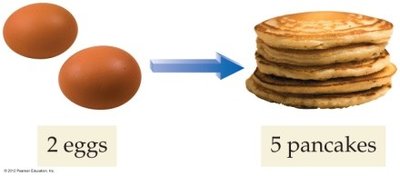
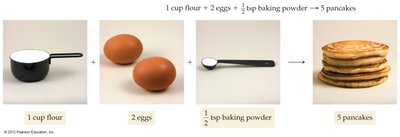

Additional info: The pancake recipe analogy helps visualize how fixed ratios of reactants yield products, just as in chemical equations.
Stoichiometric Calculations with Chemical Equations
Balanced chemical equations provide the mole-to-mole relationships necessary for stoichiometric calculations.
Example: The synthesis of ammonia is represented by the equation:
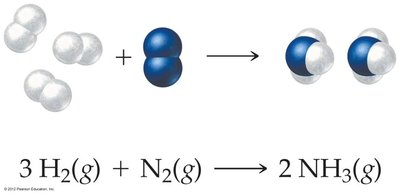
Given 3 mol of N2 and excess H2, the amount of NH3 produced can be calculated using the mole ratio from the balanced equation.
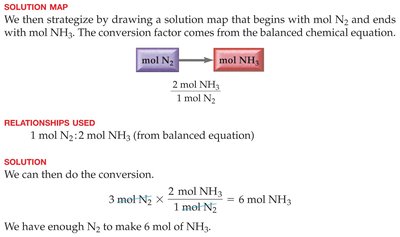
Example Calculation:
Mass Relationships in Chemical Reactions
Often, stoichiometry involves converting between mass and moles using molar mass, and then applying mole ratios from the balanced equation.
General steps:
Convert mass of reactant to moles using molar mass.
Use the mole ratio from the balanced equation to find moles of product.
Convert moles of product to mass using molar mass.


Example: Combustion of Octane
Consider the combustion of octane:
To find the mass of CO2 produced from a given mass of octane, follow the solution map:


Example Calculation:
Limiting Reactant, Theoretical Yield, and Percent Yield
Key Definitions
Limiting reactant (or limiting reagent): The reactant that is completely consumed first, thus limiting the amount of product formed.
Theoretical yield: The maximum amount of product that can be formed from the limiting reactant.
Actual yield: The amount of product actually obtained from the reaction.
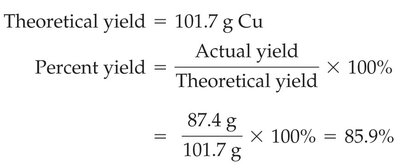
Percent yield: The ratio of actual yield to theoretical yield, expressed as a percentage.
Percent yield formula:
Example: Copper Extraction
Given: 11.5 g Cu2O and 114.5 g C react to form Cu and CO.
Find the limiting reactant and theoretical yield of Cu.
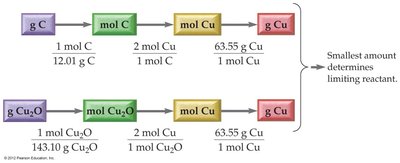
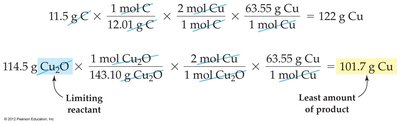
Calculation:
The limiting reactant is Cu2O, producing 101.7 g Cu (theoretical yield).
If the actual yield is 87.4 g Cu, then:
Limiting Reactant Analogy
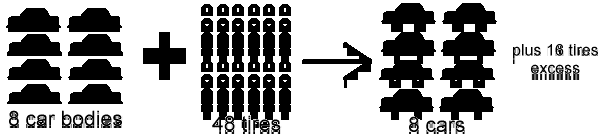
Limiting reactants can be understood using analogies, such as assembling cars from car bodies and tires. The component that runs out first limits the number of complete cars that can be made.
Enthalpy and Energy in Chemical Reactions
Enthalpy (ΔH) and Heat Flow
Enthalpy is a measure of the heat evolved or absorbed in a chemical reaction at constant pressure.
Exothermic reactions: Release heat to the surroundings; ΔH is negative.
Endothermic reactions: Absorb heat from the surroundings; ΔH is positive.
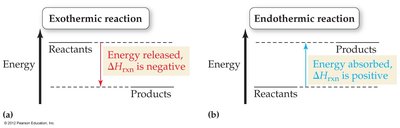
Example: Combustion of methane is exothermic, releasing 802.3 kJ per mole of CH4 reacted.
Stoichiometry Involving Enthalpy (ΔHrxn)
Thermochemical equations relate the amount of heat evolved or absorbed to the amount of reactant consumed or product formed.
Example: Complete combustion of propane
Given 1.18 × 10⁴ g of propane, calculate the heat evolved.
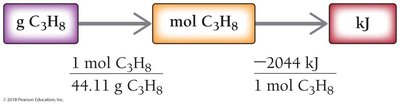
Calculation:

Additional info: The negative sign indicates heat is released (exothermic reaction).
