 Back
BackStudy Guide: Properties Affected by Intermolecular Forces (IMF)
Study Guide - Smart Notes
 Tailored notes based on your materials, expanded with key definitions, examples, and context.
Q1. Which of the following do liquids and gases have in common?
Background
Topic: States of Matter & Intermolecular Forces
This question tests your understanding of the properties shared by liquids and gases, particularly in relation to intermolecular forces and particle movement.
Key Terms:
Liquids: Have definite volume but no definite shape; particles are close but can move past each other.
Gases: Have neither definite shape nor volume; particles are far apart and move freely.
Intermolecular Forces (IMF): Forces between molecules that affect physical properties.
Step-by-Step Guidance
Review the basic properties of liquids and gases, focusing on particle movement and arrangement.
Consider which properties (e.g., ability to flow, compressibility, definite volume) are shared by both states.
Recall that both liquids and gases can flow, but only gases are easily compressed.
Think about how intermolecular forces differ between liquids and gases and how this affects their properties.
Try solving on your own before revealing the answer!
Q2. Water changes from liquid to gas at 100°C. What does this tell you about the intermolecular forces in water?
Background
Topic: Boiling Point & Intermolecular Forces
This question is about how the boiling point of a substance relates to the strength of its intermolecular forces.
Key Terms and Concepts:
Boiling Point: The temperature at which a liquid turns into a gas.
Hydrogen Bonding: A strong type of intermolecular force present in water.
IMF Strength: Higher boiling points indicate stronger intermolecular forces.
Step-by-Step Guidance
Recall that water has a relatively high boiling point compared to similar-sized molecules.
Think about what types of intermolecular forces are present in water (e.g., hydrogen bonding).
Consider how the strength of these forces affects the energy required to change water from liquid to gas.
Relate the boiling point to the strength of the intermolecular forces present.
Try solving on your own before revealing the answer!
Q3. List the types of intermolecular forces in order of increasing strength.
Background
Topic: Types of Intermolecular Forces
This question asks you to rank the different types of intermolecular forces from weakest to strongest.
Key Terms:
London Dispersion Forces (LDF): Weakest IMF, present in all molecules.
Dipole-Dipole Forces: Occur between polar molecules.
Hydrogen Bonding: Strong IMF, occurs when H is bonded to N, O, or F.
Ionic Bonds: Strongest, between ions.
Step-by-Step Guidance
List all the types of intermolecular forces you know.
Recall which types are present in all molecules and which require specific conditions (e.g., polarity, H bonded to N/O/F).
Arrange the forces from weakest to strongest based on their typical effects on boiling/melting points.
Think about examples of substances that exhibit each type of force.
Try solving on your own before revealing the answer!
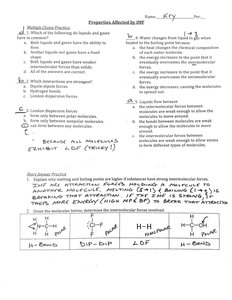
Q4. For each molecule, identify the type of intermolecular force present.
Background
Topic: Molecular Polarity & Intermolecular Forces
This question tests your ability to determine the type of intermolecular force present in a molecule based on its structure and polarity.
Key Terms:
Polarity: Whether a molecule has a net dipole moment.
IMF Types: LDF, dipole-dipole, hydrogen bonding, ionic.
Step-by-Step Guidance
Draw or visualize the Lewis structure of each molecule.
Determine if the molecule is polar or nonpolar.
Check for hydrogen atoms bonded to N, O, or F to identify hydrogen bonding.
Assign the correct type of intermolecular force based on your analysis.
Try solving on your own before revealing the answer!
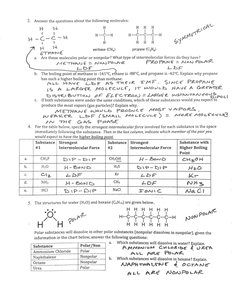
Q5. Why does water (H2O) dissolve ionic and polar substances but not nonpolar substances?
Background
Topic: Solubility & Polarity
This question is about the principle of "like dissolves like" and how water's polarity affects its ability to dissolve different substances.
Key Terms:
Polarity: Water is a polar molecule.
Solubility: Polar solvents dissolve polar and ionic solutes; nonpolar solvents dissolve nonpolar solutes.
Step-by-Step Guidance
Recall the structure and polarity of water.
Think about how water molecules interact with ionic and polar solutes via dipole-dipole and ion-dipole forces.
Consider why nonpolar substances do not dissolve well in water (lack of favorable interactions).
Relate this to the concept of "like dissolves like."
Try solving on your own before revealing the answer!
Final Answers
Q1: Both liquids and gases have the ability to flow.
Q2: Water has strong intermolecular forces (hydrogen bonding), which is why its boiling point is high.
Q3: LDF < Dipole-Dipole < Hydrogen Bonding < Ionic Bonds (increasing strength).
Q4: Assignments depend on the molecule; for example, H2O has hydrogen bonding, CH4 has LDF, etc.
Q5: Water dissolves ionic and polar substances due to its polarity and ability to form strong interactions, but not nonpolar substances.
Each answer is based on the principles of intermolecular forces and molecular polarity.
