 Back
BackStudy Guide: Properties Affected by Intermolecular Forces (IMF)
Study Guide - Smart Notes
 Tailored notes based on your materials, expanded with key definitions, examples, and context.
Q1. Which of the following is true about liquids and gases in terms of intermolecular forces?
Background
Topic: States of Matter & Intermolecular Forces
This question tests your understanding of how intermolecular forces affect the properties of liquids and gases, such as their ability to flow and take the shape of their container.
Key Terms:
Intermolecular Forces (IMF): Forces of attraction between molecules.
Liquids: Have definite volume but take the shape of their container.
Gases: Have neither definite shape nor volume; they fill their container.
Step-by-Step Guidance
Recall the main differences between liquids and gases in terms of molecular arrangement and movement.
Think about how intermolecular forces influence the ability of a substance to flow and take the shape of its container.
Consider which state (liquid or gas) has stronger intermolecular forces and how that affects their properties.
Review the definitions of liquid and gas to match them with the correct statement.
Try solving on your own before revealing the answer!
Final Answer: Both liquids and gases have the ability to flow and take the shape of their container.
Liquids have stronger intermolecular forces than gases, but both can flow and adapt to the shape of their container.
Q2. What happens to water when it changes from liquid to gas?
Background
Topic: Phase Changes & Intermolecular Forces
This question is about the process of vaporization and how intermolecular forces are involved when water changes from liquid to gas.
Key Terms:
Vaporization: The process of a liquid turning into a gas.
Intermolecular Forces: Must be overcome for molecules to escape from the liquid phase.
Step-by-Step Guidance
Recall what happens to the molecules of water during vaporization.
Think about the energy required to break intermolecular forces in the liquid phase.
Consider what happens to the arrangement and movement of water molecules as they transition to the gas phase.
Review the role of heat energy in overcoming intermolecular forces.
Try solving on your own before revealing the answer!
Final Answer: The intermolecular forces between water molecules are broken as water changes from liquid to gas.
Energy is absorbed to overcome these forces, allowing molecules to move freely as a gas.
Q3. List and describe the types of intermolecular forces.
Background
Topic: Types of Intermolecular Forces
This question asks you to identify and describe the main types of intermolecular forces that affect the properties of substances.
Key Terms and Formulas:
London Dispersion Forces (LDF): Weak forces present in all molecules due to temporary dipoles.
Dipole-Dipole Forces: Attractions between polar molecules.
Hydrogen Bonding: Strong dipole-dipole interaction involving H bonded to N, O, or F.
Ionic Forces: Attractions between ions in ionic compounds.
Step-by-Step Guidance
List each type of intermolecular force and note which molecules or compounds exhibit them.
Describe the relative strength of each force (LDF < Dipole-Dipole < Hydrogen Bonding < Ionic).
Provide examples of substances that exhibit each type of force.
Explain how these forces affect boiling points and solubility.
Try solving on your own before revealing the answer!
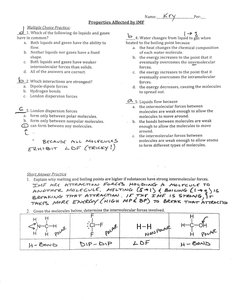
Final Answer: The main types are London Dispersion Forces, Dipole-Dipole Forces, Hydrogen Bonding, and Ionic Forces.
Each type varies in strength and affects physical properties like boiling point and solubility.
Q4. For the molecules shown (e.g., CH4, NH3, H2O, CO2), identify if they are polar or nonpolar and the type of intermolecular force they exhibit.
Background
Topic: Molecular Polarity & Intermolecular Forces
This question tests your ability to determine molecular polarity and match molecules to the correct type of intermolecular force.
Key Terms:
Polar Molecule: Has an uneven distribution of charge.
Nonpolar Molecule: Has an even distribution of charge.
Intermolecular Forces: LDF, Dipole-Dipole, Hydrogen Bonding.
Step-by-Step Guidance
Draw the Lewis structure for each molecule to determine its shape and symmetry.
Assess the electronegativity differences and molecular geometry to decide if the molecule is polar or nonpolar.
Match each molecule to the correct type of intermolecular force based on its polarity and the presence of H bonded to N, O, or F.
Fill in the table with your findings for each molecule.
Try solving on your own before revealing the answer!
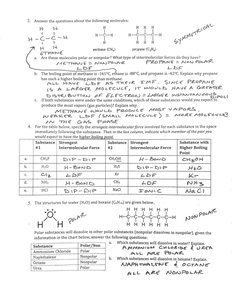
Final Answer: CH4 is nonpolar (LDF), NH3 and H2O are polar (Hydrogen Bonding), CO2 is nonpolar (LDF).
Polarity and the presence of N, O, or F bonded to H determine the type of intermolecular force.
Q5. Why does water (H2O) dissolve ionic and polar substances but not nonpolar substances?
Background
Topic: Solubility & Intermolecular Forces
This question is about the principle of "like dissolves like" and how intermolecular forces affect solubility.
Key Terms:
Polar Substance: Has regions of positive and negative charge.
Nonpolar Substance: Has no significant charge separation.
Solubility: Ability of a substance to dissolve in another.
Step-by-Step Guidance
Recall the "like dissolves like" rule: polar solvents dissolve polar and ionic solutes.
Think about the types of intermolecular forces present in water and in the solute.
Consider why nonpolar substances do not interact favorably with polar water molecules.
Review examples of substances that dissolve in water and those that do not.
Try solving on your own before revealing the answer!
Final Answer: Water dissolves ionic and polar substances due to strong dipole interactions, but does not dissolve nonpolar substances because there is no attraction.
"Like dissolves like"—polar water interacts with polar/ionic solutes, but not with nonpolar ones.
