Indietro
Adaptive Immunity: Structure, Function, and Disorders
Guida di studio - Note intelligenti
 Appunti personalizzati basati sui tuoi materiali, ampliati con definizioni chiave, esempi e contesto.
Adaptive Immunity
Overview of Adaptive Immunity
Adaptive immunity is a specialized defense mechanism that targets specific pathogens and provides long-lasting protection. It is characterized by specificity and memory, allowing the body to respond rapidly upon re-exposure to the same pathogen.
Specificity: Immunity is directed against particular pathogens, ensuring targeted defense.
Memory: Upon re-exposure, the immune system reacts quickly, often preventing noticeable illness.
Types of Adaptive Immunity
Humoral Immunity: Mediated by antibodies produced by B cells.
Cellular Immunity: Mediated by T cells that attack infected or abnormal cells.
Antigens and Antibody Response
Antigens
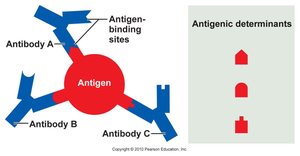
An antigen is any substance that triggers an immune response by prompting the generation of antibodies. The complexity of the molecule influences its antigenicity, with proteins being more antigenic than lipids.
Epitope (Antigenic Determinant): The specific part of an antigen recognized by the immune system; antigens often have multiple epitopes.
B Lymphocytes (B Cells)
Development and Selection
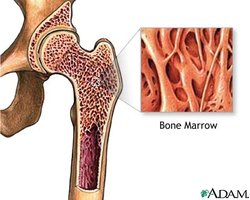
B cells develop in the red bone marrow and undergo selection to ensure they do not react to self-antigens. Those that do are destroyed, and the remaining B cells colonize lymph organs.
Site of Development: Red bone marrow
B Cell Selection: Self-reactive B cells are eliminated to prevent autoimmunity.
B Cell Activation
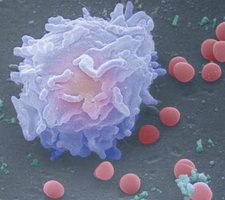
When a B cell encounters its specific antigen, it becomes activated and differentiates into plasma cells (which produce antibodies) and memory B cells (which provide long-term immunity).
Antibody Structure and Classes
Antibody Structure
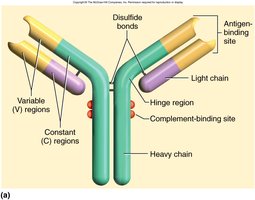
Antibodies, also known as immunoglobulins (Ig), are defensive proteins found in blood plasma and body secretions. Each antibody consists of four polypeptide chains: two heavy and two light chains, forming a Y-shaped molecule.
Variable (V) Regions: Bind to specific antigens.
Constant (C) Regions: Determine the antibody class.
Disulfide Bonds: Stabilize the structure.
Antibody Classes
Antibodies are classified based on their constant regions and functions:
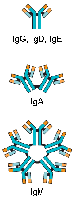
IgG: Monomer; 80% of circulating antibodies; crosses placenta; secondary immune response.
IgD: Monomer; B cell membrane antigen receptor.
IgE: Monomer; on mast cells; stimulates histamine release; attracts eosinophils.
IgA: Monomer in plasma; dimer in secretions; prevents adherence to epithelia.
IgM: Pentamer; 10% in plasma; primary immune response.
Humoral Immunity Responses
Primary and Secondary Responses
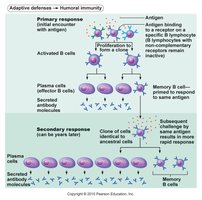
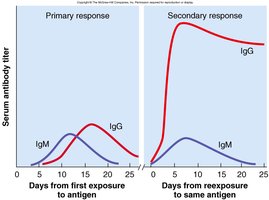
Humoral immunity involves the production of antibodies by B cells. The primary response occurs upon first exposure to an antigen, while the secondary response is faster and stronger due to memory B cells.
Primary Response: Slow, produces memory B cells.
Secondary Response: Rapid, prevents illness.
Mechanisms of Antibody Action
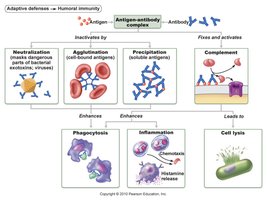
Antibodies neutralize pathogens, agglutinate cells, precipitate soluble antigens, and activate complement, leading to enhanced phagocytosis, inflammation, and cell lysis.
Cellular Immunity
T Cells and Their Functions
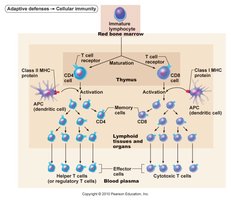
Cellular immunity is mediated by T cells, which attack foreign cells and diseased host cells. There are three main classes of T cells:
Cytotoxic T Cells (Tc, CD8): Carry out direct attacks on infected or abnormal cells.
Helper T Cells (Th, CD4): Promote Tc and B cell action; secrete interleukins to coordinate immune responses.
Memory T Cells (Tm): Provide immunity from future exposure to the same antigen.
Life Cycle of T Cells
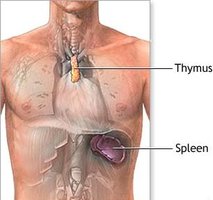
T cells originate from stem cells in the red bone marrow and mature in the thymus. They then colonize lymphatic tissues and organs. Self-reactive T cells are destroyed during maturation.
Antigen Processing and Presentation
Role of Antigen-Presenting Cells (APCs)
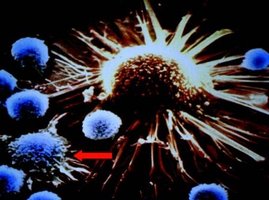
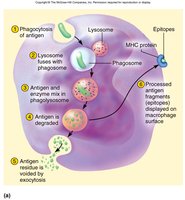
APCs, such as B cells and macrophages, phagocytize antigens and present fragments on their surface in conjunction with Major Histocompatibility Complex (MHC) molecules. This process is essential for T cell activation.
MHC I: Present on all nucleated cells; recognized by cytotoxic T cells.
MHC II: Present on APCs; recognized by helper T cells.
T Cell Activation
Activation and Proliferation
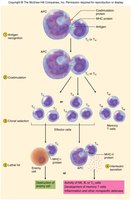
T cells recognize antigens presented by APCs, leading to their activation and proliferation. Cytotoxic T cells directly attack pathogens, while helper T cells secrete interleukins to stimulate other immune cells.
Coordination: Helper T cells coordinate both cellular and humoral immunity.
Immune System Disorders
Hypersensitivity (Allergy)
Hypersensitivity is an exaggerated immune response to harmless antigens, leading to allergic reactions. Anaphylactic shock is a severe, acute allergic reaction that can be life-threatening.
Symptoms: Bronchiole constriction, dyspnea, vasodilation, shock, death.
Treatment: Epinephrine (dilates bronchioles).

Autoimmune Disease
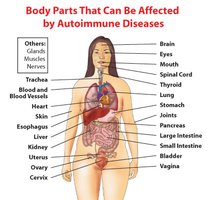
Autoimmune diseases occur when the immune system fails to recognize self-antigens and attacks the body's own tissues. Examples include Type I diabetes mellitus, lupus, and rheumatoid arthritis.
Causes: Cross-reactivity of antibodies, structural changes in self-antigens due to viruses or drugs.
AIDS: Human Immunodeficiency Virus (HIV)
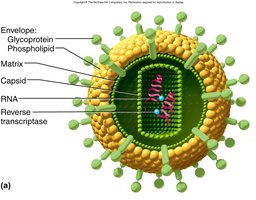
HIV is a virus that primarily invades helper T cells (CD4), leading to a significant reduction in their numbers and resulting in acquired immunodeficiency syndrome (AIDS). Individuals with AIDS are highly susceptible to infections.
Normal TH Count: 600–1,200 cells/μL blood
AIDS TH Count: < 200 cells/μL blood