 Indietro
Blood: Structure, Function, and Clinical Relevance
Guida di studio - Note intelligenti
 Appunti personalizzati basati sui tuoi materiali, ampliati con definizioni chiave, esempi e contesto.
Blood: Structure, Function, and Clinical Relevance
Overview of Blood
Blood is a specialized connective tissue essential for the transport of substances, regulation of physiological parameters, and protection against disease. It consists of a liquid matrix called plasma and formed elements, including erythrocytes, leukocytes, and platelets.
Functions of Blood
Transport: Delivers oxygen and nutrients to cells, removes metabolic wastes, and transports hormones.
Regulation: Maintains body temperature, pH balance, and fluid volume.
Protection: Prevents blood loss through clotting and combats infection via immune cells and proteins.
Physical Characteristics and Volume
Blood is a sticky, opaque fluid with a metallic taste.
Color varies with oxygen content: scarlet red (high O2) to dark red (low O2).
Normal pH: 7.35–7.45.
Accounts for ~8% of body weight; average volume is 5–6 L in males and 4–5 L in females.
Composition of Blood
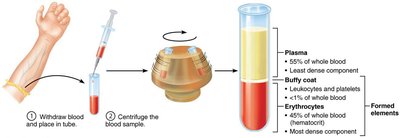
Blood consists of plasma (the liquid matrix) and formed elements (cells and cell fragments).
Plasma: ~55% of blood volume; mainly water, proteins, nutrients, hormones, and waste products.
Formed Elements: Erythrocytes (red blood cells), leukocytes (white blood cells), and thrombocytes (platelets).
Blood Plasma
Plasma is a straw-colored, sticky fluid that serves as the medium for transporting substances throughout the body.
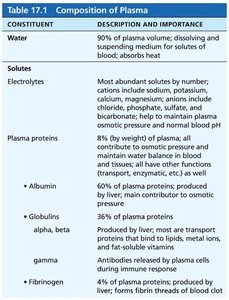
Composed of about 90% water.
Contains over 100 dissolved solutes, including nutrients, gases, hormones, waste products, proteins, and inorganic ions.
Plasma proteins (mainly produced by the liver) are the most abundant solutes and include albumin, globulins, and fibrinogen.
Constituent | Description and Importance |
|---|---|
Water | 90% of plasma volume; dissolving and suspending medium for solutes of blood; absorbs heat |
Electrolytes | Most abundant solutes by number; help maintain plasma osmotic pressure and normal blood pH |
Albumin | 60% of plasma proteins; main contributor to osmotic pressure |
Globulins | 36% of plasma proteins; transport proteins and antibodies |
Fibrinogen | 4% of plasma proteins; forms fibrin threads of blood clot |

Formed Elements of Blood
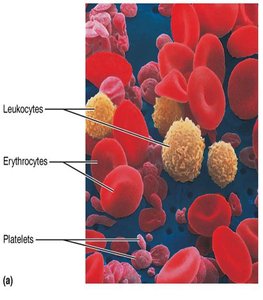
The formed elements include erythrocytes, leukocytes, and platelets. Only leukocytes are complete cells; erythrocytes lack nuclei and organelles, and platelets are cell fragments.
Erythrocytes (RBCs): Specialized for oxygen transport.
Leukocytes (WBCs): Involved in immune defense.
Platelets (Thrombocytes): Essential for blood clotting.

Erythrocytes (Red Blood Cells)
Erythrocytes are small, biconcave, anucleate cells filled with hemoglobin, optimized for gas transport.
Biconcave shape increases surface area for gas exchange.
Hemoglobin constitutes 97% of cell volume and binds reversibly with oxygen.
No mitochondria; do not consume the oxygen they transport.
Normal hemoglobin values: Males 13–18 g/100 ml; Females 12–16 g/100 ml.
Hemoglobin Structure and Function
Each hemoglobin molecule consists of four polypeptide chains (globin) and four heme groups.
Each heme contains an iron atom that binds one O2 molecule; thus, each hemoglobin can carry four O2 molecules.
Oxygen loading in the lungs forms oxyhemoglobin (ruby red); unloading in tissues forms deoxyhemoglobin (dark red).
About 20% of CO2 binds to hemoglobin, forming carbaminohemoglobin.
Hematopoiesis and Erythropoiesis
Hematopoiesis is the process of blood cell formation, occurring in red bone marrow. Erythropoiesis is the specific formation of erythrocytes.
Hematopoietic stem cells give rise to all formed elements.
Hormones (especially erythropoietin, EPO) and dietary factors regulate erythropoiesis.
EPO is produced by the kidneys in response to hypoxia (low oxygen levels).
Testosterone increases EPO production, leading to higher RBC counts in males.
Clinical Measures: Hematocrit and Hemoglobin
Hematocrit is the percentage of blood volume occupied by erythrocytes. It is a key diagnostic measure for anemia and polycythemia.
Normal hematocrit: Males 47% ± 5%; Females 42% ± 5%.
Hemoglobin concentration is also measured to assess oxygen-carrying capacity.
Blood Disorders
Anemia: Abnormally low oxygen-carrying capacity due to blood loss, decreased RBC production, or increased RBC destruction.
Polycythemia: Excess RBCs increase blood viscosity, leading to sluggish flow.
Leukemias: Overproduction of abnormal WBCs; classified by cell type and progression speed.
Bleeding Disorders: Include thrombocytopenia (low platelets), impaired liver function, and hemophilia (hereditary clotting factor deficiencies).
Hemostasis: Prevention of Blood Loss
Hemostasis is a rapid series of events that stop bleeding. It involves three main steps:
Vascular Spasm: Vasoconstriction reduces blood flow after vessel injury.
Platelet Plug Formation: Platelets adhere to exposed collagen, become activated, and aggregate to form a temporary plug.
Coagulation: A cascade of clotting factors leads to the conversion of fibrinogen to fibrin, stabilizing the clot.
Blood Typing and Transfusion
Blood transfusions require compatibility testing to prevent immune reactions. The most clinically significant blood group systems are ABO and Rh.
ABO System: Based on the presence of A and/or B antigens on RBCs. Type O is the universal donor; type AB is the universal recipient.
Rh System: Presence (+) or absence (–) of the D antigen. Rh incompatibility can cause hemolytic disease of the newborn.
Transfusion reactions occur if mismatched blood is given, leading to agglutination and hemolysis.
Diagnostic Blood Tests
Hematocrit and hemoglobin tests for anemia.
Blood glucose for diabetes.
Differential WBC count for infection or immune disorders.
Comprehensive metabolic panel (CMP) and complete blood count (CBC) for overall health assessment.
