 Indietro
Development and Inheritance: Key Concepts in Human Embryology
Guida di studio - Note intelligenti
 Appunti personalizzati basati sui tuoi materiali, ampliati con definizioni chiave, esempi e contesto.
Development and Inheritance
Overview of Development
Development refers to the changes in characteristics and structures that occur from fertilization to maturity. This process involves differentiation, where cells become specialized by turning certain genes on or off, resulting in distinct cell types.
Prenatal development: Occurs before birth and includes embryonic and fetal stages.
Postnatal development: Continues after birth until maturity.
Prenatal Development Stages
Prenatal development is divided into three main stages:
Embryonic development: First two months after fertilization; major organs and structures begin to form.
Fetal development: Week 9 to birth; growth and maturation of organs.
Gestation: The total time spent in prenatal development, divided into trimesters.
Fertilization
Fertilization occurs when two haploid gametes (sperm and oocyte) fuse to form a diploid zygote. The sperm delivers paternal chromosomes, while the oocyte provides maternal chromosomes, organelles, and nourishment.
Capacitation: Sperm undergoes changes in the uterine tube to become capable of fertilizing the oocyte.
Zona pellucida: A thick envelope surrounding the oocyte that sperm must penetrate.
Corona radiata: Layer of cells surrounding the oocyte, which sperm must traverse using acrosomal enzymes.
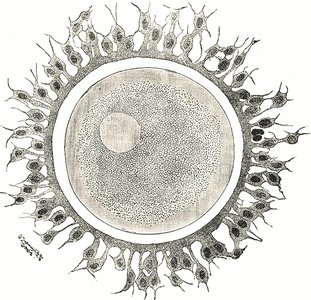
Mechanism of Fertilization
The process of fertilization involves several steps:
Sperm binds to receptors in the zona pellucida.
Acrosomal enzymes digest the zona pellucida, allowing sperm to reach the oocyte membrane.
Fusion of sperm and oocyte membranes triggers oocyte activation, completion of meiosis II, and prevention of polyspermy.
Nuclei of sperm and oocyte fuse to form a zygote, which begins cleavage (cell division).
Oogenesis and Follicle Development
Oogenesis is the process of oocyte formation and maturation within ovarian follicles:
Primordial follicles: Present before puberty.
Primary, secondary, and tertiary follicles: Stages of follicle development leading to ovulation.
Ovulation: Release of the secondary oocyte, which is arrested in metaphase II.
Corpus luteum: Formed from the ruptured follicle; secretes hormones to maintain pregnancy.
Cleavage and Blastocyst Formation
After fertilization, the zygote undergoes cleavage, producing blastomeres:
Morula: A solid ball of cells formed after three days of cleavage.
Blastocyst: A hollow structure with a fluid-filled cavity (blastocoele), an outer trophoblast layer, and an inner cell mass that will become the embryo.
Implantation
Implantation is the process by which the blastocyst embeds in the uterine wall (endometrium). The endometrium reforms over the blastocyst, and chorionic villi extend into the endometrium to facilitate nutrient exchange.
Ectopic pregnancy: Occurs when implantation happens outside the uterus, most commonly in the uterine tubes.
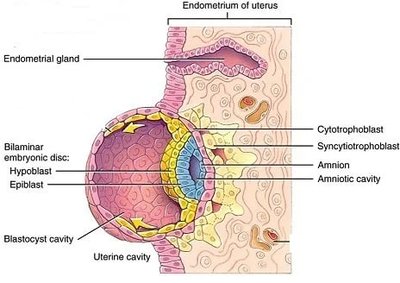
Formation of Embryonic Layers
During the first trimester, the inner cell mass separates from the trophoblast, forming the amniotic cavity. Gastrulation converts the bilayered embryonic disc into a trilayered disc:
Ectoderm: Forms skin and nervous system.
Mesoderm: Forms skeleton, muscles, and blood vessels.
Endoderm: Forms structures associated with the gut tube and urinary system.
Extra-Embryonic Membranes
Several membranes support embryonic development:
Yolk sac: Site for early blood cell formation.
Amnion: Contains amniotic fluid, protecting the embryo.
Allantois: Contributes to bladder formation.
Chorion: Contains blood vessels and forms the placenta.
Placenta and Fetal Circulation
The placenta is a temporary organ that allows for diffusion between maternal and fetal blood. It releases hormones such as human chorionic gonadotropin (hCG), progesterone, and relaxin.
Umbilical arteries: Carry deoxygenated blood from fetus to placenta.
Umbilical vein: Returns oxygenated blood to the fetus.
Ductus venosus: Shunts blood to the liver.
Foramen ovale and ductus arteriosus: Bypass the pulmonary circuit in fetal circulation.
Labor and Childbirth
Labor is the process of childbirth, initiated by hormonal changes:
Dilation stage: Cervix dilates, contractions increase, and amnion ruptures.
Expulsion stage: Cervix fully dilates, contractions reach maximum intensity, and the fetus is delivered.
Placental stage: Placenta detaches and is expelled.
Summary Table: Key Structures and Functions
Structure | Function |
|---|---|
Zona pellucida | Protects oocyte; sperm must penetrate for fertilization |
Corona radiata | Surrounds oocyte; provides additional protection |
Blastocyst | Early embryo; implants in uterus |
Placenta | Exchange of nutrients, gases, and wastes between mother and fetus |
Amnion | Protects embryo in amniotic fluid |
Yolk sac | Early blood cell formation |
Allantois | Contributes to bladder formation |
Chorion | Forms placenta; contains blood vessels |
Additional info: The notes have been expanded to provide academic context and definitions for key terms, as well as a summary table for clarity.
