 Indietro
Immunity: Nonspecific and Specific Defenses in Human Anatomy & Physiology
Guida di studio - Note intelligenti
 Appunti personalizzati basati sui tuoi materiali, ampliati con definizioni chiave, esempi e contesto.
Immunity Overview
Definition and Divisions
Immunity is the body's ability to resist infection and disease, primarily caused by microorganisms such as viruses and bacteria. The immune system is divided into two major types: nonspecific (innate) immunity and specific (adaptive) immunity. Both types work together to protect the body.
Nonspecific Immunity: Provides general defenses against pathogens, does not distinguish between different pathogens, and is present from birth.
Specific Immunity: Targets particular pathogens using lymphocytes, which recognize, respond to, and remember specific antigens.
Nonspecific (Innate) Immunity
Physical Barriers
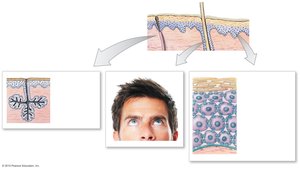
Physical barriers are the first line of defense, preventing pathogens from entering the body. These include the skin, hair, mucous membranes, and surface secretions.
Skin and Hair: Act as mechanical barriers; sweat and sebum create an "acid mantle" that inhibits microbial growth.
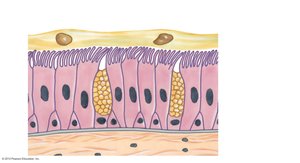
Mucous Membranes: Line various tracts and produce mucus, which traps pathogens. Tight junctions between epithelial cells and underlying fibrous layers reinforce the barrier.
Surface Secretions: Tears and other secretions may contain antibodies and lysozymes, providing additional antimicrobial protection.
Phagocytic Cells
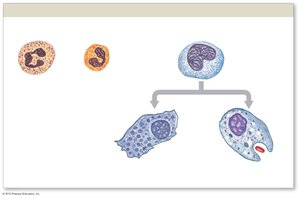
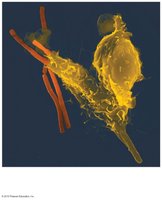
Phagocytes are immune cells that engulf and destroy pathogens and debris. The main types include:
Neutrophils: Most common phagocytes, rapidly respond to infection.
Eosinophils: Less common, assist in phagocytosis, especially in parasitic infections.
Monocytes/Macrophages: Monocytes leave the bloodstream and differentiate into macrophages, which are highly effective at phagocytosis.
Phagocytes are attracted to sites of injury by positive chemotaxis and can exit the bloodstream via diapedesis.
Chemical Mediators
Chemical mediators coordinate immune responses and include:
Histamine and Heparin: Promote inflammation and attract immune cells; released by basophils and mast cells.
Cytokines: Proteins that act as messengers, stimulating inflammation and attracting phagocytes.
Complement System: Plasma proteins that activate in a cascade, triggering inflammation, attracting phagocytes, and forming membrane attack complexes to destroy pathogens.
Interferons: Proteins produced by lymphocytes, macrophages, or infected cells that interfere with viral replication and attract macrophages.
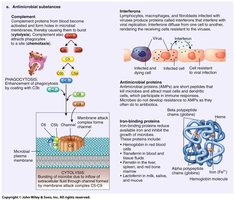
Inflammation and Fever
Inflammation is a localized tissue response to injury, characterized by redness, swelling, heat, and pain. Damaged cells release chemicals that stimulate mast cells to release histamine and heparin, causing vasodilation and increased permeability. Fever is a systemic response, where pyrogens raise body temperature to enhance immune efficiency.
Inflammation: Attracts phagocytes, isolates damaged area, and activates specific defenses.
Fever: Increases metabolism and enzyme efficiency, but prolonged fever can damage proteins.
Specific (Adaptive) Immunity
Lymphocytes and Antigen Presentation
Specific immunity relies on lymphocytes, which constitute 20-40% of circulating white blood cells. They respond to antigens and are classified as:
T Cells: Include cytotoxic T cells (destroy infected cells), helper T cells (activate other immune cells), and suppressor T cells (regulate immune response).
B Cells: Differentiate into plasma cells that produce antibodies.
NK Cells: Natural killer cells patrol tissues and destroy abnormal cells.
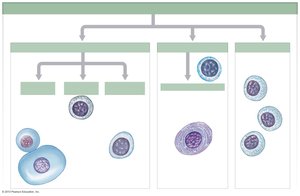
Lymphopoiesis
Lymphocytes originate from hemocytoblasts in red bone marrow. T cells mature in the thymus, B cells and NK cells mature in the bone marrow and migrate to peripheral tissues.
Antigen Presentation
Antigens must be presented to lymphocytes to trigger an immune response. Major histocompatibility complexes (MHCs) display antigens:
MHC I: Present self-antigens; trigger response if cell is infected or abnormal.
MHC II: Present foreign antigens on antigen-presenting cells (APCs) like macrophages and dendritic cells.
Cell-Mediated and Antibody-Mediated Immunity
Cell-Mediated Immunity
Cell-mediated immunity targets intracellular pathogens by destroying infected cells. Cytotoxic T cells recognize antigens presented on MHC I molecules and release chemicals that lyse infected cells.
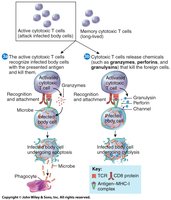
Antibody-Mediated Immunity
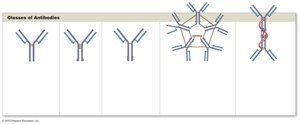
Antibody-mediated immunity targets extracellular pathogens. B cells differentiate into plasma cells, which produce antibodies (immunoglobulins). Antibodies are composed of two pairs of polypeptide chains (light and heavy), with variable segments for specificity and constant segments for immune functions.
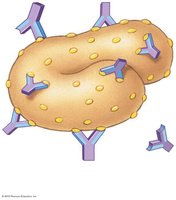
Antibody Functions and Classes
Antibodies neutralize pathogens, prevent adhesion, activate complement, opsonize antigens, agglutinate pathogens, stimulate inflammation, and attract phagocytes. There are several classes of antibodies:
IgG: Provides resistance against viruses, bacteria, and toxins; most abundant.
IgE: Attaches to basophils and mast cells, promoting inflammation.
IgD: Found on B cells, involved in sensitization.
IgM: First antibody produced after antigen exposure; responsible for agglutination of incompatible blood types.
IgA: Found in glandular secretions; attacks pathogens before they enter tissues.
Acquiring Adaptive Immunity
Adaptive immunity can be acquired actively or passively:
Active Natural: Exposure to antigens in the environment.
Active Artificial: Vaccination.
Passive Natural: Maternal antibodies transferred via placenta or milk.
Passive Artificial: Administration of lab-made antibodies (e.g., antivenom).
Allergies and Hypersensitivity
Allergies are excessive immune responses to antigens, often resulting in inflammation and targeting normal cells. Sensitization produces large amounts of IgE, activating mast cells and basophils. Responses can be localized (e.g., allergic rhinitis) or systemic (e.g., anaphylaxis).
Summary Table: Nonspecific vs. Specific Immunity
Type | Main Components | Functions |
|---|---|---|
Nonspecific (Innate) | Physical barriers, phagocytes, chemical mediators, inflammation, fever | General defense, prevents entry, destroys pathogens, triggers inflammation |
Specific (Adaptive) | Lymphocytes (T cells, B cells, NK cells), antibodies | Targeted defense, memory, destroys infected cells, neutralizes pathogens |
Key Equations and Concepts
Antibody Structure:
Complement Activation Cascade:
Example: Immune Response to Bacterial Infection
Upon bacterial invasion, physical barriers and phagocytes respond first. If bacteria breach these defenses, antigen presentation activates helper T cells, which stimulate cytotoxic T cells and B cells. Plasma cells produce antibodies, and memory cells ensure a rapid response to future exposures.
Example: Allergic Reaction
First exposure to an allergen sensitizes mast cells and basophils via IgE. Subsequent exposure triggers massive histamine release, causing inflammation and symptoms such as itching and swelling.
