 Indietro
Muscle Tissue: Types, Contraction, Energy, and Pathology
Guida di studio - Note intelligenti
 Appunti personalizzati basati sui tuoi materiali, ampliati con definizioni chiave, esempi e contesto.
Muscle Contraction Types and Load Dependence
Motor Units and Asynchronous Contraction
Motor units are groups of muscle fibers innervated by a single motor neuron. Asynchronous contraction allows muscles to maintain tension over time without fatigue, as different motor units contract at different times. - Motor Unit: A single motor neuron and all the muscle fibers it innervates. - Asynchronous Contraction: Motor units contract in shifts, maintaining steady tension. - Application: This mechanism prevents muscle fatigue during sustained activities. 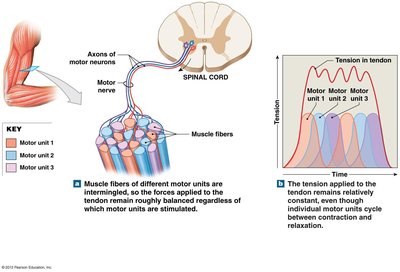
Resistance and Contraction Speed
The speed and extent of muscle shortening depend on the load applied. Smaller loads allow greater and faster shortening, while larger loads slow contraction and reduce shortening. - Small Load: Muscle shortens quickly and extensively. - Large Load: Muscle shortens slowly and minimally. - Intermediate Load: Muscle response is between the two extremes. 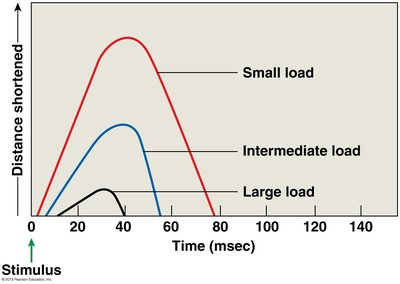
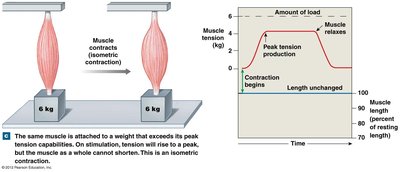
Isotonic and Isometric Contractions
Muscle contractions are classified based on changes in muscle length and tension. - Isotonic Contraction: Muscle length changes while tension remains constant. - Isometric Contraction: Muscle length remains constant while tension changes. - Concentric Isotonic: Muscle shortens as it contracts. - Eccentric Isotonic: Muscle lengthens as it contracts. 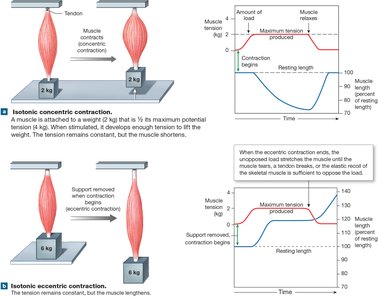
Energy Storage and Metabolism in Muscle Fibers
Energy Sources in Muscle Fibers
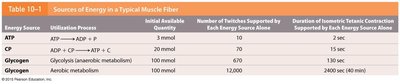
Muscle fibers utilize several energy sources to sustain contraction, each with different durations and capacities.
Energy Source | Utilization Process | Initial Quantity | Number of Twitches Supported | Duration of Isometric Contraction |
|---|---|---|---|---|
ATP | ATP → ADP + P | 5 mmol | 10 | 2 sec |
CP (Creatine Phosphate) | CP + ADP → ATP + C | 15 mmol | 70 | 15 sec |
Glycogen (Anaerobic) | Glycolysis | 100 mmol | 670 | 130 sec |
Glycogen (Aerobic) | Aerobic metabolism | 100 mmol | 12,000 | 2400 sec (40 min) |
Metabolism in Moderately Active Muscle
During moderate activity, muscles use glucose and fatty acids to produce ATP, which powers contraction. - Glucose and Fatty Acids: Catabolized to generate ATP. - ATP Production: Supports ongoing muscle contraction. 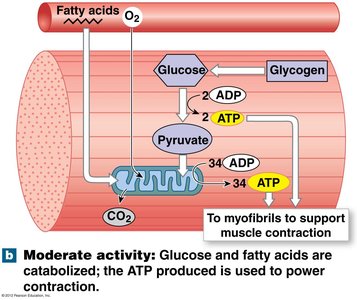
Muscle Fatigue and Recovery
Causes and Effects of Muscle Fatigue
Muscle fatigue is the loss of ability to perform an activity, caused by depletion of energy reserves and accumulation of metabolic byproducts. - Energy Depletion: Occurs at moderate and peak activity levels. - Acid Buildup: Leads to muscle damage at peak activity.
Recovery Period and the Cori Cycle
Recovery involves restoration of normal conditions, repair of microdamage, and replenishment of energy stores. The Cori cycle processes lactic acid produced during intense activity. - Cori Cycle Steps: 1. Active muscles release lactic acid. 2. Liver converts lactic acid to pyruvate, then to glucose. 3. Glucose returns to muscle and is stored as glycogen.
Skeletal Muscle Fiber Types and Athletic Performance
Properties of Skeletal Muscle Fiber Types
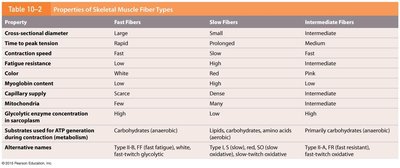
Muscle fibers are classified as fast, slow, or intermediate, each with distinct properties affecting athletic performance.
Property | Fast Fibers | Slow Fibers | Intermediate Fibers |
|---|---|---|---|
Diameter | Large | Small | Intermediate |
Contraction Speed | Rapid | Prolonged | Medium |
Fatigue Resistance | Low | High | Intermediate |
Color | White | Red | Pink |
Myoglobin Content | Low | High | Intermediate |
Capillary Supply | Few | Many | Intermediate |
Mitochondria | Few | Many | Intermediate |
Glycolytic Enzyme | High | Low | Intermediate |
ATP Substrates | Carbohydrates | Lipids, carbohydrates, amino acids | Primarily carbohydrates |
Alternative Names | Type II, fast glycolytic | Type I, slow oxidative | Type IIa, fast oxidative |
Histology of Fast and Slow Fibers
Slow fibers contain more mitochondria and capillaries than fast fibers, supporting greater endurance.
Hypertrophy, Conditioning, and Muscle Performance
Hypertrophy and Conditioning
Physical conditioning leads to hypertrophy, increasing muscle size, force, and endurance. - Hypertrophy: Enlargement of muscle fibers due to increased activity. - Aerobic Endurance: Supported by more mitochondria and enhanced cardiovascular performance. - Anaerobic Endurance: Supported by larger glycogen reserves and higher glycolytic enzyme levels. 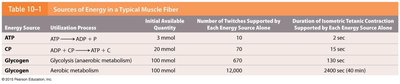
Pathology: Fibromyalgia
Fibromyalgia Overview
Fibromyalgia is a chronic disorder characterized by widespread pain, tenderness, fatigue, and sleep disturbances. - Symptoms: Increased sensitivity to pain, fatigue, trouble sleeping. - Classification: Considered a disorder due to unclear etiology. 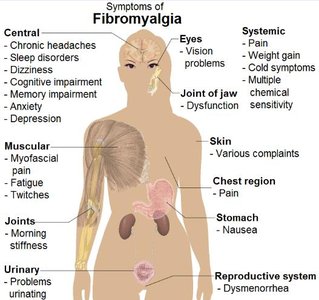
Comparison of Muscle Tissue Types
Cardiac Muscle Tissue
Cardiac muscle cells are short, branched, and striated, interconnected by intercalated discs. - Location: Heart - Function: Circulates blood, maintains blood pressure 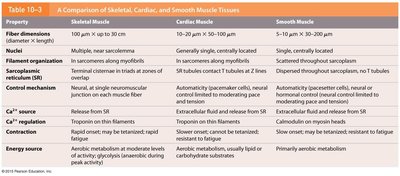
Smooth Muscle Tissue
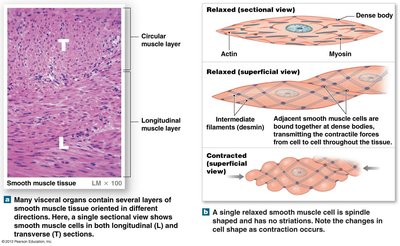
Smooth muscle cells are short, spindle-shaped, and nonstriated, with a single central nucleus. - Locations: Walls of blood vessels, digestive, respiratory, urinary, and reproductive organs - Function: Moves food, regulates diameter of blood vessels 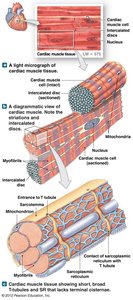
Comparison Table: Skeletal, Cardiac, and Smooth Muscle
Property | Skeletal Muscle | Cardiac Muscle | Smooth Muscle |
|---|---|---|---|
Fiber Dimensions | 100 μm x up to 30 cm | 10–20 μm x 50–100 μm | 5–10 μm x 30–200 μm |
Nuclei | Multiple, per sarcomere | Generally single, centrally located | Single, centrally located |
Filament Organization | In sarcomeres along myofibrils | In sarcomeres along myofibrils | Scattered throughout sarcoplasm |
Sarcoplasmic Reticulum | Terminal cisternae in triads | SR lacks terminal cisternae | Dispersed throughout sarcoplasm |
Control Mechanism | Voluntary | Involuntary | Involuntary |
Ca2+ Source | SR | Extracellular fluid and SR | Extracellular fluid and SR |
Energy Source | Aerobic/anaerobic | Primarily aerobic | Primarily aerobic |
Additional info:
- Muscle contraction types and fiber properties are essential for understanding athletic performance and muscle pathology. - The tables and diagrams provide a comprehensive comparison of muscle tissue types and their physiological roles.
