 Indietro
Respiratory System: Pressure, Gas Exchange, and Disorders
Guida di studio - Note intelligenti
 Appunti personalizzati basati sui tuoi materiali, ampliati con definizioni chiave, esempi e contesto.
Pressure and Flow in Respiration
Atmospheric Pressure and Boyle’s Law
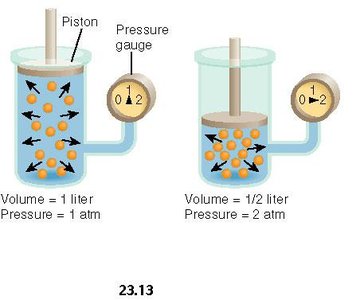
The movement of air into and out of the lungs is driven by differences in atmospheric pressure. Boyle’s Law states that the pressure of a gas is inversely proportional to its volume, which is fundamental to understanding how breathing occurs.
Atmospheric Pressure: The pressure exerted by the air surrounding the body, typically 1 atmosphere (atm) or 760 mmHg.
Boyle’s Law: As lung volume increases, pressure decreases, and vice versa. This relationship is crucial during inspiration and expiration.
Application: During inspiration, the diaphragm contracts, increasing thoracic volume and decreasing pressure, causing air to flow into the lungs.
Respiratory Cycle
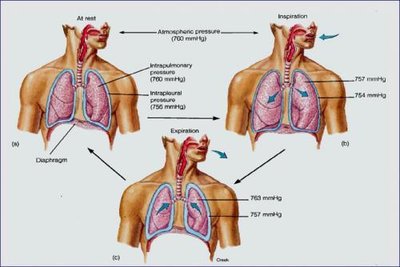
The respiratory cycle consists of inspiration and expiration, regulated by pressure gradients between the atmosphere and the lungs.
Inspiration: Air flows down its pressure gradient into the lungs.
Expiration: Air is expelled as lung volume decreases and pressure increases.
Temperature Effect: Inhaled air expands as it is warmed, aiding lung inflation.
Pneumothorax and Atelectasis
Pneumothorax
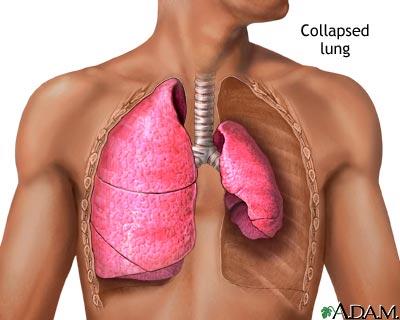
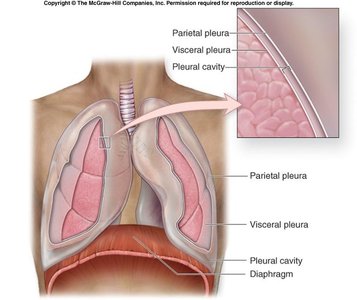
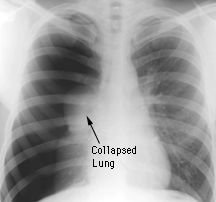
Pneumothorax is the presence of air in the pleural cavity, often due to trauma, which disrupts the pressure balance and causes lung collapse.
Pneumothorax: Air enters the pleural space, leading to loss of negative pressure and lung recoil.
Atelectasis: Collapse of all or part of the lung, often due to obstruction or pneumothorax.
Respiratory Volumes and Capacities
Factors Affecting Lung Function
Lung volumes and capacities are influenced by age, exercise, body size, and respiratory disorders.
Age: Decreases lung compliance and weakens respiratory muscles.
Exercise: Maintains strength of respiratory muscles.
Body Size: Larger bodies typically have larger lungs.
Restrictive Disorders: Reduce compliance and vital capacity (e.g., fibrosis).
Obstructive Disorders: Interfere with airflow, making expiration more difficult (e.g., asthma, COPD).
Composition of Air and Alveolar Air
Atmospheric vs. Alveolar Air
The composition of air changes as it enters the lungs and mixes with residual air.
Atmospheric Air: PN2 ~ 80%, PO2 ~ 20%, PCO2 ~ 0.04%, PH2O ~ 0.5%
Alveolar Air: PN2 ~ 75%, PO2 ~ 14%, PCO2 ~ 5%, PH2O ~ 6%
Gas Diffusion and Exchange
Principles of Gas Diffusion
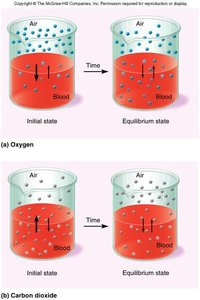
Gases diffuse down their concentration gradients, facilitating exchange in the lungs and tissues.
Diffusion: Movement of gases from areas of higher concentration to lower concentration.
Application: Oxygen diffuses from alveoli to blood; carbon dioxide diffuses from blood to alveoli.
Concentration Gradients
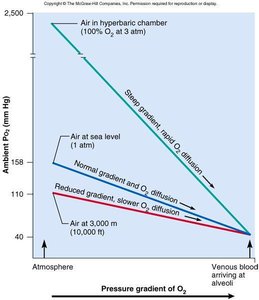
Different concentration gradients affect the rate and direction of gas exchange.
Oxygen Transport
Hemoglobin and Oxygen Binding
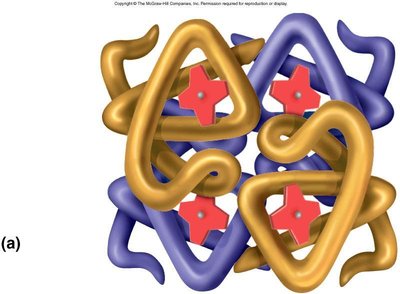
Oxygen is primarily transported by binding to hemoglobin in red blood cells.
Hemoglobin: Each molecule has four heme groups, each capable of binding one O2.
Oxyhemoglobin (HbO2): Hemoglobin bound to oxygen.
Deoxyhemoglobin (HHb): Hemoglobin not bound to oxygen.
Saturation: The percentage of hemoglobin molecules carrying oxygen.
Carbon Dioxide Transport
Mechanisms of CO2 Transport
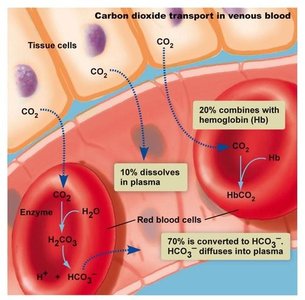
Carbon dioxide is transported in the blood by three main mechanisms.
Bicarbonate Ions (HCO3-): ~70% of CO2 is converted to bicarbonate in red blood cells.
Bound to Hemoglobin: ~20–25% binds to hemoglobin as carbaminohemoglobin (HbCO2).
Dissolved in Plasma: ~5–10% is transported dissolved directly in plasma.
Equation:
Systemic Gas Exchange
Oxygen and Carbon Dioxide Loading/Unloading
Gas exchange in tissues involves loading and unloading of O2 and CO2 according to metabolic needs.
O2 Loading: Oxygen binds to hemoglobin in the lungs.
CO2 Unloading: Carbon dioxide is released from blood into alveoli.
O2 Unloading: Oxygen is released from hemoglobin in tissues.
CO2 Loading: Carbon dioxide is picked up from tissues and transported to lungs.
Oxygen Dissociation and Regulation
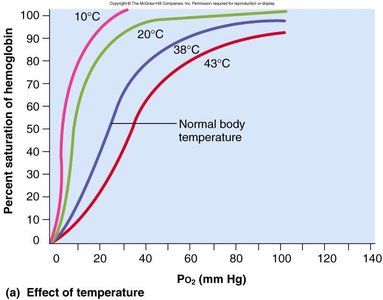
Effect of Temperature
Active tissues have higher temperatures, which promotes oxygen release from hemoglobin.
Higher Temperature: Decreases hemoglobin’s affinity for oxygen, facilitating release.
Effect of pH (Bohr Effect)
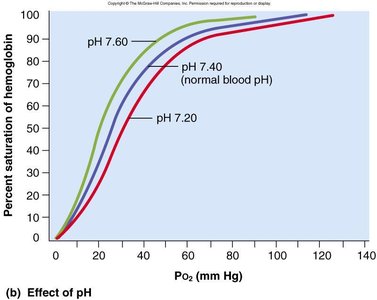
The Bohr effect describes how increased CO2 and lower pH in active tissues promote oxygen release from hemoglobin.
Lower pH: Decreases hemoglobin’s affinity for oxygen.
Bohr Effect: Active tissues produce more CO2, lowering pH and increasing O2 release.
Blood Chemistry and Respiratory Rhythm
Regulation of Breathing
The rate and depth of breathing are adjusted to maintain normal levels of pH, PCO2, and PO2.
Normal Values: pH = 7.4 ± 0.05, PCO2 = 41 mmHg, PO2 = 95 mmHg.
Acidosis: Blood pH < 7.35, often due to excess CO2 (hypercapnia).
Alkalosis: Blood pH > 7.45, often due to low CO2 (hypocapnia).
Hyperventilation: Reduces CO2 and H+, correcting acidosis.
Hypoventilation: Increases CO2 and H+, correcting alkalosis.
Equation:
Hypoxia and Oxygen Deficiency
Types and Causes of Hypoxia
Hypoxia refers to insufficient oxygen supply to tissues, with several distinct causes.
Ischemic Hypoxia: Inadequate circulation.
Anemic Hypoxia: Due to anemia.
Histotoxic Hypoxia: Metabolic poisons (e.g., cyanide).
Hypoxemic Hypoxia: Inadequate pulmonary gas exchange (e.g., high altitudes, drowning, CO poisoning).
Carbon Monoxide Poisoning
Mechanism and Effects
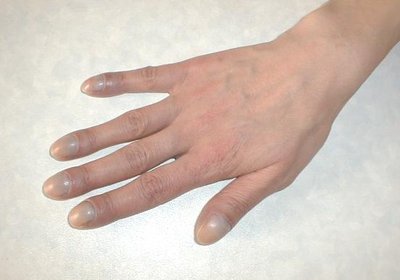
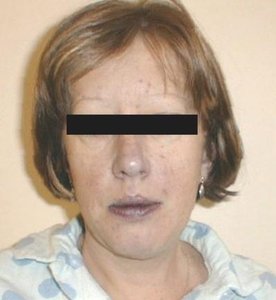
Carbon monoxide (CO) is a colorless, odorless gas that binds hemoglobin with much higher affinity than oxygen, leading to severe hypoxia.
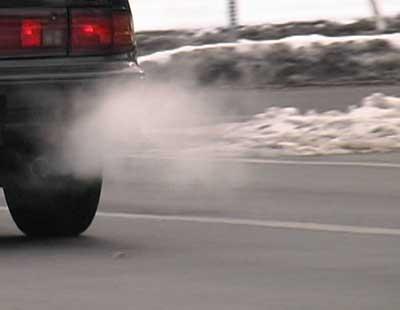
Sources: Engine exhaust, furnaces, space heaters.
Symptoms: Shortness of breath, nausea, dizziness, light-headedness; high exposure can cause death within minutes.
Oxygen Excess (Hyperoxia)
Oxygen Toxicity and Hyperbaric Oxygen
Breathing pure oxygen at high pressures can generate free radicals, damage tissues, and cause serious health effects.
Oxygen Toxicity: Occurs at O2 pressures of 2.5 atm or greater.
Effects: Destroys enzymes, damages nervous tissue, leads to seizures, coma, death.
Hyperbaric Oxygen: Used therapeutically but can cause retinal damage in premature infants.

Decompression Illness (The Bends)
Mechanism and Treatment
Decompression illness occurs when gases dissolved in blood (mainly nitrogen) form bubbles due to rapid pressure changes, causing pain and potentially serious complications.
Cause: Rapid ascent after breathing compressed air.
Treatment: Hyperbaric chamber to recompress and slowly decompress.
Prevention: Ascend slowly; avoid flying after diving.
Chronic Obstructive Pulmonary Disease (COPD)
Asthma
Asthma is a chronic inflammatory disorder characterized by bronchoconstriction and airflow obstruction.
Trigger: Allergen-induced histamine release.
Effect: Intense bronchoconstriction blocks airflow.
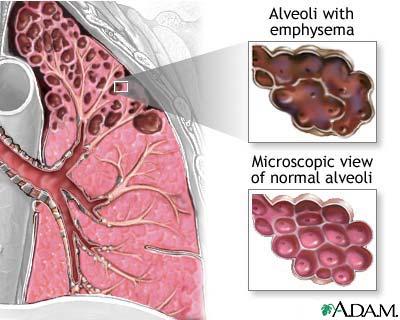
Emphysema
Emphysema involves the breakdown of alveolar walls, reducing respiratory membrane surface area and lung elasticity.
Symptoms: Lungs become rigid, less elastic; air passages collapse.
Consequences: Hypoxemia, hypercapnia, respiratory acidosis.
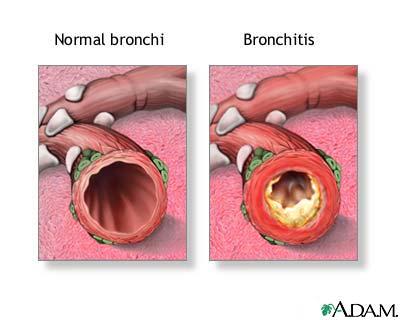
Chronic Bronchitis
Chronic bronchitis is characterized by immobilized cilia, enlarged goblet cells, and excess mucus production, leading to chronic infection and inflammation.
Effect: Sputum formation provides ideal growth media for bacteria.
Consequence: Chronic infection and bronchial inflammation.
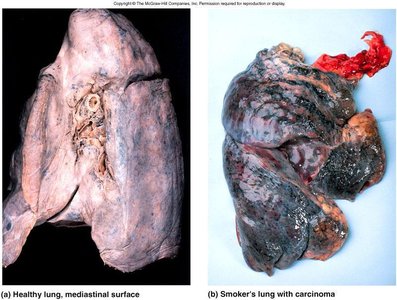
Smoking and Lung Cancer
Impact of Smoking
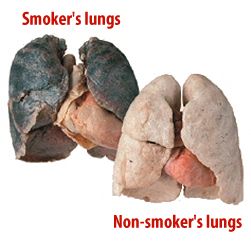
Lung cancer is the leading cause of cancer-related deaths, with smoking as the most significant risk factor.
Effect: Smoking damages lung tissue, increases risk of cancer.
Type of Hypoxia | Cause | Example |
|---|---|---|
Ischemic | Inadequate circulation | Heart failure |
Anemic | Anemia | Low hemoglobin |
Histotoxic | Metabolic poison | Cyanide poisoning |
Hypoxemic | Pulmonary gas exchange failure | High altitude, drowning |
Additional info: Table summarizes types of hypoxia for quick reference.
