 Indietro
The Chemical Level of Organization: Molecules of Cells
Guida di studio - Note intelligenti
 Appunti personalizzati basati sui tuoi materiali, ampliati con definizioni chiave, esempi e contesto.
The Chemical Level of Organization
Carbon-Based Molecular Diversity
Carbon is the foundation of molecular diversity in cells, forming the backbone of organic compounds. By sharing electrons, carbon can bond to four other atoms, allowing for branching in multiple directions and the creation of complex molecules.
Organic compounds: Molecules containing carbon bonded to other elements.
Carbon's versatility enables the formation of diverse molecular structures essential for life.
Chemical Groups and Functional Groups
The properties of organic compounds are determined by their size, shape, and the functional groups attached. Functional groups are specific clusters of atoms that influence the molecule's function and solubility.
Functional groups include hydroxyl, carbonyl, carboxyl, amino, phosphate, and methyl groups.
Compounds with functional groups are typically hydrophilic, making them soluble in water.
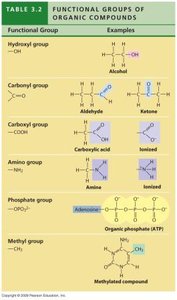
Example: Sex Hormones
Sex hormones such as estradiol and testosterone differ only in their functional groups, resulting in distinct biological actions and physical characteristics.
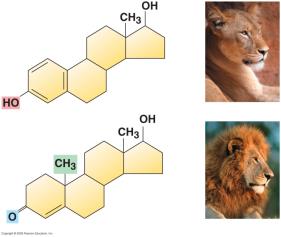
Macromolecules and Polymers
Classes of Biological Molecules
Cells synthesize a vast array of large molecules from a small set of monomers. The four major classes of biological molecules are carbohydrates, proteins, lipids, and nucleic acids.
Macromolecules: Large molecules, often polymers, made from repeating monomer units.
Monomers: The building blocks of polymers; universal among living organisms.
Polymer Formation and Breakdown
Monomers are linked to form polymers through dehydration reactions, which remove water. Polymers are broken down by hydrolysis, which adds water. Enzymes catalyze these reactions in cells.
Dehydration reaction: Builds polymers by removing water.
Hydrolysis: Breaks polymers by adding water.
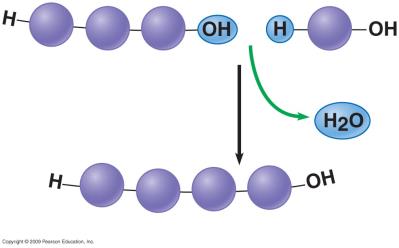
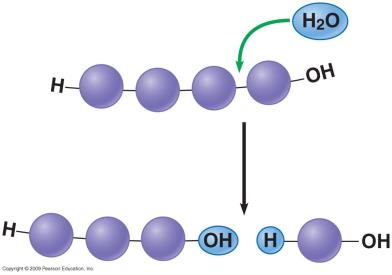
Carbohydrates
Monosaccharides
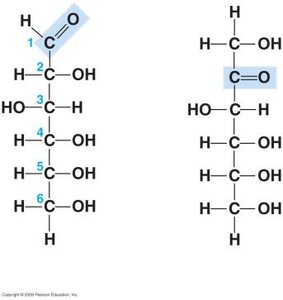
Monosaccharides are the simplest carbohydrates, serving as the main fuel for cellular work and as raw materials for other organic molecules. Their carbon skeletons vary in length, typically from 3 to 7 carbons.
Glucose and fructose are common 6-carbon monosaccharides.
Disaccharides
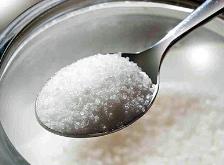
Disaccharides are formed when two monosaccharides join via a dehydration reaction. Sucrose, a common disaccharide, is formed from glucose and fructose.
Polysaccharides
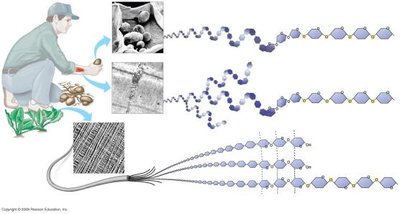
Polysaccharides are long chains of monosaccharide units. They serve as storage molecules (starch in plants, glycogen in animals) or structural compounds (cellulose in plants, chitin in insects).
Polysaccharides are hydrophilic, making them water-absorbent.
Lipids
Fats and Fatty Acids
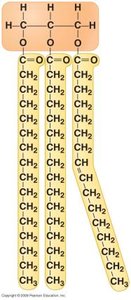
Lipids are hydrophobic molecules important for energy storage. Fats are composed of glycerol and three fatty acids, forming triglycerides. Fatty acids may be saturated (no double bonds) or unsaturated (contain double bonds).
Unsaturated fats have kinks in their carbon chains due to double bonds.
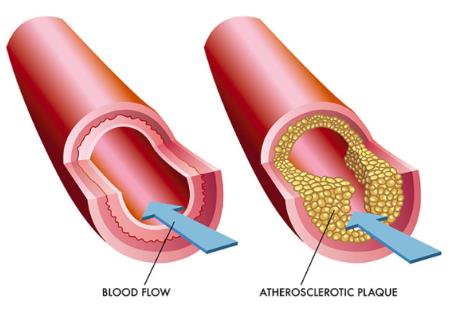
Saturated and trans-fats can promote higher cholesterol levels, contributing to atherosclerosis.
Phospholipids and Steroids
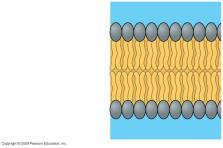
Phospholipids are major components of cell membranes, forming a bilayer with hydrophilic heads and hydrophobic tails. Steroids, such as cholesterol, have fused ring structures and play roles in membrane structure and hormone synthesis.
Proteins
Amino Acids and Peptide Bonds
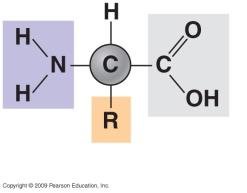
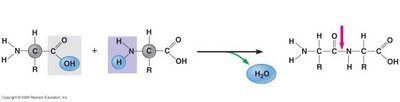
Proteins are polymers of amino acids, which have an amino group, a carboxyl group, a hydrogen atom, and an R group attached to a central carbon. Amino acids are linked by peptide bonds formed through dehydration reactions.
Amino acids are classified as hydrophobic or hydrophilic.
Protein Structure and Function
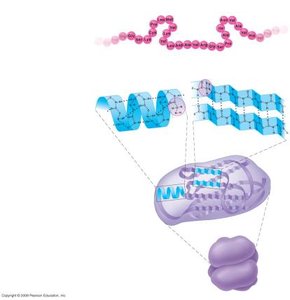
The function of a protein is determined by its specific shape, which is dictated by the sequence of amino acids. Proteins can be denatured by changes in temperature, salt concentration, or pH, losing their function.
Proteins have four levels of structure: primary, secondary, tertiary, and quaternary.
Primary structure: unique amino acid sequence.
Secondary structure: alpha helix or pleated sheet formed by hydrogen bonding.
Tertiary structure: three-dimensional shape from R group interactions.
Quaternary structure: association of multiple polypeptide chains.
Nucleic Acids
Nucleotides and DNA/RNA Structure
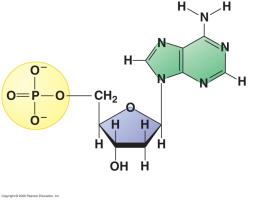
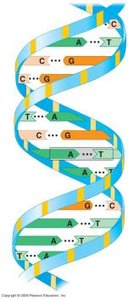
Nucleic acids (DNA and RNA) are polymers of nucleotides, each consisting of a 5-carbon sugar, a phosphate group, and a nitrogenous base. DNA contains adenine, thymine, cytosine, and guanine; RNA contains adenine, cytosine, guanine, and uracil.
Nucleic acid polymers form a sugar-phosphate backbone with protruding bases.
DNA is double-stranded, forming a double helix; RNA is usually single-stranded.
Genes and Mutations
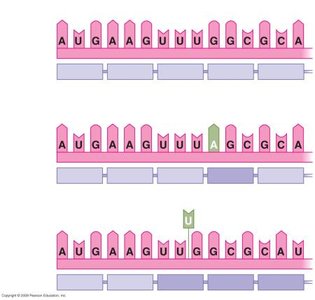
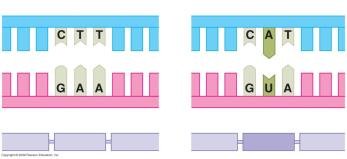
A gene is a sequence of nucleotides that instructs the formation of a polypeptide. Mutations are changes in the DNA sequence, which can alter protein function and lead to disease.
Mutations can be spontaneous or induced by mutagens (radiation, chemicals).
Types of mutations: base substitutions, deletions, insertions.
Carcinogenesis and Malignant Cells
Mechanisms of Carcinogenesis
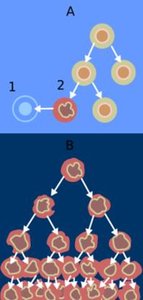
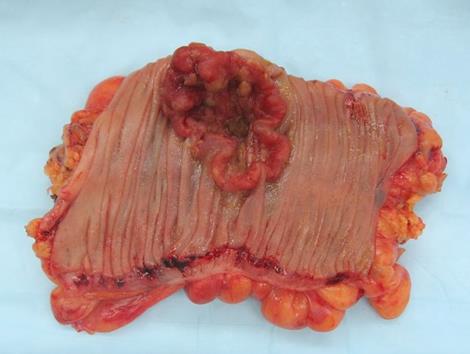
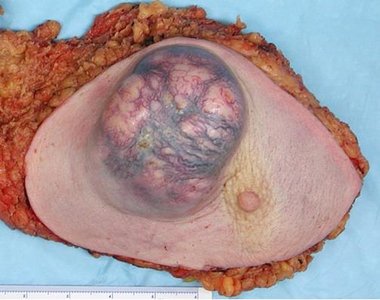
Cancer can arise from environmental factors, viruses, or genetic predisposition. Carcinogens cause mutations in DNA, leading to uncontrolled cell division and the formation of malignant cells.
Malignant cells avoid apoptosis and multiply uncontrollably.
They are clonal, originating from a single defective cell, and can metastasize to other organs.
Oncogenes and Tumor Suppressor Genes
Oncogenes are cancer-causing genes, while tumor suppressor genes (such as p53 and p16) help prevent cancer by inactivating carcinogens, aiding DNA repair, and enhancing immune response.
Cancer Progression
Cancer develops gradually, starting with loss of tumor suppressor genes, followed by activation of oncogenes, and further genetic changes leading to malignancy and metastasis.
