 Indietro
The Endocrine System: Structure, Function, and Regulation
Guida di studio - Note intelligenti
 Appunti personalizzati basati sui tuoi materiali, ampliati con definizioni chiave, esempi e contesto.
The Endocrine System
Overview of the Endocrine System
The endocrine system is one of the two major regulatory systems of the body, alongside the nervous system. It consists of organs that synthesize and secrete chemical messengers called hormones into the blood, which interact with specific cells known as target cells. Tissues containing these target cells are referred to as target tissues. Target cells possess receptors for hormones, enabling changes in cellular function.
Hormones: Chemical messengers secreted into the blood.
Target Cells: Cells with specific receptors for hormones.
Target Tissues: Tissues where target cells reside.
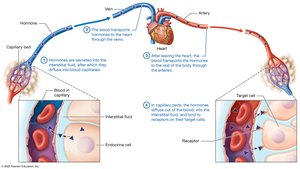
Comparison of the Endocrine and Nervous Systems
The endocrine system regulates body functions by releasing hormones into the bloodstream, which travel to distant target cells. Unlike the nervous system, endocrine cells do not come into direct contact with their targets.
Hormones are secreted into interstitial fluid, then diffuse into blood capillaries.
Blood transports hormones throughout the body.
Hormones bind to receptors on target cells in capillary beds.
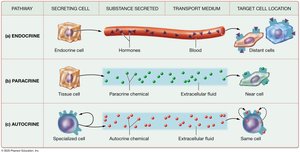
Paracrine and Autocrine Signals
Not all chemical signals act as classic hormones. Some act locally:
Paracrine signals: Chemicals secreted by cells into extracellular fluid to influence nearby cells.
Autocrine signals: Chemicals secreted by a cell to elicit effects from the same cell.
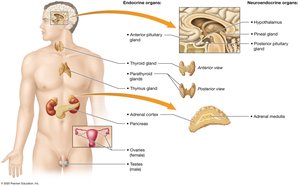
Overview of Endocrine Organs
Endocrine glands are ductless organs composed of glandular epithelial cells that secrete hormones into the interstitial fluid for transport by the bloodstream. Their effects are generally longer-lasting than those of the nervous system.
Primary endocrine organs: Anterior pituitary, thyroid, parathyroid, adrenal cortices, pancreas, thymus, ovaries/testes.
Secondary endocrine glands: Heart, kidneys, small intestine, adipose tissue.
Neuroendocrine organs: Hypothalamus, pineal gland, adrenal medulla.
Hormones: Structure, Transport, and Action
Classes of Hormones
Hormones are classified based on their chemical structure:
Amino acid-based hormones: Derived from amino acids; mostly hydrophilic.
Peptide/protein hormones: Chains of amino acids; generally hydrophilic.
Steroid hormones: Derived from cholesterol; hydrophobic and lipid-soluble.
Hormone Transport in Blood
Free hormones: Small, hydrophilic hormones travel freely in plasma.
Bound hormones: Hydrophobic hormones form complexes with binding proteins, extending their lifespan in blood.
Target Cells and Receptors
Hormones bind to specific receptors on or within target cells, which may be located in the plasma membrane, cytosol, or nucleus.
Some hormones bind to one type of target cell; others bind to multiple cell types.
Binding to different receptors can produce opposite effects (e.g., epinephrine).
Mechanisms of Hormone Action
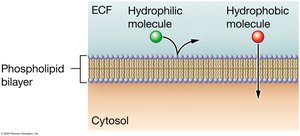
Hormones act through different mechanisms depending on their solubility:
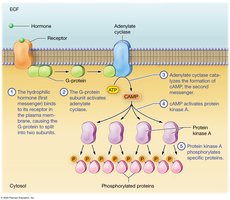
Hydrophilic hormones: Bind to cell surface receptors and activate second-messenger systems (e.g., cAMP pathway).
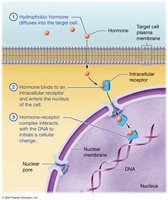
Hydrophobic hormones: Diffuse into cells, bind to intracellular receptors, and directly influence gene expression.
Regulation of Hormone Secretion
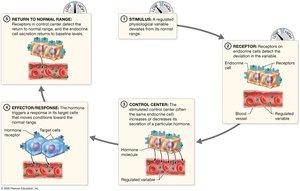
Hormone secretion is regulated by various stimuli and negative feedback loops:
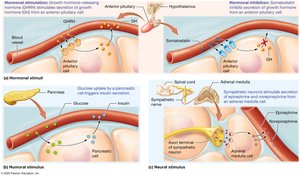
Hormonal stimuli: Response to other hormones.
Humoral stimuli: Response to changes in ion or compound concentration.
Neural stimuli: Response to nervous system signals.
Hypothalamus and Pituitary Gland
Structure and Functional Relationships
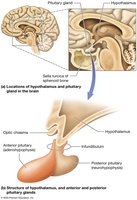
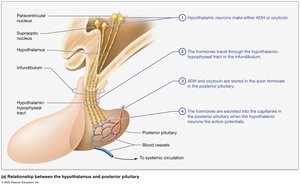
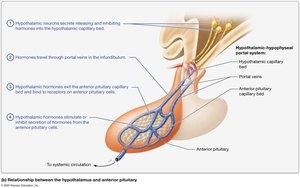
The hypothalamus connects to the pituitary gland via the infundibulum. The anterior pituitary is a true gland, while the posterior pituitary is nervous tissue that stores neurohormones.
Hormones of the Hypothalamus and Posterior Pituitary
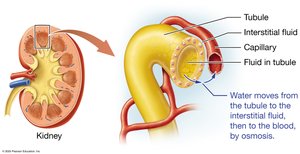
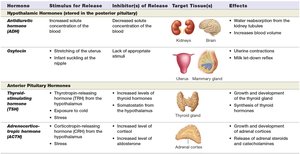
Antidiuretic hormone (ADH): Promotes water retention by kidneys; released in response to high solute concentration.
Oxytocin: Stimulates uterine contractions and milk ejection; operates via positive feedback.
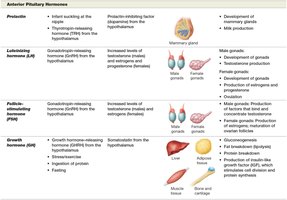
Anterior Pituitary Hormones
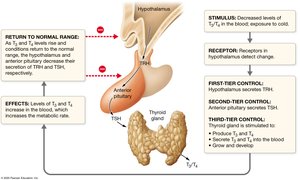
Thyroid-stimulating hormone (TSH): Stimulates thyroid gland.
Adrenocorticotropic hormone (ACTH): Stimulates adrenal cortex.
Prolactin: Stimulates milk production.
Luteinizing hormone (LH): Stimulates sex hormone production.
Follicle-stimulating hormone (FSH): Stimulates gamete production.
Growth hormone (GH): Stimulates growth and metabolism.
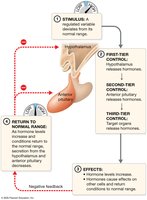
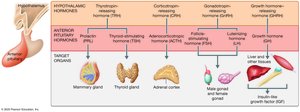
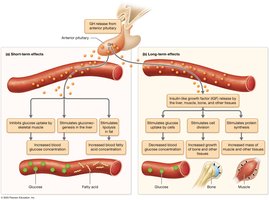
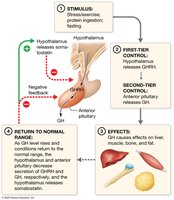
Hormones of the Hypothalamus and Pituitary Gland (Table)
Hormone | Stimulus for Release | Inhibitor(s) of Release | Target Tissue(s) | Effects |
|---|---|---|---|---|
ADH | Increased solute concentration | Decreased solute concentration | Kidneys, brain | Water reabsorption, increased blood volume |
Oxytocin | Stretching of uterus, infant suckling | Lack of appropriate stimulus | Uterus, mammary gland | Uterine contractions, milk let-down reflex |
TSH | TRH from hypothalamus | Somatostatin | Thyroid gland | Growth and development, secretion of thyroid hormones |
ACTH | CRH from hypothalamus, stress | Increased level of cortisol | Adrenal cortex | Growth and development, secretion of adrenal cortex hormones |
Thyroid and Parathyroid Glands
Structure and Function
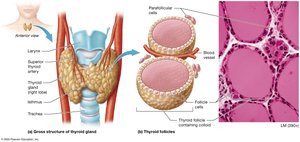
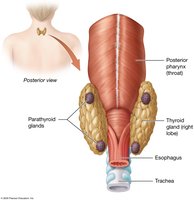
The thyroid gland is located in the anterior neck and consists of two lobes connected by the isthmus. It contains thyroid follicles, follicle cells, and parafollicular cells. The parathyroid glands are usually four small glands embedded in the posterior thyroid.
Thyroid Hormones: Metabolic Regulators
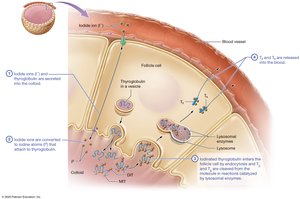
Triiodothyronine (T3): Contains three iodine atoms; more active.
Thyroxine (T4): Contains four iodine atoms; converted to T3 in target cells.
Regulate basal metabolic rate, thermoregulation, growth, and development.
Synergize with the sympathetic nervous system.
Thyroid Disorders
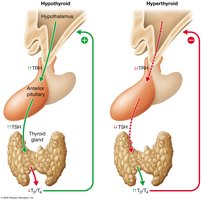
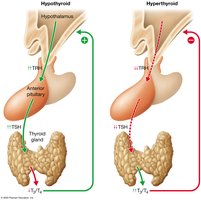
Hyperthyroidism: Overproduction of thyroid hormones; causes weight loss, heat intolerance, and cardiovascular effects.
Hypothyroidism: Underproduction; causes weight gain, cold intolerance, and slow heart rate.
Graves Disease: Autoimmune hyperthyroidism; may cause goiter and exophthalmos.
Goiter: Enlargement of the thyroid gland.

Parathyroid Hormone and Calcitonin: Bone Homeostasis
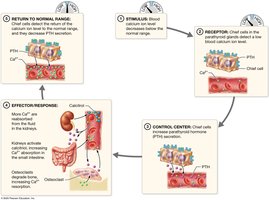
Parathyroid hormone (PTH): Increases blood calcium by stimulating osteoclasts, increasing intestinal absorption, and kidney reabsorption.
Calcitonin: Produced by thyroid parafollicular cells; inhibits osteoclasts, lowers blood calcium.
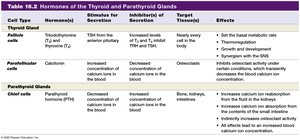
Cell Type | Hormone | Stimulus for Secretion | Inhibitor(s) of Secretion | Target Tissue(s) | Effects |
|---|---|---|---|---|---|
Follicle cells | T3/T4 | TSH | Increased T3/T4 | Nearly every cell | Basal metabolic rate, thermoregulation, growth, development, SNS synergy |
Parafollicular cells | Calcitonin | Increased blood calcium | Decreased blood calcium | Osteoclasts | Inhibits osteoclasts, lowers blood calcium |
Chief cells | PTH | Decreased blood calcium | Increased blood calcium | Bone, kidneys, intestine | Increases blood calcium |
Summary
The endocrine system is essential for regulating metabolism, growth, development, and homeostasis. Hormones act through specific mechanisms and are tightly regulated by feedback loops. Disorders of the endocrine system can have widespread effects on health and physiology.
