 Indietro
The Integumentary System: Structure and Function of Skin and Hair
Guida di studio - Note intelligenti
 Appunti personalizzati basati sui tuoi materiali, ampliati con definizioni chiave, esempi e contesto.
The Integumentary System
Overview of the Skin
The skin is the largest organ of the human body and forms the primary interface between the body and the external environment. It consists of three main layers: the epidermis, dermis, and hypodermis (subcutaneous tissue). Each layer has distinct functions and structures that contribute to the overall protective, sensory, and regulatory roles of the integumentary system.
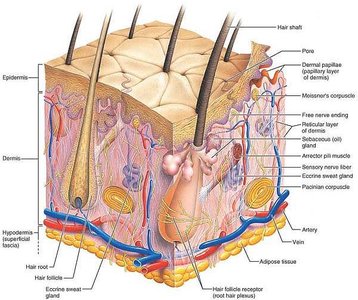
Structure of a Hair Follicle
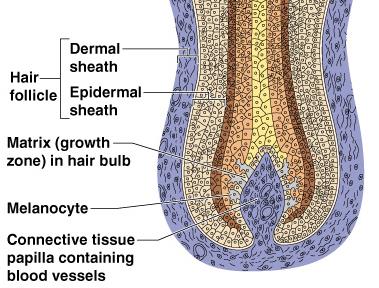
Hair follicles are specialized structures embedded in the skin, responsible for the production and growth of hair. They extend from the epidermis into the dermis and sometimes into the hypodermis.
Hair follicle: A tubular invagination of the epidermis that extends deep into the dermis.
Hair bulb: The expanded base of the follicle where hair growth occurs.
Hair follicle receptor (root hair plexus): Sensory nerve endings that wrap around the hair bulb, allowing hair to act as touch receptors.
Hair papilla: A projection of dermal tissue into the hair bulb, containing capillaries that supply nutrients and growth signals.
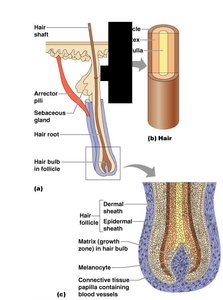
Layers of the Hair Follicle
The hair follicle wall is composed of several layers, each with specific structural and functional roles.
Dermal root sheath: The outermost connective tissue layer.
Glassy membrane: A thickened basement membrane inside the dermal root sheath.
Epidermal root sheath: Composed of external and internal layers, becomes thinner near the hair papilla.
Hair matrix: A single layer of actively dividing epithelial cells covering the papilla, responsible for producing new hair cells.
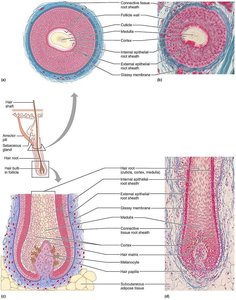
Arrector Pili Muscle
Each hair follicle is associated with a bundle of smooth muscle cells called the arrector pili. These muscles contract in response to cold or fear, pulling the hair upright and causing goose bumps.
Function: Thermoregulation and emotional response.
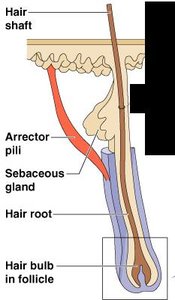
Structure of Hair
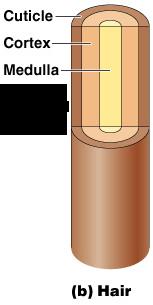
Hair is composed of dead, keratinized cells and consists of two main regions: the shaft (visible above the skin) and the root (embedded within the skin). The hair shaft is made up of three concentric layers:
Medulla: The innermost core, containing large cells and air spaces; absent in fine hair.
Cortex: The middle layer, composed of several layers of completely keratinized, flattened cells.
Cuticle: The outermost layer, a single layer of heavily keratinized cells overlapping like shingles, providing strength and preventing matting.
Hair Color
Hair color is determined by the type and amount of melanin produced by melanocytes in the hair matrix and transferred to cortical cells.
Melanin: Produces colors ranging from blonde to black.
Trichosiderin: An iron-containing pigment responsible for red hair.
Gray/white hair: Results from decreased melanin production and air bubbles replacing melanin in the hair shaft.
Types and Growth of Hair
Hair varies in shape, size, and texture, and can be classified as vellus or terminal hair. Growth and density are influenced by nutrition, blood circulation, and hormones.
Vellus hair: Pale, fine body hair found in children and adult females; lacks a medulla.
Terminal hair: Dark, coarse hair found on the scalp, axillary, and pubic regions; appears in males on the face, chest, arms, and legs at puberty.
Hair texture: Determined by the shape of the hair shaft (flat = kinky, oval = wavy, round = straight).
Homeostatic Imbalance: Excessive Hair (Hirsutism)
Excessive androgen production from ovarian or adrenal tumors can cause hirsutism and other masculine characteristics in females.
Hair Growth Cycle
Hair follicles undergo cycles of growth, regression, and rest. The rate and duration of these cycles vary by body region, sex, and age.
Active growth phase: Weeks to years.
Regressive phase: Matrix cells die, follicle base shrivels.
Resting phase: 1–3 months.
Average growth: 2.5 mm per week; scalp follicles active for 6–10 years, eyebrow follicles for 3–4 months.
Hair Thinning and Baldness
Hair thinning and baldness (alopecia) occur when hair is not replaced as quickly as it is lost, often after age 40. Male pattern baldness is genetically determined and sex-influenced.
Drug treatments: Minoxidil and other medications can stimulate hair growth, but effects are temporary.
Causes of hair thinning: High fever, trauma, protein deficiency, lactation, certain drugs, autoimmune attack, burns, or radiation.
Functions of Hair
Hair serves several important functions in humans:
Sensory: Detects insects and touch.
Protection: Guards scalp against trauma, heat loss, and sunlight; eyelashes shield eyes; nose hairs filter particles.
Functions of the Integumentary System
Protection
The skin provides chemical, physical, and biological barriers against environmental hazards.
Chemical barriers: Melanin protects against UV radiation; acidic sweat and sebum inhibit bacterial growth.
Physical barriers: Continuity of skin and keratinized cells prevent entry of pathogens and water loss.
Biological barriers: Langerhans' cells and dermal macrophages engulf foreign substances; DNA absorbs UV radiation.
Cutaneous Sensation
The skin contains specialized sensory receptors for touch, pressure, and pain.
Hair follicle receptors: Detect movement of hair.
Merkel discs and Meissner's corpuscles: Detect light touch.
Pacinian corpuscles: Detect deep pressure.
Free nerve endings: Detect pain and temperature.
Body Temperature Regulation
The skin regulates body temperature through sweat production and constriction/dilation of dermal capillaries.
Sweat glands: Cool the body by evaporative heat loss.
Capillary constriction: Reduces heat loss.
Metabolic Function
The skin synthesizes vitamin D from cholesterol when exposed to sunlight, which is essential for calcium absorption.
Blood Reservoir
The skin can hold up to 5% of the body's blood supply, which can be diverted as needed.
Excretion
The skin excretes limited amounts of nitrogenous wastes (ammonia, urea, uric acid) through sweat.
Homeostatic Imbalances of Skin
Skin Cancer
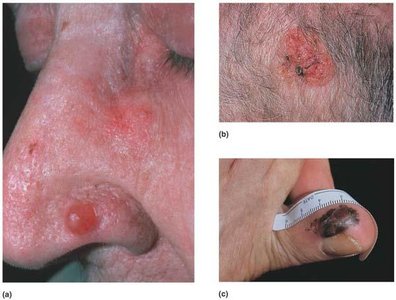
Excessive sun exposure can damage skin cells and lead to skin cancer. There are three main types:
Basal cell carcinoma: Least malignant, most common; arises from stratum basale cells.
Squamous cell carcinoma: Rapid growth and potential metastasis; arises from keratinocytes of stratum spinosum.
Melanoma: Most dangerous; cancer of melanocytes, highly metastatic and resistant to chemotherapy.
ABCD(E) Rule for Recognizing Melanoma
The ABCD(E) rule helps identify melanoma:
A: Asymmetry
B: Border irregularity
C: Color variation
D: Diameter greater than 6 mm
E: Elevation above skin surface (optional)
Burns
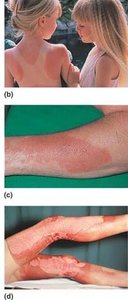
Burns are injuries caused by heat, electricity, radiation, or chemicals, resulting in protein denaturation and cell death. The most immediate threat is dehydration and electrolyte imbalance, followed by infection.
Classification of Burns
First-degree burns: Damage only the epidermis; redness, swelling, pain; heal in 2–3 days.
Second-degree burns: Damage epidermis and upper dermis; blisters, pain; heal in 3–4 weeks.
Third-degree burns: Damage entire skin thickness; area appears gray-white, red, or black; not painful due to destroyed nerve endings; skin grafting required.
Critical Burns
Over 25% of body with second-degree burns
Over 10% of body with third-degree burns
Third-degree burns on face, hands, or feet
Rule of Nines
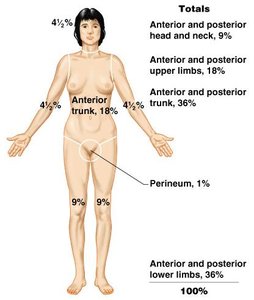
The Rule of Nines is used to estimate the extent of burns by dividing the body into regions, each representing approximately 9% of the total body surface area.
Body Region | Percentage |
|---|---|
Head and neck (anterior & posterior) | 9% |
Upper limbs (anterior & posterior) | 18% |
Trunk (anterior & posterior) | 36% |
Lower limbs (anterior & posterior) | 36% |
Perineum | 1% |
Summary Table: Types of Skin Cancer
Type | Origin | Malignancy | Common Sites | Treatment |
|---|---|---|---|---|
Basal cell carcinoma | Stratum basale | Least malignant | Face | Surgery |
Squamous cell carcinoma | Stratum spinosum | Moderate | Head, hands | Surgery/radiation |
Melanoma | Melanocytes | Most malignant | Anywhere with pigment | Early detection, surgery |
Key Equations
For burn estimation:
For sweat excretion:
Conclusion
The integumentary system is essential for protection, sensation, temperature regulation, metabolic functions, blood storage, and excretion. Understanding its structure and function is crucial for recognizing and managing common disorders such as skin cancer and burns.
