 Indietro
The Lymphatic and Immune Systems: Structure, Function, and Regulation
Guida di studio - Note intelligenti
 Appunti personalizzati basati sui tuoi materiali, ampliati con definizioni chiave, esempi e contesto.
The Lymphatic System
Functions of the Lymphatic System
The lymphatic system is a crucial component of the body's defense mechanisms and fluid balance. It performs several key functions:
Drains excess interstitial fluid: Returns fluid from tissues to the bloodstream, preventing edema.
Transports dietary lipids: Absorbs fats and fat-soluble vitamins from the digestive tract.
Carries out immune responses: Provides sites for immune cell activation and proliferation.
Components of the Lymphatic System
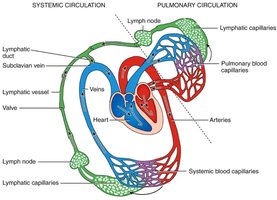
Lymph: The fluid transported by lymphatic vessels.
Lymphatic vessels: Network of tubes that carry lymph throughout the body.
Lymphatic tissues & organs: Includes lymph nodes, thymus, spleen, and lymphoid nodules.
Lymphatic Vessels and Circulation
Lymphatic vessels collect lymph from tissues and return it to the bloodstream via the subclavian veins. Lymph nodes filter lymph and are sites of immune cell activation.
Lymphatic Tissues & Organs
Lymphoid Tissues and Organs
Lymphoid tissues: Aggregates of immune cells found in mucous membranes (e.g., tonsils, Peyer's patches).
Lymph nodes: Small, bean-shaped structures that filter lymph and house lymphocytes.
Thymus: Site of T cell maturation.
Spleen: Filters blood, removes old red blood cells, and mounts immune responses.
Defense System Overview
Antigens vs. Pathogens
Antigens: Molecules recognized by the immune system as foreign, triggering an immune response.
Pathogens: Disease-causing organisms (bacteria, viruses, fungi, parasites).
Types of Defenses
Innate (nonspecific) defenses: Present at birth; provide general protection.
Adaptive (specific) defenses: Develop in response to specific antigens; involve memory and specificity.
Innate Immunity
Physical Barriers
Physical barriers are the first line of defense against pathogens:
Skin: The epidermis acts as a tough, impermeable barrier.
Mucous membranes: Line body cavities; mucus traps pathogens.
Cilia: Move mucus and trapped particles out of the respiratory tract.
Other fluids: Tears, saliva, and urine flush out microbes.
Phagocytes
Neutrophils (microphages): Engulf and destroy pathogens.
Macrophages: Can be wandering or fixed; ingest and digest microbes.
Properties: Chemotaxis (movement toward chemicals), adherence, ingestion, digestion.
Natural Killer (NK) Cells
NK cells: Destroy infected or abnormal cells by releasing perforin and inducing apoptosis.
Antimicrobial Proteins
Interferons (IFNs): Proteins that inhibit viral replication.
Transferrin: Binds iron, limiting bacterial growth.
Complement system: Group of proteins that enhance phagocytosis, cause cell lysis, and promote inflammation.
Complement System
Effects: Inflammation, enhanced phagocytosis, cell lysis via membrane attack complex (MAC).
Pathways: Lectin, alternative, classical.
Inflammatory Response and Fever
Inflammation: Vasodilation and increased permeability of blood vessels, mediated by histamine, kinins, prostaglandins, leukotrienes, and complement proteins.
Fever: Elevated body temperature due to pyrogens and interleukin-1 (IL-1).
Adaptive Immunity
Characteristics of Adaptive Immunity
Specificity: Targets specific antigens.
Versatility: Can respond to a wide variety of antigens.
Tolerance: Distinguishes self from non-self antigens.
Memory: Remembers previous encounters for faster responses.
Types of Adaptive Immunity
Active immunity: Body produces its own antibodies (naturally acquired or artificially induced).
Teaches how to make its own immune defense
Artificially acquired
you get bitten by a raccoon; get shot for immune defense
Passive immunity: Antibodies are transferred from another source (naturally acquired or artificially induced).
Breastfeeding, breast milk
Immune defense is given, rather than learned
Antigens and Antigen Recognition
Anything able to activate your immune system
Structure of Antigens
Antigens are molecules that trigger immune responses. They contain specific regions called epitopes that are recognized by immune cells.
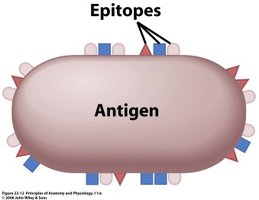
Antigen receptors: Proteins on lymphocytes that bind to epitopes.
Somatic recombination: Process that generates antigen receptors.
Major Histocompatibility Complex (MHC)
Helps determine transplant compatibility
MHC class I: Present on all nucleated cells; present endogenous antigens to CD8+ T cells.
Antigens start inside cell, then move outside cell
non- professional
MHC class II: Present on antigen-presenting cells; present exogenous antigens to CD4+ T cells.
Presents foreign antigens
outside of the cell, finds outside infected antigen to destroy infection
Here's an infection we need to destroy "
Dendritic cells, neutrophils & macrophages, B Cells
Antigen Processing and Presentation
Endogenous Antigen Presentation
MHC I molecules: Present antigens from within the cell to CD8+ T cells.
"Non-professional" antigen presentation: Occurs in most cells.
Exogenous Antigen Presentation
Antigen-presenting cells (APCs): Dendritic cells, neutrophils, macrophages, B cells.
MHC II molecules: Present antigens from outside the cell to CD4+ T cells.
T Cells
Activation and Differentiation
Sensitization: Initial exposure to antigen.
T-cell receptors (TCRs): Bind to antigen-MHC complexes.
Costimulation: Additional signals required for activation.
Anergy: Inactivation if costimulation is absent.
Proliferation: Activated T cells divide and form clones.
Differentiation: Formation of effector and memory cells.
Types of T Cells
CD4+ cells: Helper T cells (TH) produce interleukin-2 (IL-2); regulatory T cells (Treg) modulate immune responses.
CD8+ cells: Cytotoxic T cells (TC) destroy infected cells; memory cells provide long-term immunity.
Elimination of Pathogens
Cytotoxic T cells: Release perforin, cytokines, and lymphotoxin to kill target cells.
Immunological surveillance: Continuous monitoring for abnormal cells.
B Cells and Antibodies
B Cell Activation
Sensitization: B cells encounter antigen.
B-cell receptors (BCRs): Bind to antigens.
Costimulation: Required for full activation.
Plasma cells: Produce antibodies.
Memory B cells: Provide long-term immunity.
Antibody Structure and Classes
Heavy and light chains: Polypeptide chains forming the antibody.
Constant and variable segments: Variable segments bind antigens; constant segments determine class.
Antigen binding sites: Regions that interact with epitopes.
Antibody Classes and Functions
Classes: IgA, IgD, IgE, IgG, IgM.
Functions: Neutralizing pathogens, binding, agglutination/precipitation, complement activation, opsonization, inflammation.
Antibody Responses
Primary response: Initial exposure; slower, lower antibody titer.
Secondary response: Subsequent exposure; faster, higher antibody titer.
Immune Regulation
Self-Recognition and Self-Tolerance
The immune system must distinguish self from non-self to prevent autoimmunity. This is achieved through positive and negative selection of T and B cells.
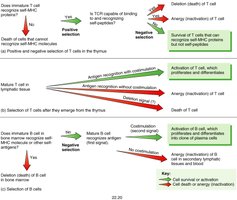
Positive selection: Ensures T cells recognize self-MHC.
Negative selection: Eliminates T cells that react strongly to self-antigens.
Deletion: Removal of self-reactive cells.
Anergy: Inactivation of self-reactive cells.
Regulatory Mechanisms
Regulatory T cells (Tr): Suppress immune responses.
Cytokines: Mediate communication between immune cells.
Red blood cells (RBCs): Not directly involved in immune regulation but can be affected by immune responses.
Immune Disorders
Types of Immune Disorders
Autoimmune diseases: Immune system attacks self-tissues; involves dysregulated T cells and autoantibodies.
Immunodeficiency diseases: Reduced immune function (e.g., SCID, AIDS).
Allergies: Exaggerated immune response to harmless antigens (allergens); includes anaphylaxis and delayed hypersensitivity.
Stress and the Immune System
Effects of Stress
Glucocorticoids: Hormones that depress inflammation, reduce phagocyte activity, and inhibit interleukin secretion.
Summary Table: Innate vs. Adaptive Immunity
Feature | Innate Immunity | Adaptive Immunity |
|---|---|---|
Specificity | Non-specific | Highly specific |
Memory | None | Present |
Cells involved | Phagocytes, NK cells | T cells, B cells |
Response time | Immediate | Delayed |
Examples | Skin, complement | Antibodies, cytotoxic T cells |
Additional info: Some details and examples were inferred for completeness and clarity based on standard Anatomy & Physiology curriculum.
