 Indietro
The Urinary System: Structure, Function, and Filtration
Guida di studio - Note intelligenti
 Appunti personalizzati basati sui tuoi materiali, ampliati con definizioni chiave, esempi e contesto.
The Urinary System
Components and Functions of the Urinary System
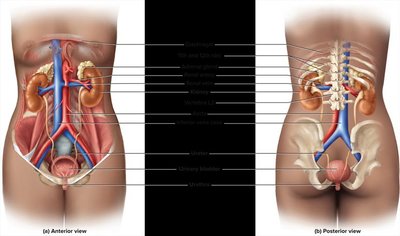
The urinary system is essential for maintaining homeostasis by filtering blood, removing wastes, and regulating fluid and electrolyte balance. It consists of several organs that work together to produce, store, and eliminate urine.
Kidneys: Filter blood and produce urine.
Ureters: Transport urine from kidneys to bladder.
Urinary bladder: Stores urine until excretion.
Urethra: Conducts urine out of the body.
Key Functions:
Excretion of toxic metabolic wastes
Regulation of blood volume, pressure, and osmolarity
Electrolyte and acid-base balance
Secretion of erythropoietin (stimulates red blood cell production)
Final step in synthesizing calcitriol (active vitamin D)
Detoxification of some drugs
Excretion and Types of Wastes
Excretion is the process of separating and eliminating wastes from body fluids.
Waste: Any substance that is useless or in excess of the body’s needs.
Metabolic waste: Produced by metabolic processes.
Nitrogenous wastes: Highly toxic; includes urea (50%), uric acid, and creatinine.
Nephrons: The Functional Unit of the Kidney
Structure of the Nephron
Nephrons are the microscopic functional units of the kidney responsible for urine formation. Each nephron consists of two main parts:
Renal corpuscle: Site of blood filtration.
Renal tubule: Processes filtrate into urine.
Renal Corpuscle
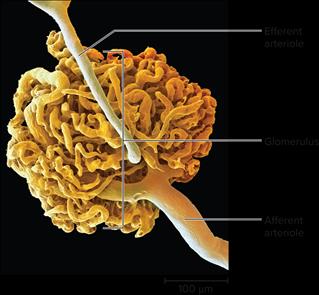
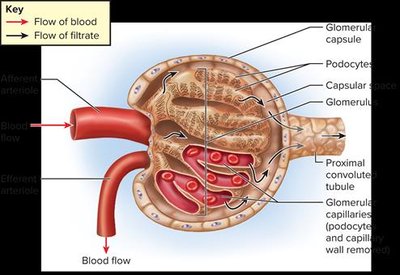
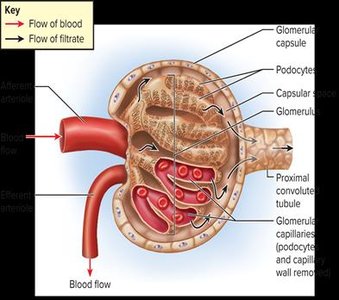
The renal corpuscle is composed of a glomerulus (a ball of capillaries) surrounded by a two-layered glomerular capsule.
Capsular space: Separates the inner and outer layers.
Afferent arteriole: Brings blood into the glomerulus (larger diameter).
Efferent arteriole: Takes blood away (smaller diameter, creates high pressure).
Renal Tubule
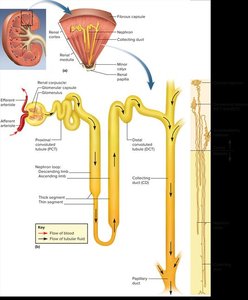
The renal tubule is divided into four regions, each with specialized functions:
Proximal convoluted tubule (PCT): Absorbs nutrients like glucose, amino acids, and small peptides; lined with cuboidal epithelium and microvilli.
Nephron loop (Loop of Henle): U-shaped; descending limb is permeable to water, ascending limb actively transports ions.
Distal convoluted tubule (DCT): Responsible for sodium and chloride reabsorption.
Collecting duct (CD): Receives fluid from multiple nephrons; mainly reabsorbs water; urine is officially formed here.
Urine Formation: Filtration, Reabsorption, Secretion, and Conservation
Stages of Urine Formation
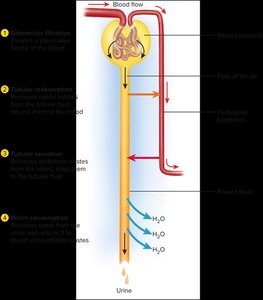
The kidneys convert blood plasma to urine in four stages:
Glomerular filtration: Water and solutes are filtered from blood into the nephron.
Tubular reabsorption: Useful substances are reabsorbed into the blood.
Tubular secretion: Additional wastes are secreted into the tubule.
Water conservation: Water is reabsorbed to concentrate urine.
Glomerular Filtration
Glomerular filtration is the first step in urine formation, occurring at the renal corpuscle.
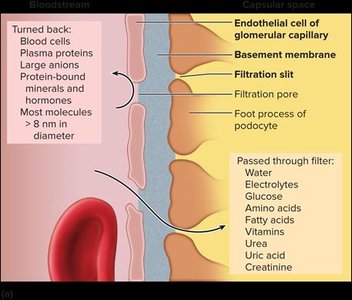
Filtration membrane: Consists of capillary endothelium (fenestrated), basement membrane (glycoprotein gel), and filtration slits formed by podocytes.
Selective permeability: Allows water, electrolytes, glucose, amino acids, fatty acids, vitamins, urea, uric acid, and creatinine to pass; blocks blood cells and large proteins.
Filtration Pressure
Filtration is driven by high blood pressure in the glomerulus, which is higher than in other capillaries.
Pressure overrides osmotic and capsular fluid pressure.
Hypertension risk: Kidneys are vulnerable to high blood pressure, which can cause capillary rupture and renal failure.
Glomerular Filtration Rate (GFR)
GFR is the amount of filtrate formed per minute by both kidneys.
Normal values: Females ~105 mL/min (150 L/day), Males ~125 mL/min (180 L/day).
Urine output: Only 1-2 L/day is excreted; 99% of filtrate is reabsorbed.
Regulation of GFR
GFR must be tightly regulated to maintain homeostasis.
Too high: Leads to dehydration and electrolyte depletion.
Too low: Causes reabsorption of wastes.
Regulation mechanisms:
Neural control (sympathetic constriction of afferent arterioles)
Hormonal control (renin-angiotensin-aldosterone system)
Local control (renal autoregulation via juxtaglomerular apparatus)
Renal Autoregulation
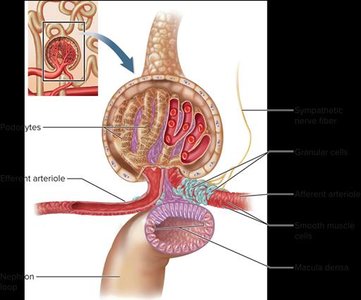
Nephrons can independently regulate their GFR through the juxtaglomerular apparatus, which monitors flow rate and osmolarity.
Macula densa: Sensory cells in the DCT that detect changes in flow and composition.
Granular cells: Secrete renin in response to changes in blood pressure.
Summary Table: Components and Functions of the Urinary System
Component | Main Function |
|---|---|
Kidneys | Filter blood, produce urine, regulate fluid/electrolyte balance |
Ureters | Transport urine to bladder |
Urinary bladder | Store urine |
Urethra | Conduct urine out of body |
Key Terms and Definitions
Nephron: Functional unit of the kidney.
Glomerulus: Ball of capillaries in the renal corpuscle.
Glomerular filtration rate (GFR): Volume of filtrate produced per minute.
Podocyte: Specialized cell in the glomerular capsule forming filtration slits.
Renin: Enzyme secreted by kidneys to regulate blood pressure.
Relevant Equations
GFR Calculation:
Filtration Pressure:
Example: Application of GFR Regulation
If blood pressure drops, the kidneys secrete renin, activating the renin-angiotensin-aldosterone system, which increases blood pressure and maintains GFR.
Additional info:
Juxtaglomerular apparatus is critical for local autoregulation of GFR.
Podocytes and filtration slits are essential for selective permeability in glomerular filtration.
