 Indietro
Basic Principles of Immunological Reactions: Innate & Adaptive Immune Responses
Guida di studio - Note intelligenti
 Appunti personalizzati basati sui tuoi materiali, ampliati con definizioni chiave, esempi e contesto.
BASIC PRINCIPLES OF IMMUNOLOGICAL REACTIONS
Overview of the Immune System
The immune system is a complex network of cells, tissues, and molecules that protects the body from pathogens and foreign substances. Immunity refers to the body's ability to resist infection and disease. There are two main types of immunity: innate immunity (non-specific, inborn) and adaptive immunity (specific, acquired).
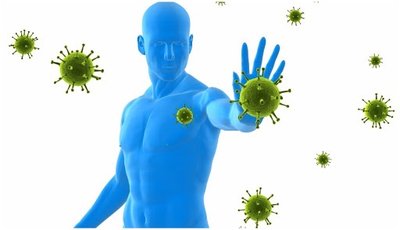
Innate Immunity
Innate immunity is the body's first line of defense and responds rapidly to pathogens. It is non-specific and present from birth. The innate immune system consists of surface barriers and internal defenses.
Surface Barriers: Physical and chemical barriers that prevent pathogen entry.
Internal Defenses: Cellular and molecular mechanisms that eliminate pathogens that breach surface barriers.
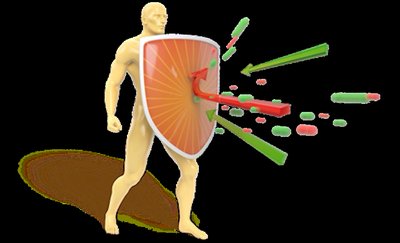
Surface Barriers
Surface barriers include the skin and mucous membranes, which act as physical and chemical shields against pathogens.
Skin: Keratinized epithelium forms a dry, watertight barrier. Glands secrete acidic pH (5.5), sebum, and lysozyme. Fatty acids inhibit microbial colonization.
Mucous Membranes: Line body cavities exposed to the environment (respiratory, gastrointestinal, urogenital tracts). Mucus traps microbes, cilia expel them, and microcidal molecules (e.g., β-defensins) destroy pathogens.
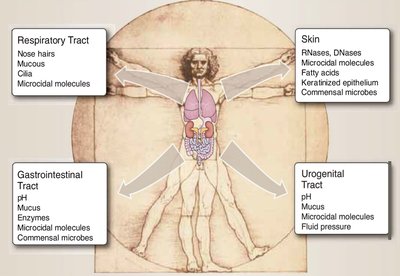
Surface Barriers: Mucous Membranes
Mucous membranes provide additional protection through specialized structures and secretions.
Respiratory Tract: Nose hairs filter particles, mucus traps microbes, cilia move secretions outward, and microcidal molecules destroy pathogens.
Gastrointestinal Tract: Mucus protects epithelial cells, stomach acid (pH 1-3) kills microorganisms, digestive enzymes degrade pathogens, and commensal microbes provide protective effects.
Urogenital Tract: Urination flushes microbes, acidic vaginal secretions (pH 4.4-4.6) inhibit pathogens, and microcidal molecules are present.
Microcidal Molecules
Various tissues synthesize and secrete microcidal molecules that inhibit or kill microbes.
Skin: α-defensins, β-defensins, cathelicidin, RNases, DNases, lysozyme
Respiratory Tract: β-defensins
Gastrointestinal Tract: α-defensins, cryptidin, digestive enzymes
Lacrimal Secretions: Lysozyme in tears
Commensal Microbes
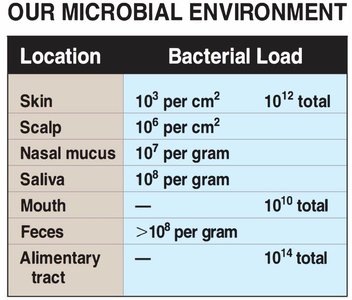
Commensal microbes exist in a symbiotic relationship with the body, defending their territory and inhibiting pathogenic microbes. They are abundant on the skin and in the gastrointestinal tract, aiding in digestion and providing protection.
Internal Defenses
When pathogens penetrate surface barriers, the body activates internal defenses, which include phagocytes, natural killer cells, inflammation, antimicrobial proteins, and fever.
Phagocytes: Macrophages, neutrophils, eosinophils, dendritic cells
Natural Killer Cells: Attack abnormal cells
Inflammation: Tissue response to injury
Antimicrobial Proteins: Interferons and complement proteins
Fever: Elevated body temperature as a defense mechanism
Phagocytes
Phagocytes are cells that engulf and digest pathogens. The main types are:
Macrophages: Chief phagocytes, derived from monocytes. Free macrophages migrate to infection sites; fixed macrophages reside in tissues (e.g., Kupffer cells in liver, microglia in brain).
Neutrophils: Become phagocytic upon encountering infectious material.
Eosinophils: Weakly phagocytic, important in defense against parasites.
Dendritic Cells: Develop from hematopoietic stem cells, capture and display antigens to T cells.
Phagocytosis Process
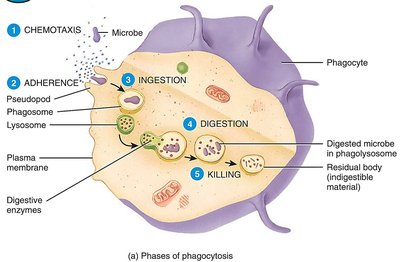
The process of phagocytosis involves several steps:
Chemotaxis: Movement of phagocytes toward the site of infection, guided by chemoattractants.
Adherence: Attachment of phagocyte to the microbe.
Ingestion: Pseudopods engulf the microbe, forming a phagosome.
Digestion: Phagosome merges with lysosome to form a phagolysosome; enzymes degrade the microbe.
Killing: Microbes are destroyed by enzymes and oxidants; indigestible material remains in residual bodies.
Natural Killer Cells
Natural killer (NK) cells are lymphocytes that attack infected or abnormal cells. They are not phagocytic and lack the membrane molecules found in B and T cells. NK cells kill a wide variety of infected and cancerous cells before the adaptive immune system is activated.
Mode of Killing: Release granzymes (protein-digesting enzymes) to induce apoptosis; release perforin to create channels in the membrane, causing cytolysis.
Inflammation
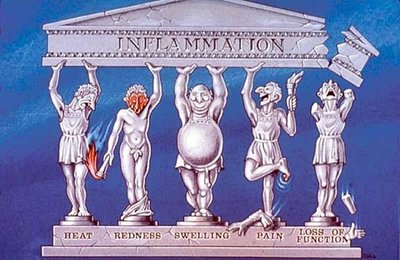
Inflammation is a tissue response to injury, with beneficial effects such as disposal of microbes, prevention of spread, and preparation for tissue repair. The four cardinal signs are redness, heat, swelling, and pain.
Vasodilation & Increased Permeability: Inflammatory chemicals (cytokines, histamine) cause blood vessels to dilate and become more permeable, allowing defensive proteins and cells to enter the injured area.
Emigration of Phagocytes: Neutrophils and monocytes migrate to the site of inflammation, where they perform phagocytosis. Dead cells and fluid accumulate as pus.
Tissue Repair: Inflammation prepares the site for tissue repair.
Antimicrobial Proteins
Antimicrobial proteins enhance innate defenses by attacking microorganisms or hindering their reproduction.
Interferons: Proteins released by virus-infected cells and certain lymphocytes; protect uninfected cells from viral infection.
Complement: Proteins that destroy bacteria by cell lysis, enhance phagocytosis, and intensify inflammation.
Fever
Fever is an abnormally high body temperature, commonly occurring during infection and inflammation. The hypothalamic thermostat is reset by pyrogens (chemicals secreted by leukocytes, macrophages, and bacteria).
Mild-Moderate Fever: Beneficial, intensifies interferon effects, inhibits microbial growth, and speeds up repair reactions.
High Fever: Dangerous, can denature enzymes.
Adaptive Immunity
Adaptive immunity is the body's ability to defend itself against specific invading agents. It is the third line of defense and is not always ready; it must be primed by an initial antigen exposure. Adaptive immunity is characterized by specificity, memory, and systemic action.
Antigens: Substances recognized as foreign that provoke immune responses.
Specificity: Targets particular antigens.
Memory: Remembers previously encountered antigens.
Systemic: Acts throughout the body.
Types of Adaptive Immune Responses
Adaptive immunity is divided into two main types:
Type | Mechanism | Cells Involved | Target Pathogens |
|---|---|---|---|
Cell-mediated immunity | Cells attacking cells | Cytotoxic T cells (with Helper T cells) | Intracellular pathogens, cancer cells, transplant tissues |
Humoral immunity | Antibody attacking cells | B cells (transform into plasma cells to secrete antibodies, with Helper T cells) | Extracellular pathogens in body fluids (blood, lymph) |

An antigen can provoke both types of adaptive immune responses.
Summary Table: Innate vs. Adaptive Immunity
Innate Immunity | Adaptive Immunity |
|---|---|
|
|
Example: The skin acts as a physical barrier, while antibodies produced by B cells target specific pathogens in the blood.
Additional info: Adaptive immunity provides long-lasting protection due to memory cells, while innate immunity offers immediate but non-specific defense.
