 Indietro
Cell Cycle, Mitosis, and Chromosome Structure: Study Notes for General Biology
Guida di studio - Note intelligenti
 Appunti personalizzati basati sui tuoi materiali, ampliati con definizioni chiave, esempi e contesto.
Cell Cycle and Mitotic Division
Overview of the Cell Cycle
The cell cycle is the process by which a single cell divides to produce two genetically identical daughter cells. This cycle is fundamental to growth, development, and maintenance in multicellular organisms, and is an outgrowth of the Cell Theory.
Cell Theory: All living things are composed of cells; the cell is the basic unit of life; all cells arise from pre-existing cells.
Eukaryotic, somatic cells: Non-reproductive cells containing the species-specific number of DNA molecules (e.g., humans have 46 chromosomes).
Cell Division: Consists of two main steps: Mitosis (nuclear division) and Cytokinesis (cytoplasmic division).
Interphase: The period of normal cellular activity between divisions; most of the cell cycle is spent in interphase.
Functions of the Cell Cycle
Unicellular organisms: Basis for asexual reproduction and colony expansion.
Multicellular organisms: Enables growth from zygote to adult, and replacement/regeneration of damaged or dead cells.
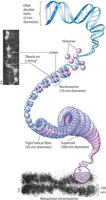
Genetic Component of Cell Reproduction
Genome and Chromosome Number
Genome: The total amount of DNA in a species; eukaryotic genomes are large, prokaryotic genomes are small.
Humans have 46 chromosomes, distributed as homologous pairs.
Position of Cell Cycle in Eukaryotic Life Cycle
Somatic cells: Diploid (2N), containing homologous pairs.
Gametes: Produced by meiosis, haploid (N).
Fertilization: Fusion of gametes restores diploid number.
Alternation of Generations
Concept and Life Cycle
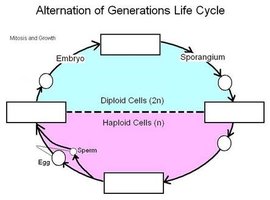
Alternation of generations describes the life cycle in which organisms alternate between haploid (N) and diploid (2N) stages.
Meiosis: Reduces chromosome number by half, producing haploid gametes.
Fertilization: Restores diploid chromosome number.
Essential for completing the life cycle and producing successive generations.
DNA Structure and Chromosome Forms
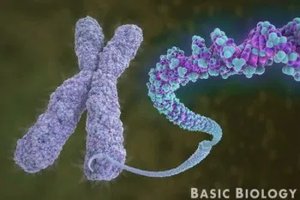
Chromatin, Sister Chromatids, and Chromosomes
Eukaryotic DNA appears in three sequential forms during the cell cycle:
Chromatin: DNA during interphase; long, thread-like strands with associated proteins, described as granular in appearance.
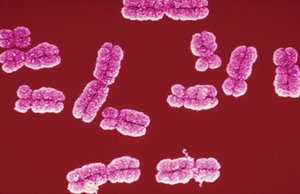
Sister Chromatids: Produced by duplication and condensation; two strands bonded at the centromere, visible during prophase and metaphase.
Chromosomes: Single-stranded, condensed DNA, visible during anaphase and telophase.
Phases of the Cell Cycle
Interphase
Normal cell activities occur (e.g., growth, development, exo-/endo-/phagocytosis, nerve transmission, muscle contraction).
Interphase occupies about 90% of the cell cycle.
Mitosis
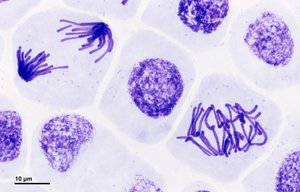
Mitosis is best understood as a continuous process divided into four phases:
Prophase: Nuclear membrane begins to dissociate, nucleoli move to cytoplasm, DNA condenses into chromatids, centrioles and spindle apparatus move toward poles.
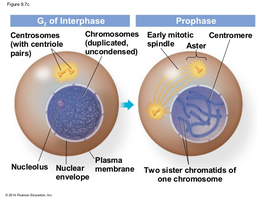
Metaphase: Nuclear membrane fully dispersed, chromatids align across the equatorial plane, spindle fibers attach to centromeres.
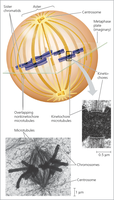
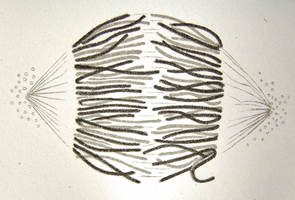
Anaphase: Spindle fibers contract, chromatids are pulled apart to opposite poles, equatorial plane disappears.
Telophase: Nuclear membrane re-forms, centrioles and spindle apparatus retreat, cytokinesis occurs, cleavage furrow (animal cells) or cell plate (plant cells) forms.
Cytokinesis
Division of cytoplasm and organelles.
Animal cells form a cleavage furrow; plant cells form a cell plate.
Homologous Pairs and Karyotypes
Homologous Chromosomes
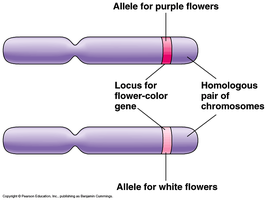
Homologous pairs are chromosomes of the same size, form, and banding pattern, with genes for the same trait at the same locus.
One homologue is maternal, one is paternal.
Humans have 23 homologous pairs: 22 autosomes and 1 pair of sex chromosomes (XX or XY).
Karyotype
A karyotype is a clinical representation of homologous pairs, used to identify gender and genetic disorders.
Produced by halting mitosis in metaphase, scattering chromatids, and arranging pairs by size, banding, and centromere position.
Can reveal abnormalities such as trisomy 21 (Down Syndrome).
Exceptions and Clinical Relevance
Cells Not Undergoing Mitosis
Erythrocytes: Lack a nucleus, cannot divide by mitosis.
Neurons: Mitosis is highly reduced after adolescence.
Cancer: Uncontrolled mitosis produces irregular cells (tumors).
HeLa Cells
Immortal cancer cell line derived from Henrietta Lacks, used extensively in medical research.
Summary Table: Chromatin, Chromatids, and Chromosomes
Form | Stage | Description |
|---|---|---|
Chromatin | Interphase | Granular, thread-like DNA |
Sister Chromatids | Prophase & Metaphase | Duplicated, condensed strands joined at centromere |
Chromosomes | Anaphase & Telophase | Single, condensed DNA strands |
Summary Table: Homologous Chromosome Criteria
Criterion | Observable? |
|---|---|
Size & Form | Yes |
Color Band Patterns | Yes |
Centromere Position | Yes |
Gene Locus | No (requires molecular analysis) |
Origin (Maternal/Paternal) | No (inferred) |
Key Equations
Diploid to Haploid: (Meiosis)
Haploid to Diploid: (Fertilization)
Example
Human somatic cell: 46 chromosomes (2N)
Human gamete: 23 chromosomes (N)
Fertilized zygote: 46 chromosomes (2N)
Additional info: Academic context was added to clarify the phases of mitosis, chromosome structure, and the alternation of generations.
