 Indietro
Cell Cycle, Mitosis, Meiosis, DNA Replication, and Transcription/Translation Study Guide
Guida di studio - Note intelligenti
 Appunti personalizzati basati sui tuoi materiali, ampliati con definizioni chiave, esempi e contesto.
Cell Cycle and Cell Division
Overview of the Cell Cycle
The cell cycle is the series of events that cells undergo as they grow and divide. It consists of several distinct phases that ensure proper replication and distribution of genetic material.
Interphase: The cell grows, replicates its DNA, and prepares for division.
Mitosis: Division of the nucleus, resulting in two identical daughter cells.
Cytokinesis: Division of the cytoplasm, completing cell division.
Phases of the Cell Cycle
G1 Phase: Cell grows and performs normal functions.
S Phase: DNA replication occurs.
G2 Phase: Cell prepares for mitosis.
M Phase: Mitosis and cytokinesis take place.
Mitosis
Stages of Mitosis
Mitosis is the process by which a cell divides to produce two genetically identical daughter cells. It is essential for growth, repair, and asexual reproduction.
Prophase: Chromosomes condense, spindle fibers form.
Metaphase: Chromosomes align at the cell's equator.
Anaphase: Sister chromatids are pulled apart to opposite poles.
Telophase: Nuclear membranes reform around each set of chromosomes.
Example: Skin cells undergo mitosis to replace damaged tissue. 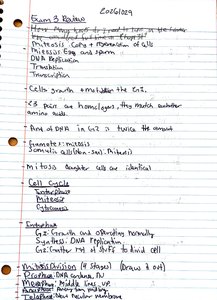
Meiosis
Purpose and Stages of Meiosis
Meiosis is a specialized type of cell division that produces gametes (egg and sperm) with half the number of chromosomes. It is crucial for sexual reproduction and genetic diversity.
Meiosis I: Homologous chromosomes separate, reducing chromosome number by half.
Meiosis II: Sister chromatids separate, similar to mitosis.
Key Points:
Meiosis results in four non-identical daughter cells.
Crossing over and recombination occur during Prophase I, increasing genetic variation.
Example: Human gametes are produced via meiosis, each containing 23 chromosomes. 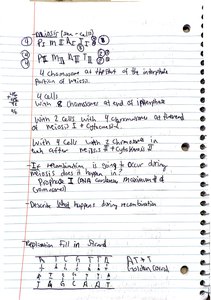
DNA Replication
Mechanism of DNA Replication
DNA replication is the process by which a cell copies its DNA before cell division. It ensures that each daughter cell receives a complete set of genetic information.
Helicase: Enzyme that unwinds the DNA double helix.
DNA Polymerase: Synthesizes new DNA strands by adding nucleotides.
Leading and Lagging Strands: DNA is synthesized continuously on the leading strand and in fragments (Okazaki fragments) on the lagging strand.
Example: During S phase, DNA replication occurs in preparation for mitosis. 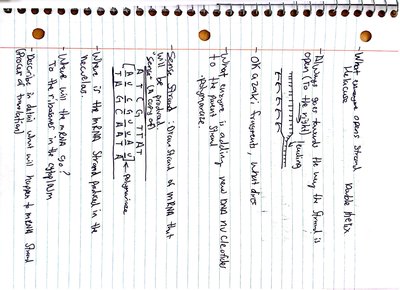
Transcription and Translation
Transcription: DNA to RNA
Transcription is the process by which a segment of DNA is copied into RNA by the enzyme RNA polymerase.
Template Strand: The DNA strand used to synthesize RNA.
RNA Polymerase: Enzyme that builds the RNA strand.
mRNA: Messenger RNA carries genetic information from DNA to the ribosome.
Translation: RNA to Protein
Translation is the process by which mRNA is decoded by ribosomes to produce a specific polypeptide (protein).
tRNA: Transfer RNA brings amino acids to the ribosome.
Codon: Three-base sequence in mRNA that specifies an amino acid.
Anticodon: Three-base sequence in tRNA complementary to the mRNA codon.
Example: The sequence AUG in mRNA codes for the amino acid methionine, the start signal for translation. 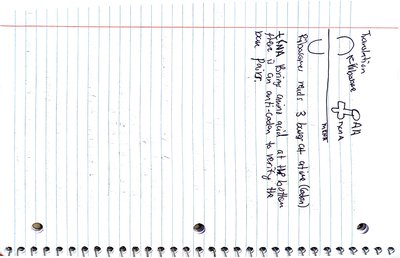
Summary Table: Comparison of Mitosis and Meiosis
Feature | Mitosis | Meiosis |
|---|---|---|
Number of Divisions | 1 | 2 |
Number of Daughter Cells | 2 | 4 |
Genetic Identity | Identical | Non-identical |
Chromosome Number | Diploid | Haploid |
Function | Growth, repair | Gamete production |
Key Terms and Definitions
Homologous Chromosomes: Chromosome pairs, one from each parent, similar in shape and gene content.
Sister Chromatids: Identical copies of a chromosome connected by a centromere.
Crossing Over: Exchange of genetic material between homologous chromosomes during meiosis.
Okazaki Fragments: Short DNA fragments synthesized on the lagging strand during DNA replication.
Codon: Three-nucleotide sequence in mRNA specifying an amino acid.
Anticodon: Three-nucleotide sequence in tRNA complementary to the codon.
Equations and Formulas
DNA Replication:
Transcription:
Translation:
Additional info:
These notes cover essential concepts for General Biology, including cell division, DNA replication, and gene expression.
Diagrams and tables have been recreated and expanded for clarity and completeness.
