 Indietro
Unit Two Bio Test Study Guide
Guida di studio - Note intelligenti
 Appunti personalizzati basati sui tuoi materiali, ampliati con definizioni chiave, esempi e contesto.
Cell Membrane Transport
Osmosis and Types of Solutions
Osmosis is a fundamental process in biology, describing the movement of water across a selectively permeable membrane. The nature of the surrounding solution affects cell behavior:
Hypertonic Solution: Has a higher solute concentration compared to another solution. Water moves out of the cell, causing it to shrink.
Hypotonic Solution: Has a lower solute concentration. Water moves into the cell, which may cause animal cells to swell and burst (lyse).
Isotonic Solution: Equal solute concentration on both sides of the membrane. Water moves equally in both directions, maintaining cell size.
Osmosis: The diffusion of water across a selectively permeable membrane.
Example: An animal cell placed in a hypotonic solution will lyse because water enters the cell by osmosis, increasing internal pressure until the membrane ruptures.
Diffusion and Transport Across Membranes
Diffusion is the movement of molecules from an area of high concentration to low concentration. The cell membrane regulates this movement through various mechanisms:
Passive Transport: Movement of substances without energy input, from high to low concentration.
Facilitated Diffusion: Diffusion of solutes through transport proteins in the membrane.
Active Transport: Movement of substances against the concentration gradient, requiring energy.
Transport Proteins:
Channel Proteins: Form pores for rapid movement of water or small ions (e.g., aquaporins).
Gated Channel Proteins: Open or close in response to stimuli, allowing selective passage (e.g., sodium channels in nerve cells).
Carrier Proteins: Change shape to transport specific molecules (e.g., glucose transporters).
Example: Oxygen, being small and nonpolar, diffuses easily across the membrane, while large polar molecules require carrier proteins.
Selective Permeability of the Cell Membrane
The cell membrane is selectively permeable, allowing only certain molecules to cross:
Can Cross: Small nonpolar molecules, carbon dioxide, small lipid-soluble molecules, some small uncharged polar molecules.
Cannot Cross: Ions, large polar molecules, macromolecules.
Cell Structure and Function
Prokaryotic vs. Eukaryotic Cells
Cells are classified based on the presence or absence of a nucleus and organelles:
Only Prokaryotic Cells | Both | Only Eukaryotic Cells |
|---|---|---|
Nucleoid, Circular chromosome, Plasmids, Capsule, Pili/fimbriae, Prokaryotic flagellum, Cell wall (peptidoglycan) | Cell membrane, Cytoplasm, Ribosomes, DNA, Cell wall (some) | Nucleus, Mitochondria, ER, Golgi apparatus, Lysosomes, Vacuoles, Chloroplasts, Cytoskeleton |
Unicellular vs. Multicellular: Unicellular organisms consist of one cell performing all functions; multicellular organisms have specialized cells working together.
Phospholipid Bilayer
The cell membrane is composed of a phospholipid bilayer:
Phospholipids: Molecules with hydrophilic (water-loving) heads and hydrophobic (water-fearing) tails.
Semipermeability: Allows only certain molecules to pass.
Diagram: The bilayer consists of two layers of phospholipids, with heads facing outward toward water and tails inward, away from water.
Cellular Respiration
Overview and Equation
Cellular respiration is the process by which cells convert glucose and oxygen into energy (ATP), carbon dioxide, and water:
ATP: The energy currency of the cell, a nucleic acid with three phosphates.
Cellular Respiration: Breaks down glucose to produce ATP.
Fermentation: Occurs when oxygen is unavailable, producing less ATP.
Equation for Aerobic Cellular Respiration:
Location: Cellular respiration occurs in the mitochondria, specifically in the inner membrane and matrix.

Importance of Inner Membrane Folds: The folds (cristae) increase surface area, allowing more space for electron transport chain proteins and ATP synthesis.
Electron Transport Chain (ETC)
The ETC is the final stage of cellular respiration, where electrons are passed through proteins, and hydrogen ions diffuse through ATP synthase to generate ATP.
Final Electron Acceptor: Oxygen is the final electron acceptor; without it, the ETC cannot function, and ATP production is limited.
Fermentation: If oxygen is absent, cells use fermentation to produce ATP.
Respiratory System and Gas Exchange
Structure and Function
The respiratory system enables gas exchange, supplying oxygen to the blood and removing carbon dioxide:
Key Structures: Trachea, pharynx, heart, diaphragm, alveoli.
Alveoli: Tiny air sacs where gas exchange occurs.
Large Surface Area: Increases efficiency of gas exchange.
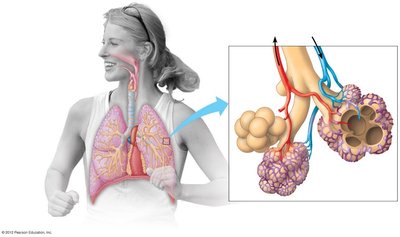
Gas Exchange: Oxygen diffuses into the blood at the alveoli, while carbon dioxide diffuses out. In body tissues, carbon dioxide diffuses into the blood, and oxygen diffuses out.
Breathing Regulation: The brain senses increasing acidity (CO2 levels) to control breathing automatically.
Cell Size and Surface Area-to-Volume Ratio
Why Cells Are Small
Cell size is limited by the surface area-to-volume ratio, which affects the efficiency of nutrient uptake and waste removal:
Surface Area: The area available for exchange of materials.
Volume: The space inside the cell.
Surface Area-to-Volume Ratio: As cells grow, volume increases faster than surface area, reducing efficiency.
Example: Smaller cells have a higher surface area-to-volume ratio, allowing faster diffusion of substances.
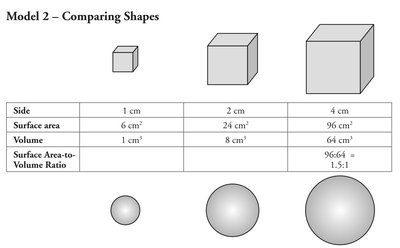
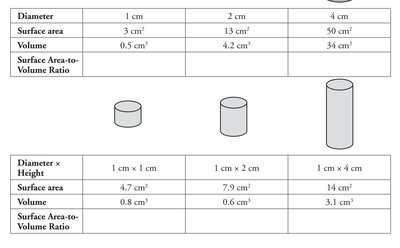
Table Purpose: These tables compare the surface area, volume, and surface area-to-volume ratio for cubes, spheres, and cylinders of different sizes, illustrating how ratio decreases as size increases.
Implications: Cells must remain small to efficiently exchange materials. Large cells may require specialized shapes or structures to maintain adequate surface area.
Additional info: The inner membrane folds in mitochondria are analogous to increasing surface area in cells, enhancing the rate of reactions and transport.
