 Indietro
Cellular Energetics Study Guide – Step-by-Step Guidance
Guida di studio - Note intelligenti
 Appunti personalizzati basati sui tuoi materiali, ampliati con definizioni chiave, esempi e contesto.
Q1. Draw and label the basic structure of an enzyme.
Background
Topic: Enzyme Structure
This question is testing your understanding of the physical structure of enzymes, including the active site and allosteric site, which are critical for enzyme function and regulation.
Key Terms:
Enzyme: A protein that catalyzes biochemical reactions.
Active Site: The region on the enzyme where the substrate binds and the reaction occurs.
Allosteric Site: A site on the enzyme other than the active site, where molecules can bind and affect enzyme activity.
Step-by-Step Guidance
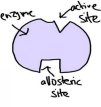
Start by drawing the general shape of an enzyme, which is typically a globular protein.
Identify and label the active site, which is usually a pocket or groove on the enzyme's surface.
Label the allosteric site, which is a separate region where regulatory molecules can bind.
Make sure to indicate that the substrate fits into the active site, like a key in a lock.
Try solving on your own before revealing the answer!
Final Answer:
The basic structure of an enzyme includes a main protein body, an active site (where substrates bind), and an allosteric site (where regulatory molecules bind). The active site is shaped specifically for the substrate, while the allosteric site can modulate enzyme activity. The provided diagram visually shows these features.
Q2. Describe how enzymes are named.
Background
Topic: Enzyme Nomenclature
This question is about understanding the conventions used to name enzymes based on their function or the substrate they act upon.
Key Terms:
-ase: The suffix used for most enzyme names.
Substrate: The molecule upon which an enzyme acts.
Step-by-Step Guidance
Recall that most enzyme names end with the suffix "-ase".
Think about how the name often reflects either the substrate or the type of reaction catalyzed (e.g., lactase breaks down lactose).
Consider examples of enzyme names and what they indicate about the enzyme's function.
Try solving on your own before revealing the answer!
Final Answer:
Enzymes are usually named by adding "-ase" to the name of the substrate they act on or the type of reaction they catalyze. For example, "lactase" breaks down lactose, and "DNA polymerase" synthesizes DNA.
Q3. True or False: enzymes are consumed by reactions.
Background
Topic: Enzyme Function
This question tests your understanding of whether enzymes are used up or remain unchanged after catalyzing a reaction.
Key Terms:
Catalyst: A substance that speeds up a reaction without being consumed.
Enzyme: A biological catalyst.
Step-by-Step Guidance
Recall the definition of a catalyst and its role in chemical reactions.
Think about whether enzymes are changed or used up during the reaction.
Consider what happens to the enzyme after the reaction is complete.
Try solving on your own before revealing the answer!
Final Answer:
False; enzymes are not consumed by reactions. They remain unchanged and can be used repeatedly to catalyze more reactions.
Q4. Can any substrate bind to any enzyme? Why or why not?
Background
Topic: Enzyme Specificity
This question is about the specificity of enzyme-substrate interactions, which is a fundamental concept in biochemistry.
Key Terms:
Substrate: The molecule that an enzyme acts upon.
Active Site: The region of the enzyme where the substrate binds.
Lock-and-Key Model: Describes how enzymes and substrates fit together specifically.
Step-by-Step Guidance
Recall the structure of the enzyme's active site and how it is uniquely shaped for a specific substrate.
Think about the lock-and-key analogy and how it explains enzyme specificity.
Consider what would happen if a substrate does not fit the active site.
Try solving on your own before revealing the answer!
Final Answer:
No, not just any substrate can bind to any enzyme. Each enzyme has a uniquely shaped active site, and only substrates with the correct shape can bind, similar to a lock and key.
Q5. Of the four classes of macromolecules, to which do enzymes belong?
Background
Topic: Macromolecules
This question tests your knowledge of the four major classes of biological macromolecules and the classification of enzymes.
Key Terms:
Macromolecule: Large biological molecules (proteins, carbohydrates, lipids, nucleic acids).
Protein: A macromolecule made of amino acids; most enzymes are proteins.
Step-by-Step Guidance
Recall the four classes of macromolecules: proteins, carbohydrates, lipids, and nucleic acids.
Think about the structure and function of enzymes.
Consider which class enzymes belong to based on their composition.
Try solving on your own before revealing the answer!
Final Answer:
Enzymes belong to the class of proteins, which are made up of amino acids.
Q6. Are enzymes necessary for all living things to function? Discuss your thoughts here.
Background
Topic: Enzyme Importance in Life
This question is about the essential role of enzymes in biological processes and life.
Key Terms:
Enzyme: Biological catalyst.
Metabolism: All chemical reactions in living organisms.
Step-by-Step Guidance
Think about the speed of chemical reactions in cells without enzymes.
Consider examples of vital reactions that require enzymes (e.g., digestion, energy production).
Reflect on what would happen if enzymes were absent in living organisms.
Try solving on your own before revealing the answer!
Final Answer:
Yes, enzymes are necessary for all living things to function because they allow vital chemical reactions to occur quickly enough to sustain life. Without enzymes, reactions would be too slow for life to exist.
Q7. Describe how enzymes are able to “speed up” reactions.
Background
Topic: Enzyme Catalysis
This question is about the mechanism by which enzymes increase the rate of biochemical reactions.
Key Terms and Formula:
Activation Energy (): The minimum energy required to start a reaction.
Enzyme: Lowers activation energy.
Step-by-Step Guidance
Recall that enzymes lower the activation energy required for a reaction.
Think about how enzymes bring substrates together in the correct orientation.
Consider how enzymes may change the shape of the substrate to facilitate the reaction.
Reflect on the effect of lowering activation energy on reaction speed.
Try solving on your own before revealing the answer!
Final Answer:
Enzymes speed up reactions by lowering the activation energy, bringing substrates together, and sometimes changing their shape to make the reaction more likely to occur.
Q8. List and describe 3 factors that can affect the function of an enzyme.
Background
Topic: Environmental Impacts on Enzyme Function
This question is about understanding how external factors influence enzyme activity.
Key Terms:
Temperature: Affects enzyme activity and can cause denaturation.
pH: Enzymes function best at specific pH levels.
Chemicals: Can inhibit or enhance enzyme activity.
Step-by-Step Guidance
Identify temperature as a factor and describe how it can increase or decrease enzyme activity.
Explain how pH affects enzyme structure and function.
Discuss the role of chemicals, including inhibitors, in affecting enzyme activity.
Try solving on your own before revealing the answer!
Final Answer:
Three factors that affect enzyme function are temperature, pH, and chemicals. Temperature can increase activity up to a point, but extreme temperatures denature enzymes. pH affects enzyme structure, and chemicals can inhibit or enhance activity.
Q9. Explain how temperature can increase, decrease, and stop an enzyme’s function.
Background
Topic: Temperature Effects on Enzyme Activity
This question is about the relationship between temperature and enzyme activity, including denaturation.
Key Terms:
Denaturation: Loss of enzyme structure and function due to extreme conditions.
Optimal Temperature: The temperature at which enzyme activity is highest.
Step-by-Step Guidance
Recall that increasing temperature generally increases enzyme activity up to an optimal point.
Think about what happens when temperature exceeds the optimal range (denaturation).
Consider how extreme temperatures can completely stop enzyme function.
Try solving on your own before revealing the answer!
Final Answer:
Temperature can increase enzyme function within an optimal range, decrease it outside that range, and stop it entirely if the enzyme is denatured by extreme temperatures.
Q10. Try creating a flow chart that traces the flow of energy through your body. What products increase entropy of you and your surroundings?
Background
Topic: Energy Flow and Entropy in Biological Systems
This question is about tracing how energy moves through the body and identifying products that increase entropy.
Key Terms:
Entropy: A measure of disorder or randomness in a system.
Energy Flow: The movement of energy through biological processes.
Step-by-Step Guidance
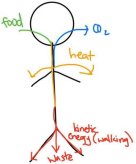
Start by identifying the sources of energy (food, oxygen).
Trace how energy is used for cellular work and movement (kinetic energy).
Identify waste products and heat as outputs that increase entropy.
Consider how these products are released into the environment.
Try solving on your own before revealing the answer!
Final Answer:
Products that increase entropy include heat, CO2, H2O, and waste. These are released as energy flows through the body, increasing disorder in the surroundings.
