 Indietro
Cellular Respiration and Energy Harvest in Cells
Guida di studio - Note intelligenti
 Appunti personalizzati basati sui tuoi materiali, ampliati con definizioni chiave, esempi e contesto.
Cellular Respiration: Overview
Introduction to Cellular Respiration
Cellular respiration is a fundamental process by which cells extract energy from organic molecules. It involves a series of enzyme-catalyzed reactions that break down large molecules, such as glucose, into smaller fragments, releasing energy stored in chemical bonds. - Cellular respiration is essential for producing ATP, the energy currency of the cell. - The process begins with digestion, followed by stepwise dismantling of fragments to harvest energy.
Redox Reactions in Cellular Respiration
Redox reactions are central to cellular respiration, involving the transfer of electrons between molecules. - Oxidation: Loss of electrons from a molecule. - Reduction: Gain of electrons by a molecule. - These reactions are often accompanied by the loss of hydrogen atoms (dehydrogenation), where electrons and protons are removed together. 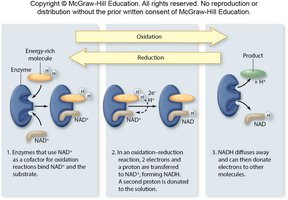
Electron Carriers and Energy Transfer
Electron carriers, such as NAD+, play a crucial role in transferring electrons and energy during cellular respiration. - NAD+ accepts two electrons and one proton to become NADH. - NADH can then donate electrons to other molecules, facilitating energy transfer. - The process is reversible, allowing NAD+ to be recycled. 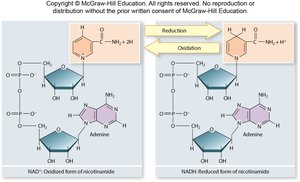
Energy Harvest and Electron Transport
During cellular respiration, electrons are transferred through a series of redox reactions, gradually losing energy. - The energy released is used to synthesize ATP or form other chemical bonds; excess energy is lost as heat. - High-energy electrons are eventually transferred to a final electron acceptor. 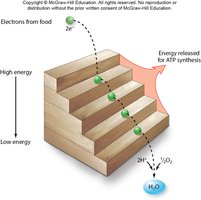
Final Electron Acceptors
The nature of the final electron acceptor determines the type of respiration: - Aerobic respiration: Oxygen (O2) is the final electron acceptor, reduced to water (H2O). - Anaerobic respiration: An inorganic molecule (not O2) is the final electron acceptor. - Fermentation: An organic molecule is the final electron acceptor.
Aerobic Respiration and ATP Production
Overall Reaction of Aerobic Respiration
Aerobic respiration involves the complete oxidation of glucose, releasing energy. - The overall equation: - Free energy change: (exergonic, spontaneous) - Energy is released in small steps to maximize ATP production and minimize heat loss.
ATP: The Energy Currency
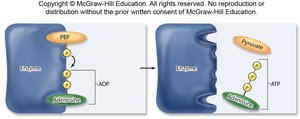
ATP (adenosine triphosphate) is used by cells to drive endergonic reactions. - Hydrolysis of ATP's terminal phosphate releases of energy. - ATP is synthesized by two mechanisms: 1. Substrate-level phosphorylation: Direct transfer of a phosphate group to ADP from another molecule. 2. Oxidative phosphorylation: ATP synthase uses energy from a proton gradient to synthesize ATP. 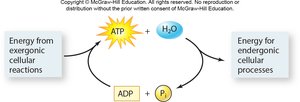
Stages of Glucose Oxidation
Major Stages
The complete oxidation of glucose occurs in four main stages: 1. Glycolysis 2. Pyruvate oxidation 3. Citric acid cycle 4. Electron transport chain & chemiosmosis 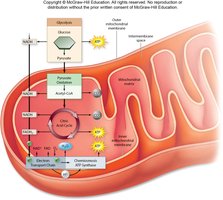
Glycolysis
Glycolysis is an ancient, anaerobic pathway that occurs in the cytoplasm. - 10-step pathway converting 1 glucose (6C) to 2 pyruvates (3C each). - Net production: 2 ATP (substrate-level phosphorylation), 2 NADH (reduction of NAD+). 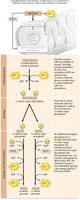
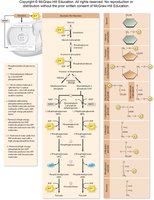
Phases of Glycolysis
- Priming reactions (steps 1-3): Glucose is phosphorylated, requiring 2 ATP. - Cleavage (steps 4-5): Fructose 1,6-bisphosphate is split into two 3-carbon sugars (G3P). - Oxidation and ATP formation (steps 6-10): G3P is oxidized, forming NADH and BPG; BPG is converted to pyruvate, yielding ATP.
Net Result of Glycolysis
- Glucose → 2 pyruvate - Net 2 ATP (4 produced, 2 used) - 2 NADH
NADH Recycling
For glycolysis to continue, NADH must be recycled to NAD+: - Aerobic respiration: Oxygen is available; NADH is oxidized in the electron transport chain, producing ATP. - Fermentation: Oxygen is absent; NADH is oxidized by reducing organic molecules. 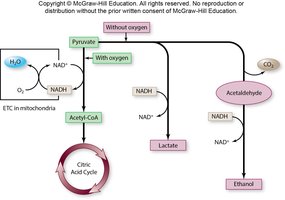
Fermentation
Types of Fermentation
Fermentation allows glycolysis to continue under anaerobic conditions by regenerating NAD+. - Ethanol fermentation (yeast): NADH reduces acetaldehyde, producing CO2, ethanol, and NAD+. - Lactic acid fermentation (animal cells): NADH reduces pyruvate, producing lactic acid and NAD+. 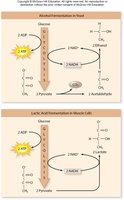
Fate of Pyruvate
Pyruvate Oxidation
The fate of pyruvate depends on oxygen availability: - With oxygen: Pyruvate is oxidized to acetyl-CoA, feeding the citric acid cycle. - Without oxygen: Pyruvate is reduced to regenerate NAD+ (fermentation).
Pyruvate Oxidation Process
- Occurs in mitochondrial matrix (eukaryotes) or cytoplasm/plasma membrane (prokaryotes). - Catalyzed by pyruvate dehydrogenase complex. - Products per pyruvate: - 1 CO2 (decarboxylation) - 1 NADH - 1 acetyl-CoA (2C attached to coenzyme A) 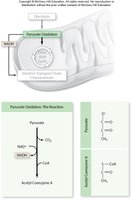
Summary Table: Pathways of Cellular Respiration
Stage | Main Location | Key Products | ATP Yield |
|---|---|---|---|
Glycolysis | Cytoplasm | 2 Pyruvate, 2 NADH | 2 ATP (net) |
Pyruvate Oxidation | Mitochondrial Matrix | 2 Acetyl-CoA, 2 NADH, 2 CO2 | 0 ATP |
Citric Acid Cycle | Mitochondrial Matrix | 6 NADH, 2 FADH2, 4 CO2 | 2 ATP |
Electron Transport Chain | Inner Mitochondrial Membrane | H2O | ~28 ATP |
Additional info: The citric acid cycle and electron transport chain are covered in subsequent sections; this chapter focuses on glycolysis, fermentation, and pyruvate oxidation. ----------------------------------------
