 Indietro
Cellular Respiration and Fermentation: Energy Production in Cells
Guida di studio - Note intelligenti
 Appunti personalizzati basati sui tuoi materiali, ampliati con definizioni chiave, esempi e contesto.
Cellular Respiration and Fermentation
Introduction to Cellular Energy Production
Cells require energy to perform essential functions, and this energy is primarily supplied by ATP. Cellular respiration and fermentation are metabolic pathways that harvest energy from high-energy molecules, such as glucose, to produce ATP. The energy released during these processes is used to add a phosphate group to ADP, forming ATP, which fuels cellular work.
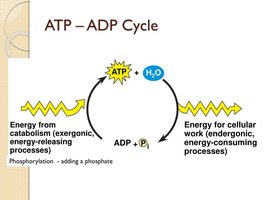
Overview of Cellular Respiration
Cellular respiration is a series of metabolic reactions that oxidize glucose to produce ATP. Most cells continuously synthesize ATP, as it is unstable and only stored briefly. Glucose is obtained from photosynthesis in plants or from food in other organisms and is stored as glycogen or starch.
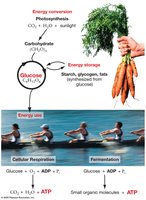
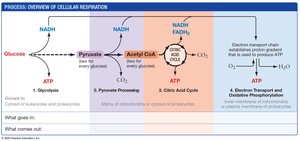
Cellular respiration consists of four main processes:
Glycolysis: Breakdown of glucose into two pyruvate molecules
Pyruvate processing: Oxidation of pyruvate to acetyl CoA
Citric acid cycle: Oxidation of acetyl CoA to CO2
Electron transport and oxidative phosphorylation: Electrons move through a transport chain, creating a proton gradient used to make ATP
Fermentation is an alternative pathway that oxidizes glucose without fully breaking it down, producing less ATP and small, reduced organic molecules as waste.
Metabolic Pathways and Regulation
Metabolism includes catabolic pathways (breakdown of molecules to harvest energy) and anabolic pathways (synthesis of larger molecules using ATP). Cellular respiration is central to metabolism, providing both energy and carbon sources for biosynthesis.
Glycolysis
Key Steps and Regulation
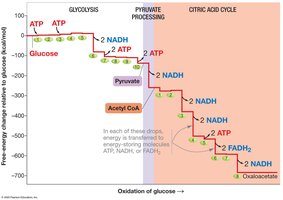
Glycolysis is a sequence of 10 reactions occurring in the cytosol. It begins with an energy investment phase, using two ATP, and ends with an energy payoff phase, producing NADH and ATP by substrate-level phosphorylation. The net yield is two NADH, two ATP, and two pyruvate per glucose molecule.
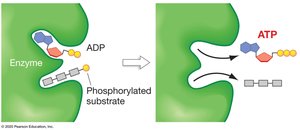
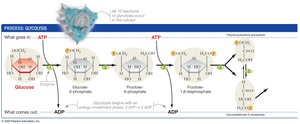
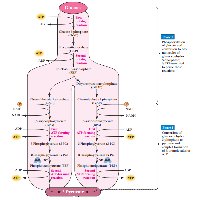
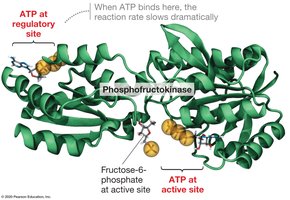
Regulation: Glycolysis is regulated by feedback inhibition, primarily at the enzyme phosphofructokinase. High ATP levels inhibit this enzyme, slowing glycolysis.
Processing Pyruvate to Acetyl CoA
Mitochondrial Structure and Pyruvate Processing
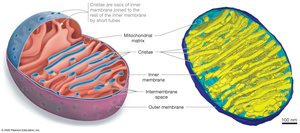
In eukaryotes, pyruvate from glycolysis is transported into mitochondria, which have inner and outer membranes and cristae. Pyruvate is processed by pyruvate dehydrogenase in the mitochondrial matrix (or cytosol in prokaryotes), producing acetyl CoA, CO2, and NADH.
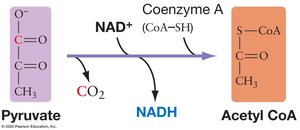
Regulation: Pyruvate processing is regulated by feedback inhibition. High levels of NADH, acetyl CoA, or ATP increase phosphorylation and inhibit the enzyme, while high levels of ADP, pyruvate, CoA, or NAD+ increase dephosphorylation and activate it.
The Citric Acid Cycle
Oxidation of Acetyl CoA
The citric acid cycle, located in the mitochondrial matrix (eukaryotes) or cytosol (prokaryotes), oxidizes acetyl CoA to CO2. The cycle starts with the formation of citrate from acetyl CoA and oxaloacetate and regenerates oxaloacetate at the end.
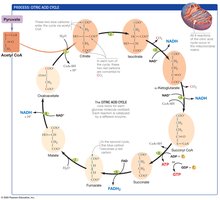
Each turn of the cycle produces:
3 NADH
1 FADH2
1 ATP (or GTP)
The cycle turns twice per glucose molecule.
Regulation of the Citric Acid Cycle
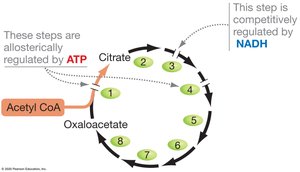
Feedback inhibition regulates the cycle at multiple points. High ATP and NADH levels decrease reaction rates, while scarcity increases them.
Glucose Oxidation: Summary and Energy Yield
Products of Glucose Oxidation
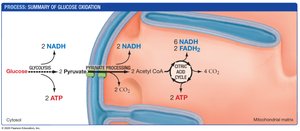
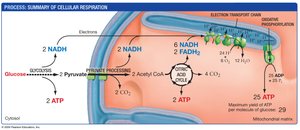
For each glucose molecule oxidized, the cell produces 6 CO2, 10 NADH, 2 FADH2, and 4 ATP. Most energy is stored in electrons carried by NADH and FADH2, which are transferred to oxygen to form water.
Electron Transport Chain and Chemiosmosis
Electron Transport Chain (ETC)
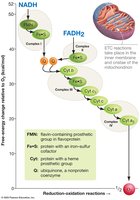
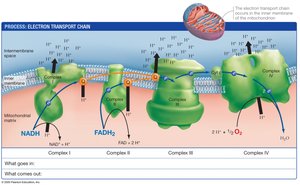
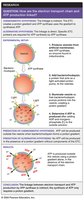
The ETC is a series of protein complexes (I-IV) and mobile carriers (Q and cytochrome c) in the inner mitochondrial membrane. Electrons from NADH and FADH2 are transferred through the chain, releasing energy used to pump protons and create a proton gradient.
ATP Synthase and Chemiosmosis
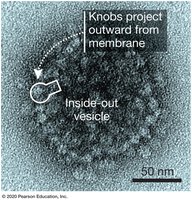
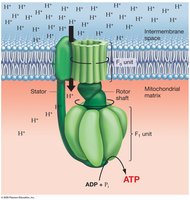
ATP synthase is a protein complex that synthesizes ATP from ADP and Pi, powered by the proton-motive force generated by the ETC. The F0 unit acts as a proton channel, and the F1 unit phosphorylates ADP as protons flow through.
ATP Yield from Cellular Respiration
Oxidative phosphorylation produces about 29 ATP per glucose molecule, making it the most efficient ATP-generating process in cells.
Aerobic and Anaerobic Respiration
Diversity of Electron Acceptors
All eukaryotes and many prokaryotes use oxygen as the final electron acceptor (aerobic respiration), which yields the most energy. Some prokaryotes use other acceptors, such as nitrate or sulfate, in anaerobic respiration, which yields less energy.
Fermentation
Fermentation Pathways
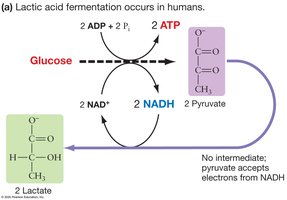
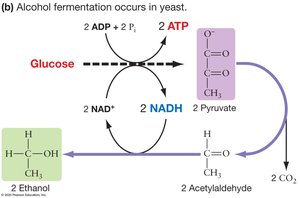
When no electron acceptor is available, the ETC stops, and NADH accumulates. Fermentation regenerates NAD+ from NADH, allowing glycolysis to continue producing ATP by substrate-level phosphorylation.
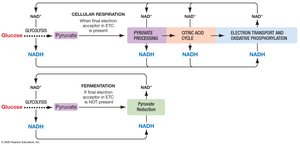
Lactic acid fermentation: Pyruvate accepts electrons from NADH, producing lactate and NAD+. This occurs in muscle cells under low oxygen conditions.
Alcohol fermentation: In yeast, pyruvate is converted to acetaldehyde and CO2. Acetaldehyde accepts electrons from NADH, producing ethanol and NAD+.
Fermentation is less efficient than cellular respiration, producing only 2 ATP per glucose. Some organisms, called facultative anaerobes, can switch between fermentation and aerobic respiration depending on oxygen availability.
Catabolic and Anabolic Pathways
Interaction of Metabolic Pathways
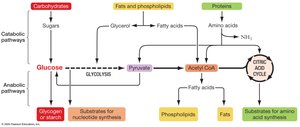
Cellular respiration interacts with other catabolic pathways. Cells use carbohydrates first for ATP production, then fats and proteins. Fats are broken down into glycerol and fatty acids, which enter glycolysis and the citric acid cycle. Proteins are broken down into amino acids, which are converted to intermediates used in glycolysis and the citric acid cycle.
Anabolic Pathways and Homeostasis
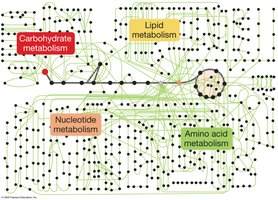
Intermediates from cellular respiration are used to synthesize macromolecules, such as nucleotides, fatty acids, and amino acids. Metabolism is organized into pathways to allow regulation and maintain homeostasis under varying environmental conditions.
Summary Table: Cellular Respiration Steps
Step | Main Input | Main Output | Location | ATP Yield |
|---|---|---|---|---|
Glycolysis | Glucose | 2 Pyruvate, 2 NADH, 2 ATP | Cytosol | 2 ATP |
Pyruvate Processing | 2 Pyruvate | 2 Acetyl CoA, 2 NADH, 2 CO2 | Mitochondrial matrix | 0 ATP |
Citric Acid Cycle | 2 Acetyl CoA | 4 CO2, 6 NADH, 2 FADH2, 2 ATP | Mitochondrial matrix | 2 ATP |
Electron Transport & Oxidative Phosphorylation | NADH, FADH2, O2 | H2O, ATP | Inner mitochondrial membrane | ~25 ATP |
Fermentation | Glucose | Lactate or Ethanol, NAD+, 2 ATP | Cytosol | 2 ATP |
Key Terms and Concepts
ATP (Adenosine Triphosphate): The primary energy carrier in cells.
Substrate-level phosphorylation: Direct transfer of a phosphate group to ADP to form ATP.
Oxidative phosphorylation: ATP synthesis powered by the proton gradient generated by the ETC.
Feedback inhibition: Regulation of metabolic pathways by the end product.
Facultative anaerobes: Organisms that can switch between aerobic respiration and fermentation.
Homeostasis: Maintenance of a stable internal environment.
Equations
Overall equation for cellular respiration:
ATP synthesis:
Example Applications
Muscle cells: Switch to lactic acid fermentation during intense exercise when oxygen is scarce.
Yeast cells: Perform alcohol fermentation to produce ethanol in anaerobic conditions.
Prokaryotes: Use alternative electron acceptors in anaerobic environments, such as nitrate or sulfate.
Additional info: Expanded explanations and context were added to ensure completeness and clarity for exam preparation.
