 Indietro
Cellular Respiration and Photosynthesis: Energy Transformations in Cells
Guida di studio - Note intelligenti
 Appunti personalizzati basati sui tuoi materiali, ampliati con definizioni chiave, esempi e contesto.
How Cells Harvest Chemical Energy
Overview of Cellular Respiration
Cellular respiration is the process by which cells extract energy from organic molecules, primarily glucose, to produce ATP, the universal energy currency of the cell. This process is essential for powering cellular activities and maintaining life.
Cellular respiration occurs in mitochondria and involves a series of redox reactions that transfer electrons from fuel molecules to oxygen.
It is an exergonic process, releasing energy that is captured as ATP and heat.
Only about 34% of the energy in glucose is converted to ATP; the rest is lost as heat.
The overall equation for cellular respiration is:

Photosynthesis and Cellular Respiration: Coupled Processes
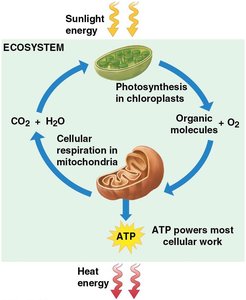
Photosynthesis and cellular respiration are interconnected processes that cycle matter and energy through ecosystems.
Photosynthesis (in chloroplasts) uses sunlight to convert CO2 and H2O into organic molecules, releasing O2.
Cellular respiration (in mitochondria) consumes O2 and organic molecules, releasing CO2 and H2O while capturing energy as ATP.
Plants produce more O2 than they use, supporting aerobic life on Earth.
Breathing and Cellular Respiration
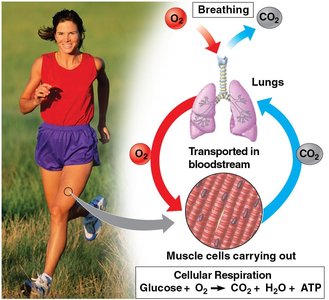
Breathing (gas exchange) and cellular respiration are linked but distinct processes.
Breathing moves O2 into the body and CO2 out, while cellular respiration uses O2 inside cells to extract energy from food.
O2 inhaled is transported by the circulatory system to cells, where it is used in respiration; CO2 exhaled is a waste product of glucose breakdown.
The oxygen atoms in CO2 come from glucose, not from inhaled O2.
ATP: The Energy Currency of the Cell
ATP (adenosine triphosphate) is required for all cellular activities, including muscle contraction, nerve signaling, biosynthesis, and maintenance.
The body must continuously produce ATP to meet energy demands.
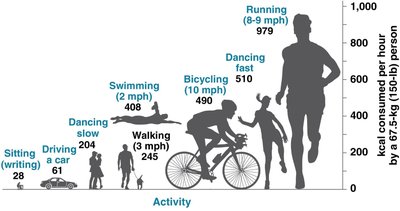
Energy expenditure varies by activity, from about 28 kcal/hr at rest to nearly 1,000 kcal/hr during intense exercise.
Active muscle cells can use up to 10 million ATP molecules per second.
Redox Reactions in Cellular Respiration
Energy is extracted from glucose through a series of oxidation-reduction (redox) reactions.
Oxidation: Loss of electrons or hydrogen atoms from a molecule.
Reduction: Gain of electrons or hydrogen atoms by a molecule.
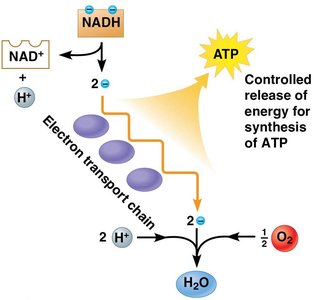
NAD+ acts as an electron carrier, becoming reduced to NADH, which delivers electrons to the electron transport chain (ETC).
Electrons "fall" from fuel to oxygen in a stepwise manner, releasing energy gradually for ATP synthesis.
Stages of Cellular Respiration
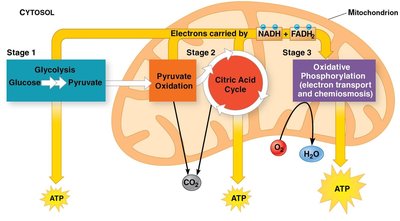
Cellular respiration occurs in three main stages:
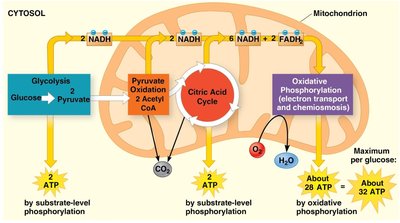
Glycolysis (cytosol): Glucose is split into two pyruvate molecules, yielding 2 ATP and 2 NADH.
Pyruvate oxidation & Citric acid cycle (mitochondrial matrix): Pyruvate is oxidized to CO2; electrons are transferred to NADH and FADH2; a small amount of ATP is produced.
Oxidative phosphorylation (inner mitochondrial membrane): NADH and FADH2 donate electrons to the ETC; the resulting H+ gradient drives ATP synthase to produce most of the cell's ATP; O2 is the final electron acceptor, forming H2O.
Glycolysis: Oxidizing Glucose to Pyruvate
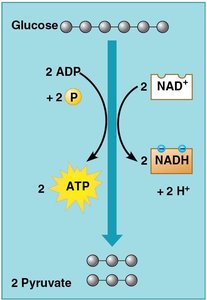
Glycolysis is a universal, ancient pathway that occurs in the cytosol and does not require oxygen.
Consists of 9 steps divided into two phases:
Energy investment phase: 2 ATP are used to phosphorylate glucose and split it into two 3-carbon molecules (G3P).
Energy payoff phase: G3P is oxidized, reducing NAD+ to NADH and generating 4 ATP by substrate-level phosphorylation.
Net yield per glucose: 2 ATP, 2 NADH, 2 pyruvate.
Pyruvate Oxidation and the Citric Acid Cycle
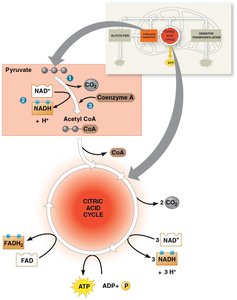
After glycolysis, pyruvate enters the mitochondrion and is further oxidized in two steps:
Pyruvate oxidation: Each pyruvate is converted to acetyl CoA, releasing CO2 and producing NADH.
Citric acid cycle: Acetyl CoA combines with oxaloacetate to form citrate. Each turn of the cycle releases 2 CO2, produces 3 NADH, 1 FADH2, and 1 ATP (by substrate-level phosphorylation).
Since two pyruvates are produced per glucose, the cycle turns twice per glucose molecule.
Oxidative Phosphorylation and Chemiosmosis
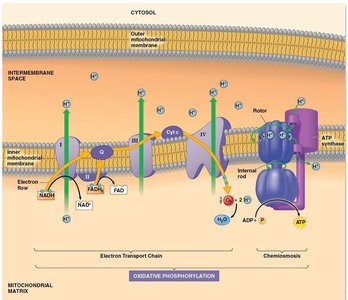
Oxidative phosphorylation is the final stage of cellular respiration, producing the majority of ATP.
Electron transport chain (ETC): NADH and FADH2 donate electrons to protein complexes in the inner mitochondrial membrane. As electrons move to O2, energy is released and used to pump H+ ions into the intermembrane space.
Chemiosmosis: The H+ gradient drives protons back through ATP synthase, catalyzing the phosphorylation of ADP to ATP.
O2 is the final electron acceptor, forming H2O.
Produces 26–34 ATP per glucose.
ATP Yield from Cellular Respiration
The maximum theoretical yield of ATP per glucose is about 32, but actual yield is often lower due to inefficiencies.
Stage | ATP Produced | NADH | FADH2 |
|---|---|---|---|
Glycolysis | 2 | 2 | 0 |
Pyruvate Oxidation + Citric Acid Cycle | 2 | 8 | 2 |
Oxidative Phosphorylation | ~28 | - | - |
Total | ~32 | - | - |
Fermentation: Anaerobic Harvesting of Energy
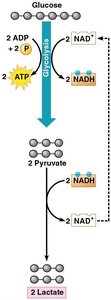
Fermentation allows cells to produce ATP by glycolysis alone when oxygen is unavailable.
Glycolysis requires NAD+; fermentation regenerates NAD+ by reducing pyruvate.
Lactic acid fermentation: Pyruvate is reduced to lactate (in muscle cells and some bacteria).
Alcohol fermentation: Pyruvate is converted to CO2 and ethanol (in yeast).
Fermentation yields only 2 ATP per glucose, so cells must metabolize glucose much faster to meet energy needs.
Glycolysis: An Ancient, Universal Pathway
Glycolysis is found in virtually all living organisms, indicating its evolutionary antiquity.
Occurs in the cytosol, requires no organelles or oxygen, and is conserved across all domains of life.
Serves as the core of both fermentation and aerobic respiration pathways.
Connections Between Metabolic Pathways
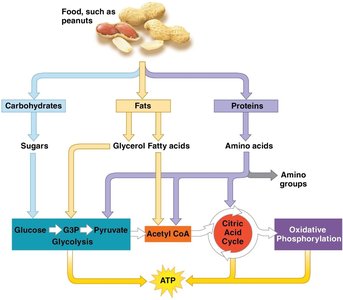
Cells can use carbohydrates, fats, and proteins as fuel for cellular respiration, and intermediates from these pathways are also used for biosynthesis.
Carbohydrates: Hydrolyzed to glucose or other sugars that enter glycolysis.
Fats: Split into glycerol (enters glycolysis) and fatty acids (converted to acetyl CoA for the citric acid cycle); yield more ATP per gram than carbohydrates.
Proteins: Digested to amino acids; after deamination, carbon skeletons enter as pyruvate, acetyl CoA, or citric acid cycle intermediates.
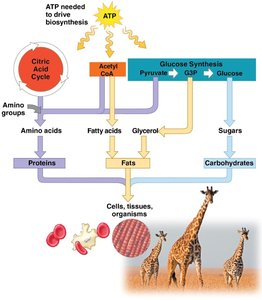
Intermediates are diverted for biosynthesis of amino acids, fatty acids, and other molecules as needed.
Feedback inhibition regulates these pathways to prevent overproduction and conserve resources.
Photosynthesis: Using Light to Make Food
Introduction to Photosynthesis
Photosynthesis is the process by which photoautotrophs convert solar energy into the chemical energy of sugars, forming the foundation of nearly all food webs on Earth.
Photoautotrophs (plants, algae, cyanobacteria, some protists) use light to make food from inorganic materials.
Heterotrophs are consumers that obtain energy by eating producers or other consumers.

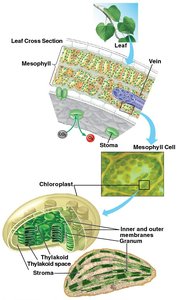
Chloroplast Structure and Photosynthesis
Chloroplasts are specialized organelles in plant cells that support the two-stage process of photosynthesis.
Chloroplasts have a double membrane and contain stacks of thylakoids (grana) where light reactions occur.
The stroma is the fluid surrounding the grana, where the Calvin cycle takes place.
Chlorophyll, the main light-absorbing pigment, is embedded in thylakoid membranes.
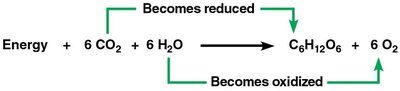
Overall equation for photosynthesis:
Photosynthesis as a Redox Process
Photosynthesis involves redox reactions, with water being oxidized and carbon dioxide being reduced.
Oxidation: Water loses electrons and H+, releasing O2.
Reduction: CO2 gains electrons and H to form glucose.
Photosynthesis is endergonic, using light energy to drive electrons "uphill" into chemical bonds.
Two Linked Stages: Light Reactions and the Calvin Cycle
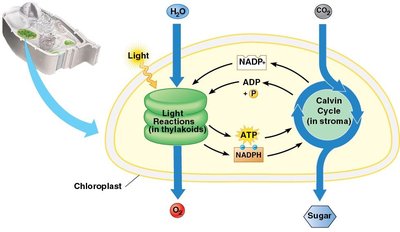
Photosynthesis occurs in two main stages: the light reactions and the Calvin cycle.
Light reactions (thylakoid membranes): Light energy splits water, releases O2, and produces ATP and NADPH.
Calvin cycle (stroma): ATP and NADPH are used to reduce CO2 into G3P, a three-carbon sugar.
Carbon fixation is the incorporation of CO2 into organic molecules, a key step of the Calvin cycle.
Photosystems: Capturing and Funneling Solar Energy
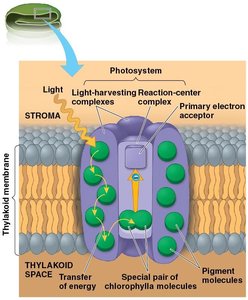
Photosystems are complexes in the thylakoid membrane that capture light energy and initiate electron transfer.
Each photosystem consists of a light-harvesting complex (antenna) and a reaction-center complex (special pair of chlorophyll a molecules).
Pigments absorb photons and transfer energy to the reaction center, exciting an electron to a higher energy state.
The excited electron is captured by a primary electron acceptor, starting the chain of electron transfers that produce ATP and NADPH.
Chemiosmosis in Thylakoids Drives ATP Synthesis
As electrons move through the electron transport chain between photosystems II and I, a proton gradient is established across the thylakoid membrane.
Protein complexes pump H+ into the thylakoid space, creating a steep gradient.
H+ flows back through ATP synthase, driving the synthesis of ATP (photophosphorylation).
Light reactions produce ATP, NADPH, and O2 for use in the Calvin cycle and cellular metabolism.
The Calvin Cycle: Reducing CO2 to Sugar
The Calvin cycle uses ATP and NADPH from the light reactions to convert CO2 into G3P, which can be used to build glucose and other organic molecules.
Step 1: Carbon fixation — RuBisCO attaches CO2 to RuBP, forming a 6-carbon intermediate that splits into two 3-carbon molecules.
Step 2: Reduction — ATP and NADPH convert the 3-carbon intermediates into G3P.
Step 3: Regeneration of RuBP — Most G3P is recycled to regenerate RuBP, allowing the cycle to continue; one G3P is net output per three CO2 fixed.
