Indietro
Cellular Respiration, Fermentation, Photosynthesis, and Cell Cycle Checkpoints: Study Notes
Guida di studio - Note intelligenti
 Appunti personalizzati basati sui tuoi materiali, ampliati con definizioni chiave, esempi e contesto.
Redox Reactions in Biology
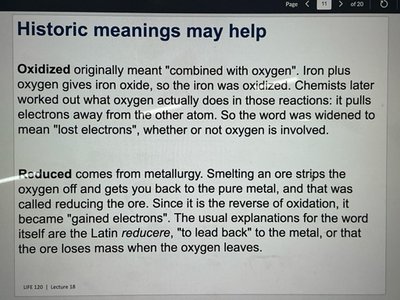
Historic Meanings of Oxidized and Reduced
Understanding the terms oxidized and reduced is fundamental in biology and chemistry. Historically, 'oxidized' meant combined with oxygen, while 'reduced' referred to the removal of oxygen from a compound. Modern definitions focus on electron transfer:
Oxidized: Loses electrons (not necessarily involving oxygen).
Reduced: Gains electrons (not necessarily involving oxygen).
Example: Iron oxide formation and smelting.
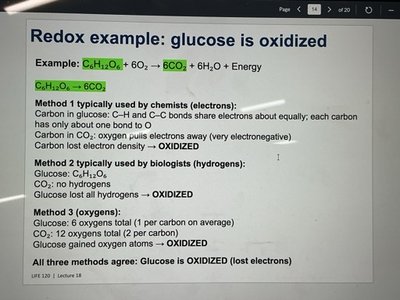
Redox Example: Glucose is Oxidized
Glucose oxidation is a central process in cellular respiration. The reaction is:
Three methods to determine oxidation:
Electrons: Carbon in glucose loses electrons to oxygen.
Hydrogens: Glucose loses hydrogens.
Oxygens: Glucose gains oxygen atoms.
Conclusion: Glucose is oxidized (loses electrons).
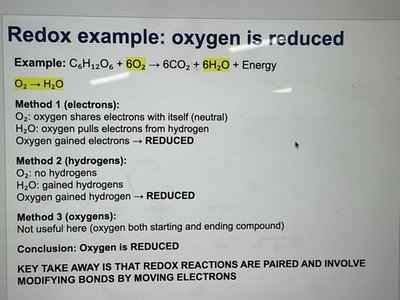
Redox Example: Oxygen is Reduced
In the same reaction, oxygen is reduced:
Oxygen gains electrons and hydrogens, forming water.
Conclusion: Oxygen is reduced.
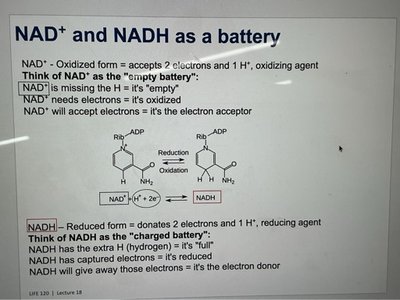
NAD+ and NADH as a Battery
NAD+ and NADH are crucial electron carriers in cellular respiration:
NAD+: Oxidized form, accepts electrons and a hydrogen ion (acts as an electron acceptor).
NADH: Reduced form, donates electrons and a hydrogen ion (acts as an electron donor).
Think of NAD+ as an 'empty battery' and NADH as a 'charged battery'.
Electron Transfer Between Molecules
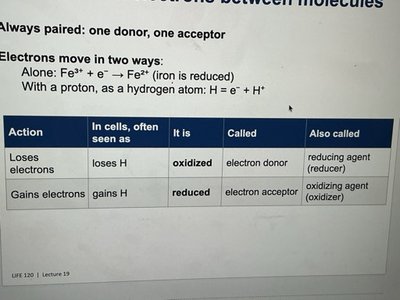
Redox reactions always involve paired electron transfer: one molecule donates, another accepts. Electrons can move alone or with a proton (as hydrogen atom).
Action | In cells, often seen as | It is | Called | Also called |
|---|---|---|---|---|
Loses electrons | loses H | oxidized | electron donor | reducing agent (reducer) |
Gains electrons | gains H | reduced | electron acceptor | oxidizing agent (oxidizer) |
Cellular Respiration
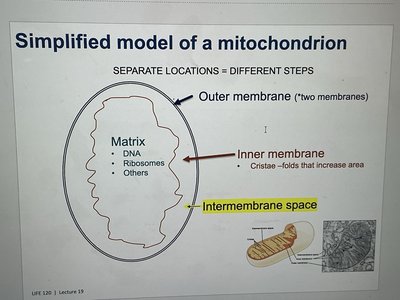
Simplified Model of a Mitochondrion
The mitochondrion is the site of cellular respiration, with distinct compartments for different steps:
Outer membrane: Encloses the organelle.
Inner membrane: Contains cristae (folds) for increased surface area.
Matrix: Contains DNA, ribosomes, and enzymes.
Intermembrane space: Area between membranes, important for proton gradient.
Two Ways to Generate ATP
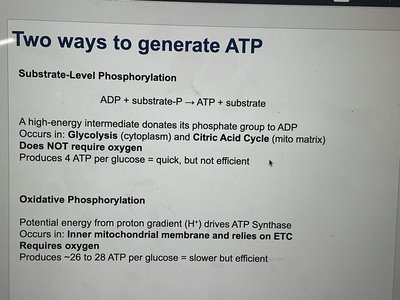
ATP is produced by two main mechanisms:
Substrate-Level Phosphorylation: Direct transfer of phosphate to ADP. Occurs in glycolysis and citric acid cycle. Does not require oxygen. Produces 4 ATP per glucose (quick, not efficient).
Oxidative Phosphorylation: Uses energy from proton gradient to drive ATP synthase. Occurs in inner mitochondrial membrane, relies on electron transport chain (ETC). Requires oxygen. Produces 26–28 ATP per glucose (slower, more efficient).
Electron Transport Chain (ETC) and H+ Pumping
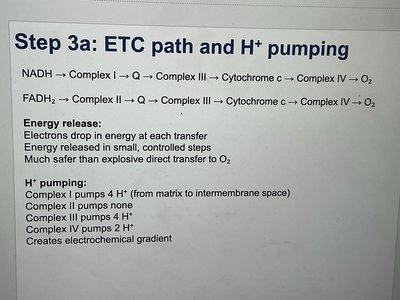
The ETC transfers electrons through a series of complexes, releasing energy and pumping protons:
NADH and FADH2 donate electrons to the chain.
Energy is released in controlled steps.
Proton (H+) pumping creates an electrochemical gradient:
Complex I: pumps 4 H+
Complex II: pumps none
Complex III: pumps 4 H+
Complex IV: pumps 2 H+
Cellular Respiration Overview
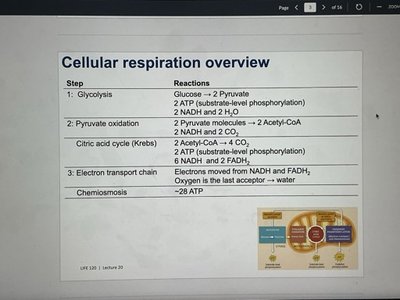
Cellular respiration consists of several steps:
Step | Reactions |
|---|---|
Glycolysis | Glucose → 2 Pyruvate 2 ATP (substrate-level phosphorylation) 2 NADH and 2 H2O |
Pyruvate oxidation | 2 Pyruvate → 2 Acetyl-CoA 2 NADH and 2 CO2 |
Citric acid cycle (Krebs) | 2 Acetyl-CoA → 4 CO2 2 ATP (substrate-level phosphorylation) 6 NADH and 2 FADH2 |
Electron transport chain | Electrons moved from NADH and FADH2 Oxygen is the last acceptor → water |
Chemiosmosis | ~28 ATP |
Fermentation
Two Types of Fermentation
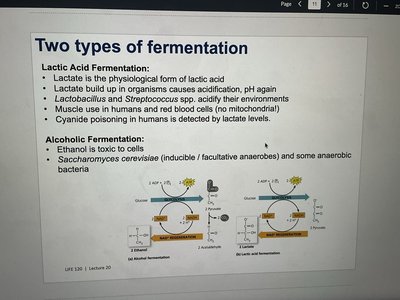
Fermentation allows cells to generate ATP without oxygen:
Lactic Acid Fermentation: Produces lactate, causes acidification, used by muscle cells and bacteria (e.g., Lactobacillus, Streptococcus).
Alcoholic Fermentation: Produces ethanol, used by yeast (Saccharomyces cerevisiae) and some bacteria.
Example: Cyanide poisoning detected by lactate levels.
Metabolic Catabolism
Respiration is Metabolic Catabolism
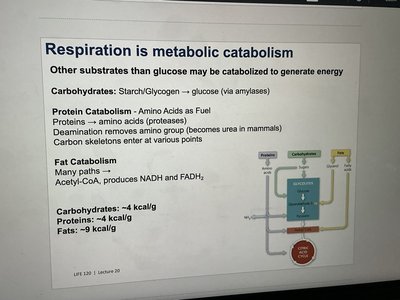
Cells can catabolize various substrates to generate energy:
Carbohydrates: Starch/glycogen → glucose (via amylases).
Protein Catabolism: Proteins → amino acids (proteases), deamination removes amino group.
Fat Catabolism: Fats → Acetyl-CoA, produces NADH and FADH2.
Energy yield: Carbohydrates: ~4 kcal/g, Proteins: ~4 kcal/g, Fats: ~9 kcal/g.
Photosynthesis: Adaptations in Plants
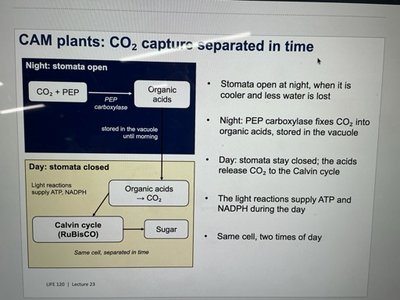
CAM Plants: CO2 Capture Separated in Time
CAM plants adapt to arid environments by separating CO2 uptake and fixation:
Night: Stomata open, CO2 fixed into organic acids by PEP carboxylase.
Day: Stomata closed, organic acids release CO2 for Calvin cycle.
Same cell, two times of day.
C4 Plants
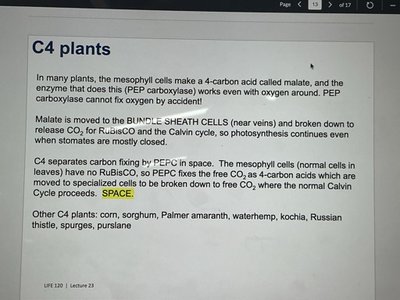
C4 plants separate carbon fixation spatially to minimize photorespiration:
Mesophyll cells make malate (4-carbon acid) via PEP carboxylase.
Malate moves to bundle sheath cells, releases CO2 for Calvin cycle.
PEP carboxylase does not fix oxygen, preventing photorespiration.
Examples: Corn, sorghum, Palmer amaranth, waterhemp, kochia, Russian thistle, spurges, purslane.
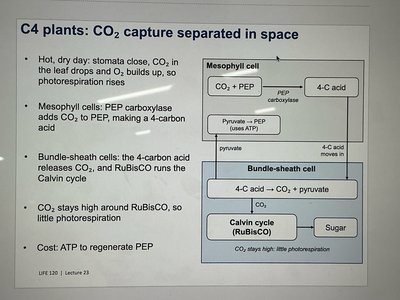
C4 Plants: CO2 Capture Separated in Space
Spatial separation of CO2 fixation in C4 plants:
Mesophyll cells: PEP carboxylase adds CO2 to PEP, making 4-C acid.
Bundle-sheath cells: 4-C acid releases CO2, Rubisco runs Calvin cycle.
Cost: ATP required to regenerate PEP.
Cell Cycle Regulation
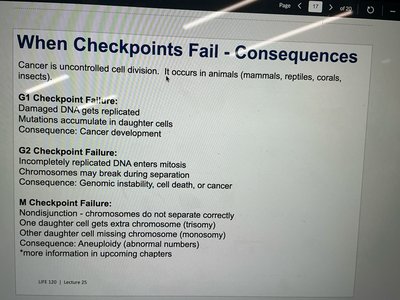
When Checkpoints Fail – Consequences
Cell cycle checkpoints ensure proper division. Failure leads to cancer and genomic instability:
G1 Checkpoint Failure: Damaged DNA replicated, mutations accumulate, cancer develops.
G2 Checkpoint Failure: Incomplete DNA enters mitosis, chromosomes may break, genomic instability, cell death, or cancer.
M Checkpoint Failure: Nondisjunction, extra/missing chromosomes, aneuploidy, abnormal chromosome numbers.