 Indietro
Central Dogma, Replication, Transcription, and Translation Study Guide
Guida di studio - Note intelligenti
 Appunti personalizzati basati sui tuoi materiali, ampliati con definizioni chiave, esempi e contesto.
Q1. The Central Dogma: Fill in the blanks
Background
Topic: Central Dogma of Molecular Biology
This question tests your understanding of how genetic information flows from DNA to RNA to protein, and the terminology for each step.
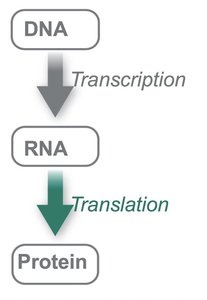
Key Terms:
DNA bases: The nucleotide sequence in DNA (A, T, C, G).
RNA bases: The nucleotide sequence in RNA (A, U, C, G).
Amino acids: The building blocks of proteins.
Transcription: The process of copying DNA into RNA.
Translation: The process of converting RNA into a protein sequence.
Step-by-Step Guidance
Recall that genetic information is stored in DNA as a sequence of nucleotide bases.
During transcription, this information is copied into RNA bases.
During translation, the RNA sequence is used to build a sequence of amino acids, forming a protein.
Review the answer choices and match each step to the correct term: DNA bases, RNA bases, amino acids.
Try solving on your own before revealing the answer!
Final Answer: D. DNA bases, RNA bases, amino acids
The central dogma describes the flow: DNA bases (information storage) → RNA bases (transcription) → amino acids (translation).
Q2. mRNA is read by a ribosome in three-nucleotide units called codons. What does each codon code for?
Background
Topic: Genetic Code and Translation
This question tests your understanding of how mRNA is translated into protein, specifically the role of codons.
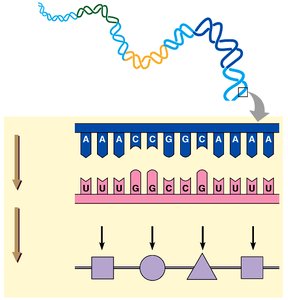
Key Terms:
Codon: A sequence of three RNA nucleotides that codes for a specific amino acid or stop signal.
Ribosome: The molecular machine that reads mRNA and synthesizes proteins.
Amino acid: The monomer unit of proteins.
Step-by-Step Guidance
Recall that mRNA is read in sets of three nucleotides, called codons.
Each codon corresponds to a specific amino acid or a stop signal in the genetic code.
Review the codon table to see which amino acids or stop signals are coded by different codons.
Try solving on your own before revealing the answer!
Final Answer: Each codon codes for an amino acid or a stop signal.
Codons are the basic units of the genetic code, and each specifies either an amino acid or a stop signal for translation.
Q3. A new nucleotide of DNA or RNA can only be added to which part of the sugar?
Background
Topic: Nucleic Acid Structure and Synthesis
This question tests your understanding of the directionality of nucleic acid synthesis and the chemistry of nucleotide addition.
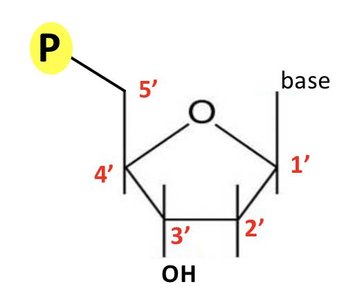
Key Terms:
3' OH: The hydroxyl group on the 3' carbon of the sugar in a nucleotide.
5' phosphate: The phosphate group attached to the 5' carbon.
Directionality: Nucleic acids are synthesized in the 5' to 3' direction.
Step-by-Step Guidance
Review the structure of a nucleotide, focusing on the sugar ring and its numbered carbons.
Recall that DNA and RNA polymerases add new nucleotides to the 3' OH group of the existing chain.
Understand why the 3' OH is essential for forming the phosphodiester bond during synthesis.
Try solving on your own before revealing the answer!
Final Answer: C. 3' OH of sugar
New nucleotides are always added to the 3' OH group, allowing the chain to grow in the 5' to 3' direction.
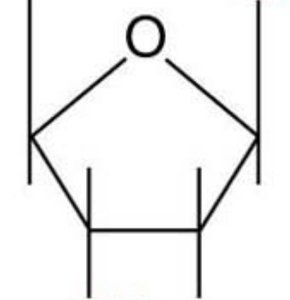
Q4. Which letter represents the 3’OH in the nucleotide diagram?
Background
Topic: Nucleotide Structure and DNA Polarity
This question tests your ability to identify the 3' OH group in a nucleotide diagram, which is crucial for understanding DNA synthesis.
Key Terms:
3' OH: The hydroxyl group on the 3' carbon of the sugar.
Polarity: DNA strands have directionality, with a 5' end and a 3' end.
Step-by-Step Guidance
Examine the nucleotide diagram and locate the carbon atoms labeled 1', 2', 3', 4', and 5'.
Identify which carbon has the OH group attached; this is the 3' OH.
Match the letter in the diagram to the 3' OH position.
Try solving on your own before revealing the answer!
Final Answer: The letter representing the 3’OH is C.
The 3' OH group is attached to the 3' carbon of the sugar, which is labeled as C in the diagram.
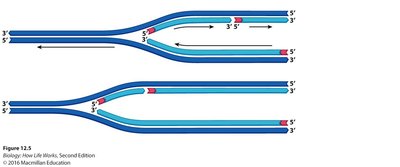
Q5. Which areas will have new DNA made as leading strands?
Background
Topic: DNA Replication and Strand Polarity
This question tests your understanding of the difference between leading and lagging strand synthesis during DNA replication.
Key Terms:
Leading strand: Synthesized continuously in the direction of the replication fork.
Lagging strand: Synthesized discontinuously in fragments (Okazaki fragments).
Origin: The starting point of DNA replication.
Polarity: DNA is synthesized in the 5' to 3' direction.
Step-by-Step Guidance
Identify the direction of the replication fork and the polarity of each DNA strand.
Recall that the leading strand is synthesized continuously toward the replication fork.
Determine which areas (labeled 1, 2, 3, 4) correspond to leading strand synthesis based on their directionality.
Review the answer choices and match the correct areas.
Try solving on your own before revealing the answer!
Final Answer: B. 1 and 3
Areas 1 and 3 are synthesized as leading strands because they are oriented in the 5' to 3' direction toward the replication fork.
Q6. Which is the template strand?
Background
Topic: Transcription and DNA Strand Polarity
This question tests your ability to distinguish between the coding (sense) strand and the template (antisense) strand during transcription.
Key Terms:
Template strand: The DNA strand used by RNA polymerase to synthesize mRNA.
Coding strand: The DNA strand with the same sequence as the mRNA (except T for U).
Polarity: Both strands have 5' and 3' ends, but are antiparallel.
Step-by-Step Guidance
Examine the diagram and identify the directionality of each strand.
Recall that the template strand is read by RNA polymerase in the 3' to 5' direction.
Determine which strand is being used as the template for mRNA synthesis.
Try solving on your own before revealing the answer!
Final Answer: B. Bottom strand
The bottom strand is the template strand because it is read by RNA polymerase to synthesize mRNA in the 5' to 3' direction.
Q7. The mRNA is…
Background
Topic: mRNA Synthesis and Translation
This question tests your understanding of the directionality of mRNA synthesis and translation.
Key Terms:
5' to 3' direction: mRNA is synthesized and read in this direction.
AUG: The start codon for translation.
Translation: The process of synthesizing a polypeptide from mRNA.
Step-by-Step Guidance
Recall that mRNA is synthesized in the 5' to 3' direction during transcription.
Translation also occurs in the 5' to 3' direction, starting at the AUG codon.
Review the answer choices and determine which statements are true.
Try solving on your own before revealing the answer!
Final Answer: E. All of the above are true
mRNA is made and read in the 5' to 3' direction, and translation starts at 5'AUG3'.
