 Indietro
Chapter 5: An Introduction to Carbohydrates - Study Notes
Guida di studio - Note intelligenti
 Appunti personalizzati basati sui tuoi materiali, ampliati con definizioni chiave, esempi e contesto.
Chapter 5: An Introduction to Carbohydrates
Overview and Roadmap
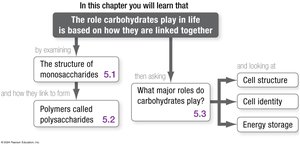
This chapter explores the structure, function, and biological significance of carbohydrates. Carbohydrates are essential biomolecules involved in cell structure, cell identity, and energy storage. The chapter is organized around three main questions: the structure of monosaccharides, the formation and structure of polysaccharides, and the major roles carbohydrates play in living organisms.
Glycobiology and Human Health
Glycobiology is the study of the structure, biosynthesis, and biological function of glycans and glycan-binding proteins. Research in this field has led to the development of protein therapies targeting cancerous cells based on their altered surface glycosylation. Glycans play crucial roles in human health and disease, particularly in cell recognition and signaling.
Glycans: Complex carbohydrates attached to proteins or lipids on cell surfaces.
Glycosylation: The process of adding carbohydrate groups to proteins or lipids, affecting cell identity and function.
Therapeutic Application: Targeting cancer cells by recognizing their unique glycosylation patterns.
Glycoproteins: Proteins with attached carbohydrates, important for cell-cell recognition.

An Introduction to Carbohydrates
Carbohydrates are classified based on the number of monomer units:
Monosaccharides: Single sugar units (e.g., glucose, ribose).
Oligosaccharides: Short chains of monosaccharides (few-sugars).
Polysaccharides: Long chains of monosaccharides (many-sugars).
Carbohydrates have the general molecular formula (CH2O)n, where n can range from 3 to over a thousand. They contain a carbonyl group and multiple carbon-hydrogen bonds.
5.1 Sugars as Monomers
Monosaccharides are the building blocks of carbohydrates. They provide chemical energy and serve as precursors for larger biomolecules. Ribose, for example, is essential for nucleotide formation in nucleic acids.
Monosaccharides: Simple sugars with variable structure and function.
Role in Evolution: Monosaccharides like ribose were crucial in early chemical evolution.
What Distinguishes One Monosaccharide from Another?
Monosaccharides differ in several structural aspects:
Location of Carbonyl Group: Aldose (end) or Ketose (middle).
Number of Carbon Atoms: Triose (3), Pentose (5), Hexose (6).
Spatial Arrangement: Different configurations of hydroxyl groups.
Ring vs. Linear Forms: Sugars often form rings in aqueous solutions.
Each monosaccharide has a unique structure and function due to these variations.
5.2 The Structure of Polysaccharides
Polysaccharides are polymers formed by linking monosaccharide monomers through condensation reactions. The covalent bond formed is called a glycosidic linkage, which can be broken by hydrolysis.
Disaccharide: Two monosaccharides linked together.
Glycosidic Linkages: Can form between any two hydroxyl groups, most commonly between C-1 and C-4 carbons.
Linkage Geometry: The orientation of the C-1 hydroxyl groups affects the structure and function of the polysaccharide.
Major Polysaccharides and Their Functions
Starch: Storage polysaccharide in plants, composed of amylose (unbranched) and amylopectin (branched).
Glycogen: Highly branched storage polysaccharide in animals, stored in liver and muscle cells.
Cellulose: Structural polysaccharide in plants, forms linear strands with hydrogen bonds for strength.
Chitin: Structural polysaccharide in fungi and animals, similar to cellulose but with N-acetylglucosamine monomers.
Peptidoglycan: Structural polysaccharide in bacteria, with peptide bonds between strands.
Table: Comparison of Major Polysaccharides
Polysaccharide | Monomer | Linkage | Function |
|---|---|---|---|
Starch | α-glucose | α-1,4 and α-1,6 | Energy storage in plants |
Glycogen | α-glucose | α-1,4 and α-1,6 | Energy storage in animals |
Cellulose | β-glucose | β-1,4 | Structural support in plants |
Chitin | N-acetylglucosamine | β-1,4 | Structural support in fungi/animals |
Peptidoglycan | Modified sugars | β-1,4 + peptide bonds | Structural support in bacteria |
5.3 What Do Carbohydrates Do?
Carbohydrates serve diverse functions in cells:
Precursors: Used to synthesize nucleotides and amino acids.
Structural Materials: Form fibrous materials like cellulose, chitin, and peptidoglycan.
Cell Identity: Glycoproteins and glycolipids display information for cell recognition and signaling.
Energy Storage: Store chemical energy in their bonds.
Carbohydrates and Structural Support
Cellulose, chitin, and peptidoglycan form long strands with hydrogen bonds, providing strength and elasticity. Their β-1,4 linkages are resistant to hydrolysis, making them durable structural materials. These fibers also form dietary fiber, important for digestive health.
The Role of Carbohydrates in Cell Identity
Carbohydrates on cell surfaces act as identification badges. Glycoproteins and glycolipids are crucial for cell-cell recognition and signaling, helping cells identify each other as "self" and communicate.
Carbohydrates and Energy Storage
Carbohydrates store energy in their chemical bonds. In photosynthesis, plants convert sunlight into chemical energy stored in carbohydrates. The energy is released when polysaccharides like starch and glycogen are hydrolyzed.
Starch and Glycogen: Easily hydrolyzed due to α-linkages.
Enzymes: Phosphorylase breaks down glycogen; amylase breaks down starch.
Glucose: Energy released from glucose is used to synthesize ATP.
Equation: General Formula for Carbohydrates
Equation: Hydrolysis of Glycosidic Linkage
Equation: ATP Formation from Glucose
Summary
Carbohydrates are vital for cell structure, identity, and energy storage. Their diverse forms and functions are determined by their monomer composition, linkage types, and structural arrangements. Understanding carbohydrates is essential for appreciating their roles in biology and human health.
